
The Ghostwriter looked perfect. The content told a very different story.
The SaaS founder within Cybersecurity hired a LinkedIn ghostwriter for Rs. 30,000 per month.
The profile had performed well. There were multiple articles that had received in excess of 50,000 impressions. The goal of the ghostwriter was to create authority.
After three months, 36 articles had been posted. The profile was getting more traction. However, the content was mostly AI, leadership and tech news. There was very little specific content around the actual technical challenges that CIOs/CISOs face.
The founder had gained some visibility, but not much cause to engage with potential customers.
This is very easy to fall into. Just because a ghostwriter has a strong profile, it can be assumed that they can produce quality content.
However, knowing that they can produce quality content does not tell you anything about how well they can research a topic they are unfamiliar with, gather ideas from a conversation, or determine what content to post.
These questions often receive far less consideration than cost and output figures. Despite this, there is a far bigger impact on the overall quality of cooperation.
To make sure you are making the right decision in employing a LinkedIn ghostwriter, here are 10 questions to ask yourself.
Why Hiring a LinkedIn Ghostwriter Is More Than a Writing Decision
The same writer won’t necessarily be up to the job with every professional.
A leadership coach is looking to share some of the experiences from his executive workshops, and a cybersecurity founder is looking to get to the CIOs who are in the process of evaluating enterprise security solutions.
The coach has a lot of stories that need structuring. The founder has the technical know how that needs to be turned into actual business conversation.
Both are employing someone to write LinkedIn posts, the job requiring quite different skill sets.
According to the Content Marketing Institute’s 2025 B2B research, only 29% of B2B marketers thought their content strategies were extremely or very effective. Of those who rated their strategies as moderately effective or less, 42% said their goals were unclear.
This is why your first move should be prior to interviewing anyone.
Just write down who you’d like to get in touch with, what bits of your experience you’d like to share and what you hope the conversation will achieve.
You can then compare professional content writing services based on the level of support you actually require rather than selecting from a standard package.
The 10 Questions You Should Ask Before Hiring a LinkedIn Ghostwriter
Question 1: Have you written content for anyone in my industry?

People with technical knowledge can produce content that is highly relevant to the reader.
If the author is a manufacturing CEO, they could write content on how adding 1% to production efficiency in a plant producing 1 million tonnes, can increase production by 10,000 tonnes per year.
This content can be inspiring. However, the technical understanding of why this observation is valuable may be missing.
For engineers, financial professionals, healthcare professionals and enterprise technology professionals, these specific details make content more valuable.
Within candidates, look for evidence that they have technical knowledge in addition to writing skill. Consider what research was carried out and what specific details needed clarification from the client.
Candidates with no direct technical experience in the sector may be able to produce relevant content if they are quick learners and can ask knowledgeable questions.
Show your knowledge by providing an example of a technical issue and writing a 150 word post on LinkedIn.
Ensure that your post is accurate, clear and contains enough detail to demonstrate genuine knowledge within the industry.
Question 2: How Will You Understand My Writing Style and Personal Experiences?

A ghostwriter has to be able to tell the difference between your view and a popular view.
Two CEOs go to the same leadership workshop.
One makes you wonder if the individual performance targets actually inhibit collaboration. The other gets you thinking about how organisations go about identifying their future leaders.
Both could no doubt write a good piece about the experience, the stories would be very different.
This is where the interviews and content discovery come in.
Work out whether the writer is drawing on recorded conversations, voice memos, past presentations or just normal conversations. A tone and topic questionnaire might be useful for onboarding but won’t tell you what the writer has actually been thinking.
Ask candidates to create a post based on a challenging business decision that you have made. You can do this by recording this decision and providing it to them.
Check for logical consistency.
Does it give a good reason for making the decision?
Have they included all the main points?
Are there any points included that you would not make?
It should sound like something you would write.
Question 3: Who Exactly Are You Planning to Reach Through My Content?
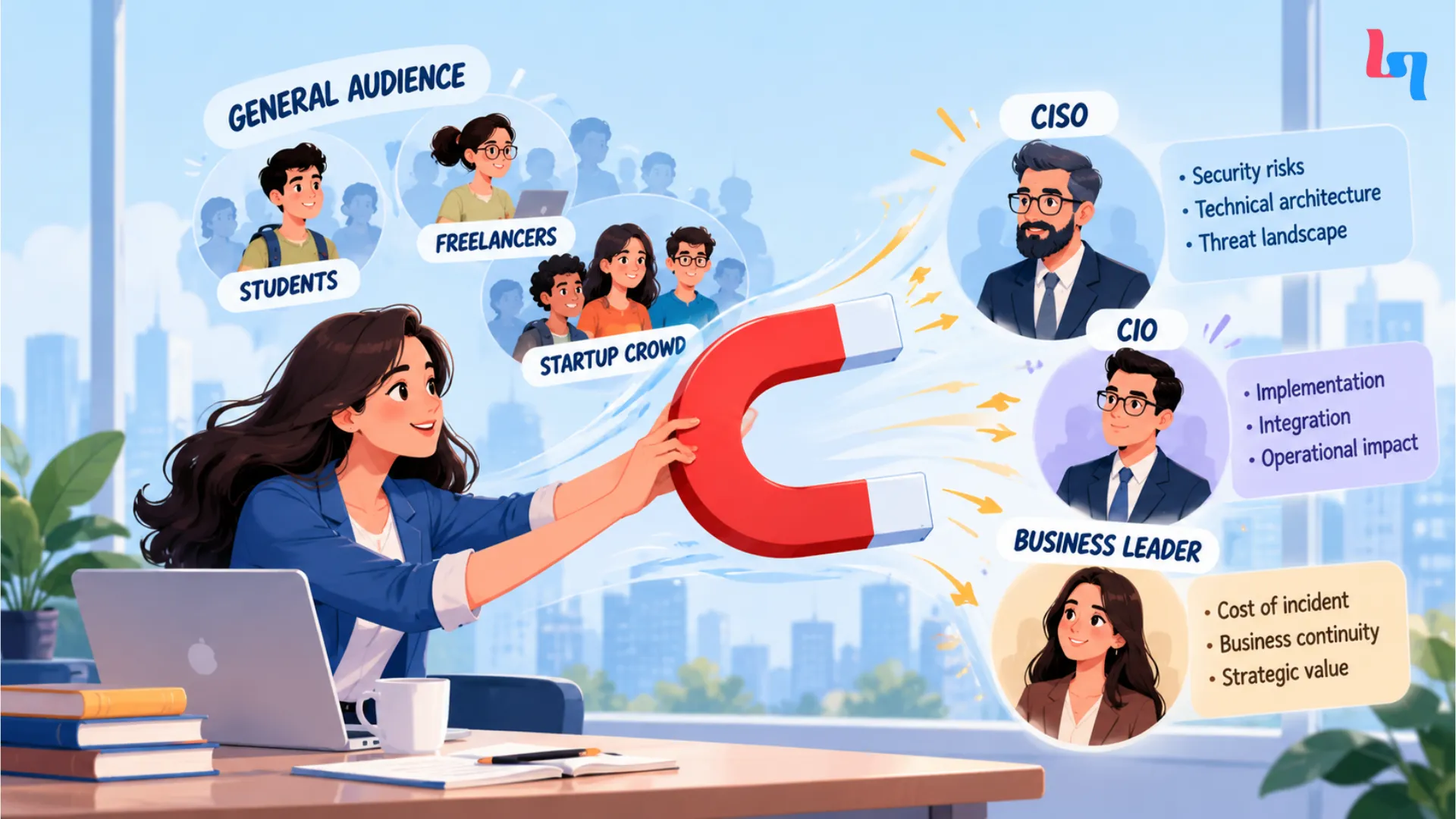
Not every person who looks at your posts is a potential customer.
The cybersecurity founder from the opening gets 20,000 impressions on a post about entrepreneurship.
Students, freelancers and the general startup crowd are all very much on board. The CIOs and CISOs that the founder is actually trying to get to have absolutely no interest in the subject.
For B2B companies selling complex solutions the audience is rarely just one person.
The 2025 Edelman–LinkedIn B2B Thought Leadership Report states that over 40% of B2B deals get stalled due to misalignment within the buying group, referencing previous research.
That makes it vital to understand how different stakeholders will assess the same business problem.
Ask a prospective writer to name three audience segments and suggest a relevant topic for each.
A cybersecurity founder might be having a chat with the CISO about the technical architecture, talking to the CIO about the implementation issues and talking to the business side about the cost of a security incident.
The proposed topics will tell us if the writer has gone beyond the generic ‘audience’ labels.
Question 4: Can You Show What Your Previous Clients Actually Achieved?

Impressive engagement figures need some context.
They have provided screenshots showing 150k impressions and fast growth.
This does not answer any of the key questions.
Was there a good starting audience?
Was engagement from the right audience?
Was content ideas thought of by the writer or was it just completing the clients’ work?
Instead of judging individual screenshots, request an anonymised case study covering a defined reporting period.
It should set out the client’s original position, their objectives, their content approach and the measurable results.
You can also look at Banter Marketo’s case studies when you’re comparing how marketing agencies present their work.
Ask them to separate results into results that can be directly attributed to the activities, and those influenced by other factors such as word of mouth, paid marketing or outreach.
If they can talk about both the positive impacts and limitations of the project, you will gain a better understanding of what to expect.
Question 5: How Do You Research and Fact Check Technical LinkedIn Posts?

An incorrect statistic can of course derail an otherwise sound argument.
A lead engineer claims that their new AI design cuts the cost of infrastructure in the cloud by 60% in an article on LinkedIn.
On investigation of the paper itself, this improvement was only achieved in some conditions.
Although the data may be correct, the implication from this article is exaggerated.
Common errors can occur when summary statistics are provided without examining the data, or when data is repeated without verifying its suitability.
The Content Marketing Institute’s 2025 B2B research found access to subject matter experts to be a challenge for content teams.
For specialist content the research should draw on both appropriate external sources and input from the professional in question.
One useful one is to give the candidate an industry report and ask them to write a post on the basis of a single finding.
Request the source link and an explanation of any limitations.
Their response should show that they can interpret the evidence properly without necessarily turning every finding into a ‘game changer’ for the industry.
Question 6: What Happens Between Our First Discussion and the Final Post?
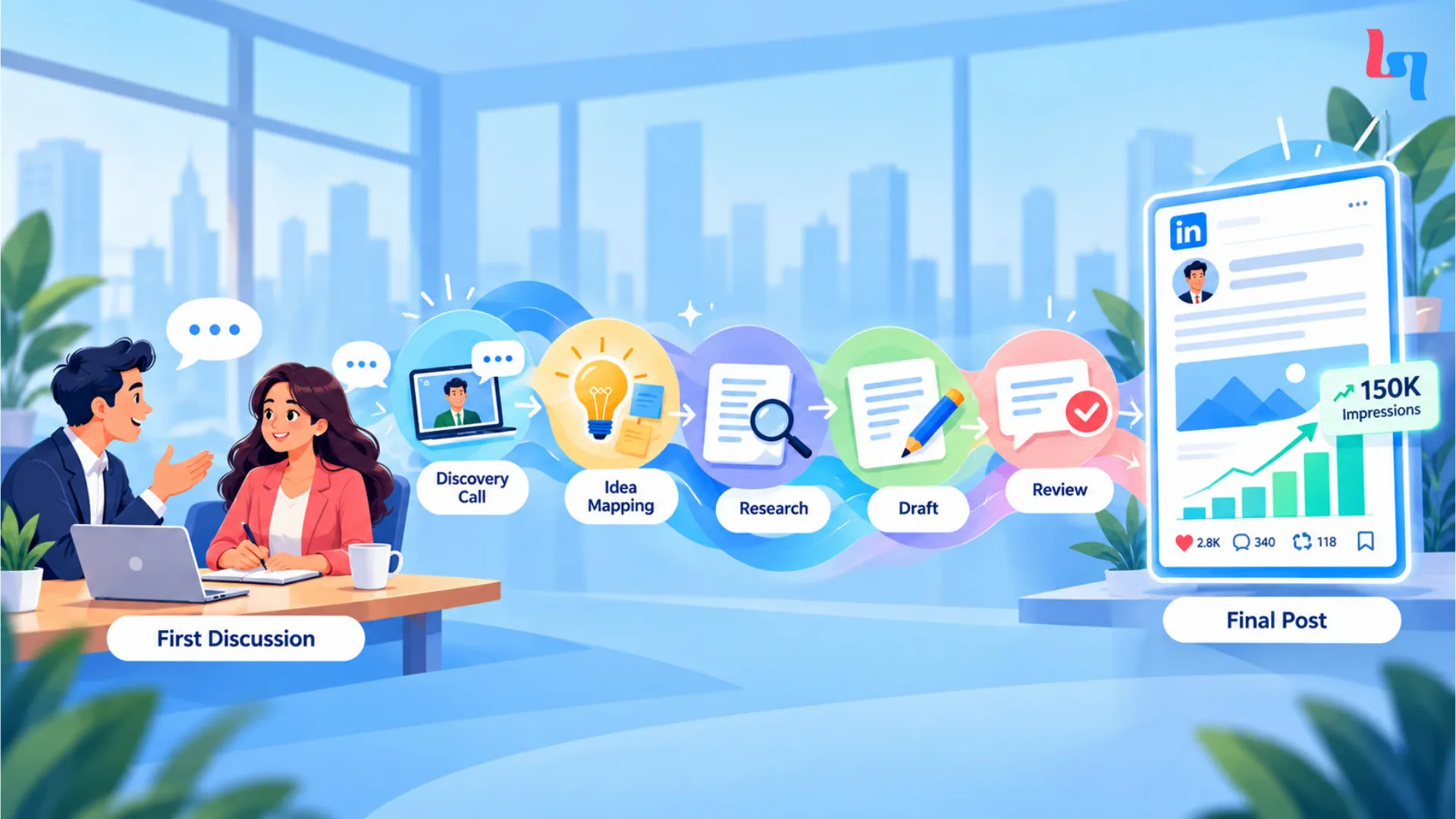
A ghostwriter should reduce the amount of time you spend in the content preparation phase.
A founder hires someone to run LinkedIn and expects the job to fit around their schedule.
Instead the writer is constantly asking for topics, articles, examples, captions and corrections. The founder ends up spending several hours a week producing the material which the writer was supposed to be putting together.
Microsoft’s 2025 Work Trend Index found that 80% of workers didn’t have enough time or energy to get on with their work.
Reduce pressure on the executive by providing structure.
How much time will be taken in interviews? What will be covered? How much research will be carried out and how many drafts will be signed off?
What changes are permissible? How long is it likely to take? Who will do the design and layout?
Your role is to provide expertise, and ensure key points are accurate. Once you have an understanding of expectations, you can allow the writer to get on with the task with a minimum of direction.
Question 7: How Will We Know Whether My LinkedIn Content Is Working?

The same growth figures can mean quite different things to different people.
A leadership consultant and a SaaS founder both pick up 2,000 followers over the course of three months.
The consultant starts getting invitations to executive workshops. The founder’s new audience is pretty much all people outside the target customer profile.
Their analytics are pretty much the same, but the progress they’re making towards their objectives is very different.
According to the Content Marketing Institute’s 2025 research, 56% of the B2B marketers who were measuring content performance said they were struggling to attribute ROI.
A buyer may well come across your content on LinkedIn but will probably only engage with your business much later via a referral or a visit to your website.
So direct attribution is very difficult.
That doesn’t mean reporting should stop at impressions and likes.
Ask the candidates for a sample dashboard which would show how they would assess engagement from the relevant professionals, audience growth, profile activity and qualified enquiries.
The most useful part of the report is the explanation of what the results mean and how they should influence future content decisions.
Question 8: What Exactly Am I Paying for Every Month?
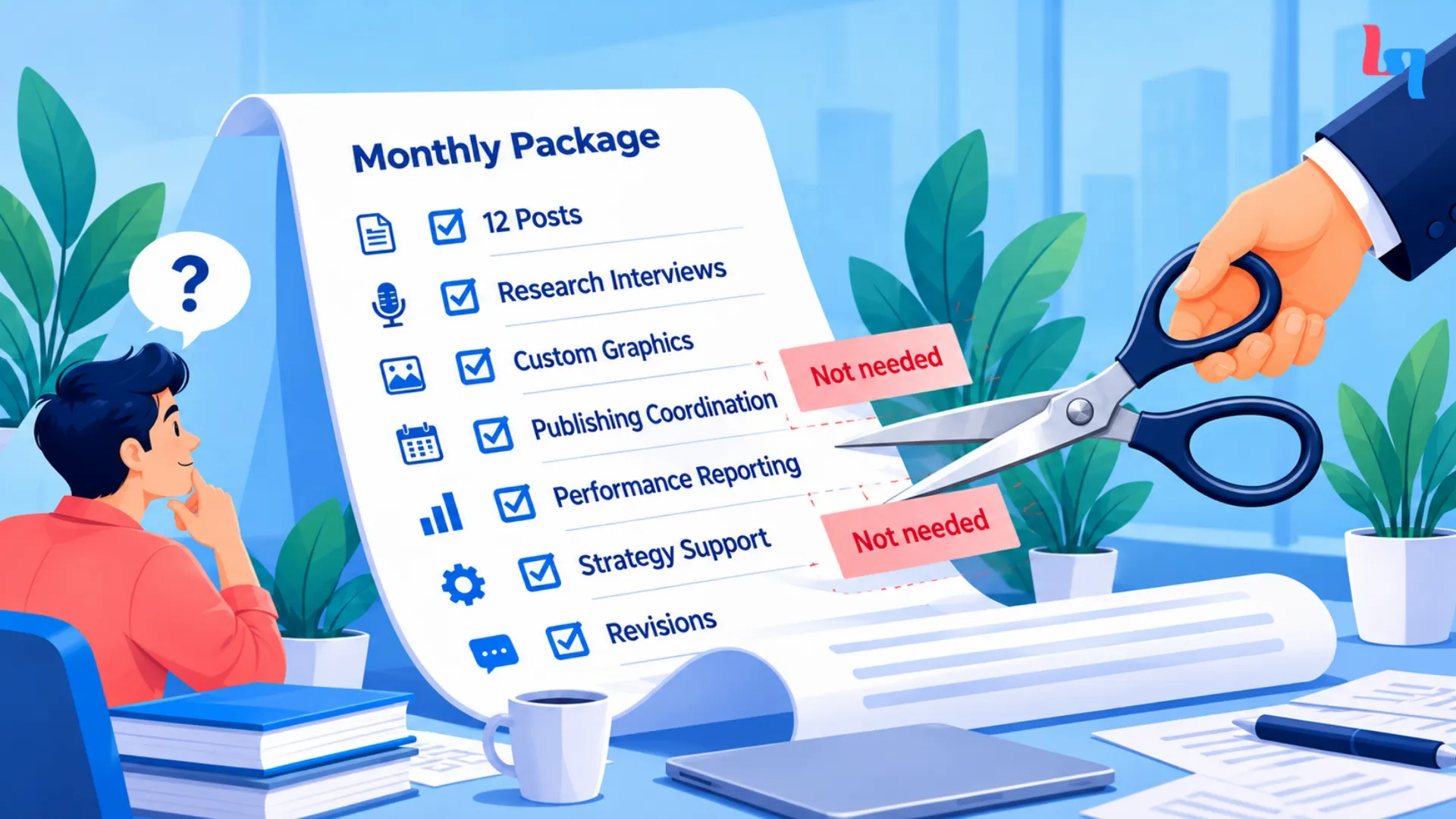
A bigger package isn’t necessarily a better deal.
Freelancer: ₹30,000 for 12 pieces of content.
Agency: 12 pieces of content, plus research, graphic design, organisation and performance reports.
Even though there may be more deliverables from an agency, it may still be better to work with a freelancer in your industry.
Meeting consistent criteria
Ask shortlisted providers to give you a quote for the same number of researched and visual content, editing, research interviews and reporting. Find out who will be creating a strategy and writing content.
You can review Banter Marketo’s social media marketing packages to see how their content and marketing services can be bundled.
Compare the proposed work with the responsibilities you’re happy to look after yourself.
Paying for more services only makes sense if those additional services are in some way going to help support you.
Question 9: How Do You Use AI Without Compromising My Authenticity?
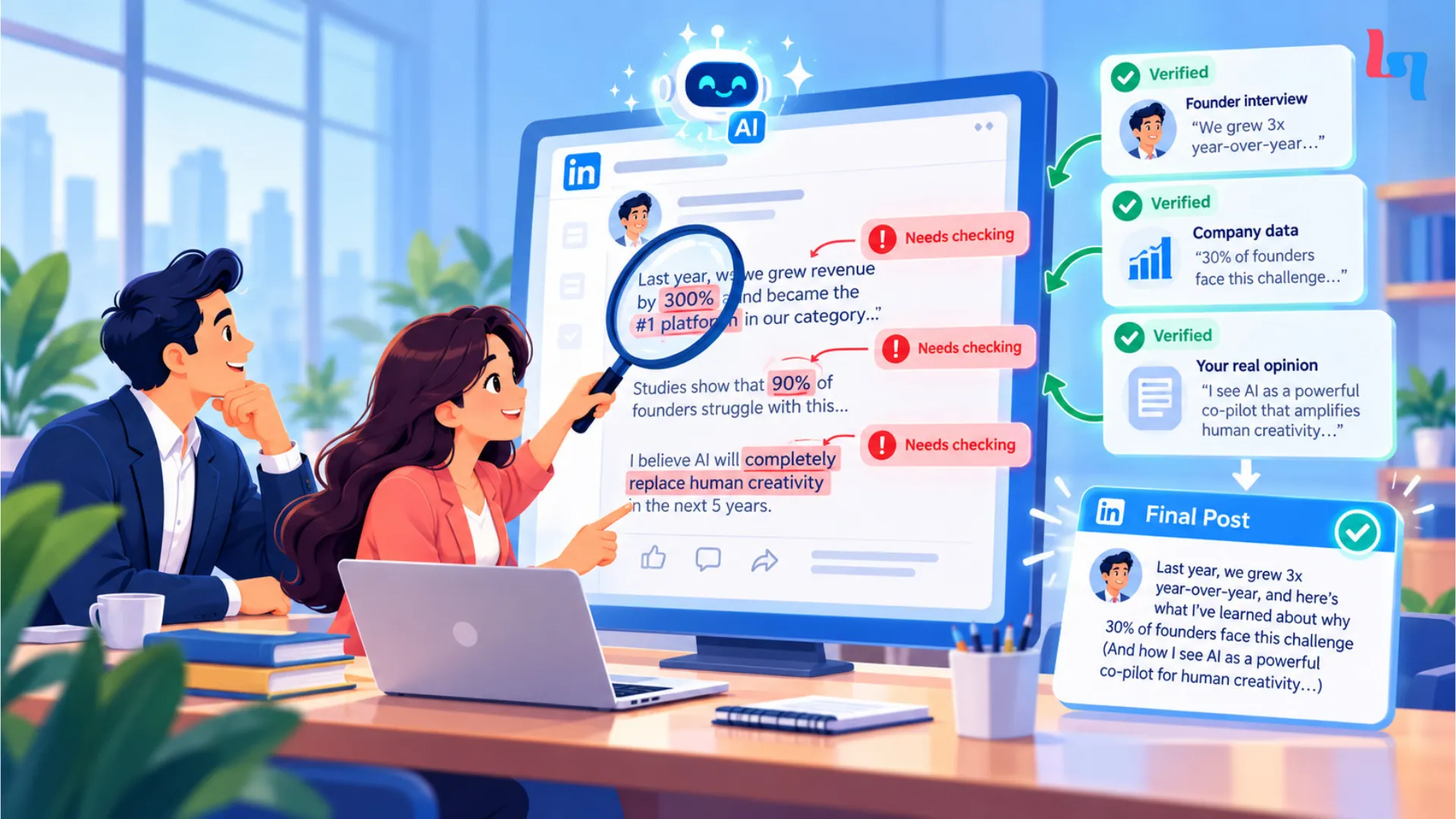
Your LinkedIn posts should not contain any achievements that you haven’t actually achieved.
An example may be a story on how they won a multi-million dollar deal with a client.
Although this is a strong story, the founder may not have had this experience. The ghostwriter has used AI to produce a compelling personal story from a fairly generic business insight.
Although using AI to structure or proofread can be a good idea, be cautious to ensure that any information is not fabricated.
Ask them what tools they use, how they confirm information to be accurate, and whether sensitive information is stored in third-party systems.
Be clear on what information can be shared from customers, company secrets, and personal information.
In practice, simply provide them with some basic notes and ask them to identify what information in the notes would require verification.
A good writer would be happy to leave out an interesting piece of information if there is no evidence to support it.
Question 10: What Happens If I Decide to End the Contract?
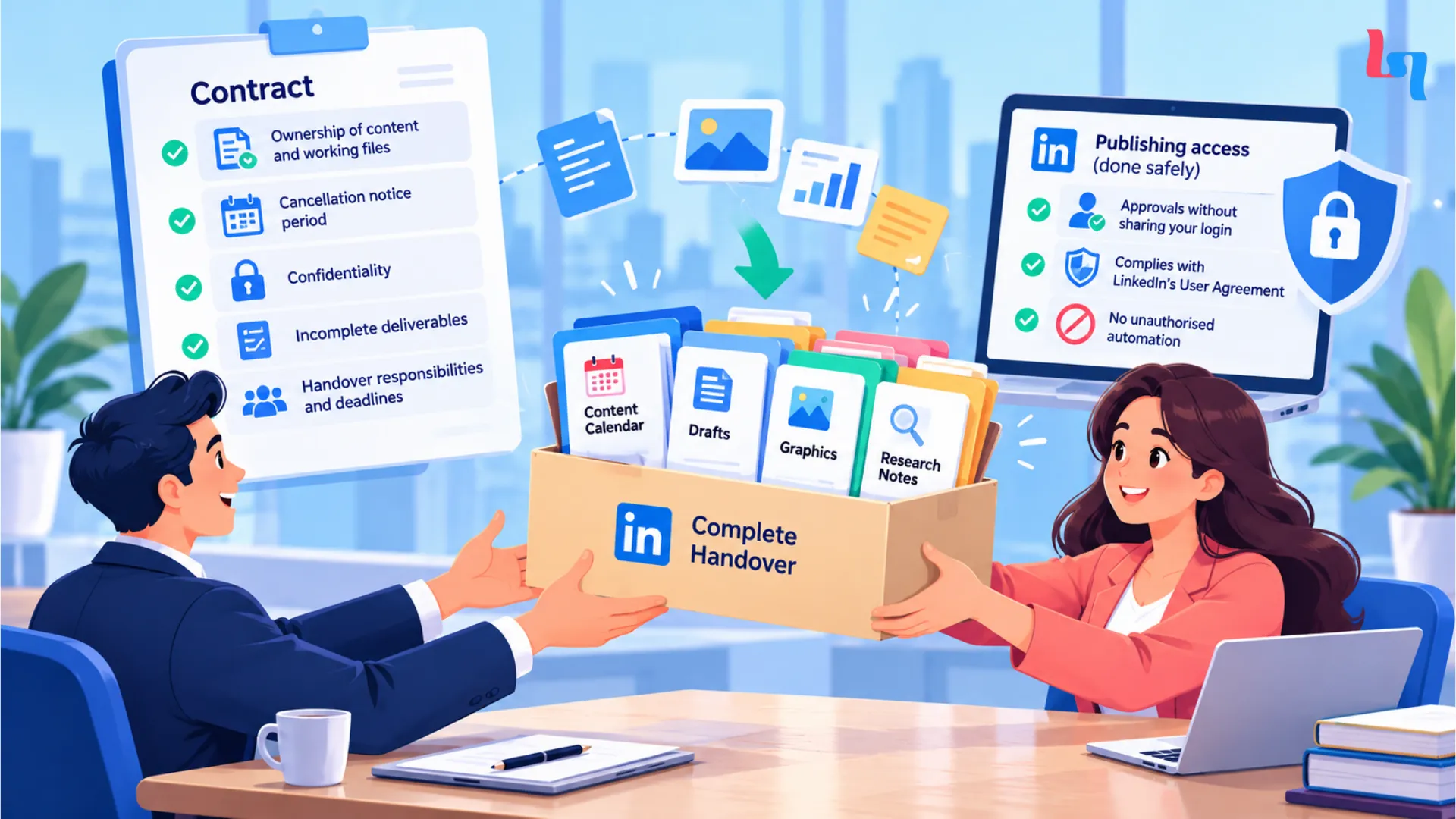
Ownership is far easier to talk about prior to the working relationship actually commencing.
After six months with a ghostwriting agency the founder has decided to take it in house.
When you go to get the content calendar, research notes, graphics and drafts, you’ll notice that the contract doesn’t actually specify what will be handed over.
This can cause issues. What should have been an easy exchange becomes a point of contention. Make it clear who owns the published posts and working files before paying for the service.
The agreement should also cover cancellation notice, confidentiality, what happens if the deliverables are not complete and who is responsible for handover.
Publishing access requires the same level of attention.
LinkedIn’s User Agreement requires members to protect their own login credentials and prohibits the sharing of accounts or the use of unauthorised automation.
Ask how the provider deals with approvals and publishing without putting your account at any unnecessary risk.
A simple handover process should tell you what files you’re going to get, the agreed delivery dates and what happens to the work that’s already been paid for.
How to Test a LinkedIn Ghostwriter Before Signing a Contract
A short paid assignment is typically far more revealing than a portfolio review.
If there are 3 candidates very similar in price, quality of writing sample and reviews:
Give each writer the same brief, relating to a real challenge in your business.
For example, if you are a B2B Software founder, you may have found that there are frequent delays in implementation.
Give them a brief including a product summary, target audience and 1 insight from previous implementations.
Interview each writer for 15 mins.
Depending on the writer, they may ask different questions. One writer may ask about writing style and frequency. Another may ask about the reasons for implementation delays, which teams are affected and what the founder has learnt in managing these teams.
This will show how well they are able to understand new topics and identify relevant experience which will contribute to a useful post.
Once the interviews are complete, ask each writer to write a post for LinkedIn. Ask them to give an explanation of the angle they have taken.
Use the same 100-point assessment framework for all candidates:
1. Industry understanding: 25 points
2. Original thinking and voice: 25 points
3. Audience relevance: 20 points
4. Research accuracy: 20 points
5. Communication and responsiveness: 10 points
These are suggested hiring weights rather than industry benchmarks.
The 2025 Edelman–LinkedIn Thought Leadership Report found that 86% of surveyed hidden decision-makers in the US preferred thought leadership that challenges their assumptions.
That makes the quality of a writer’s thinking worth examining alongside their ability to produce engaging copy.
Look for a candidate who uncovers an original perspective, explains it accurately, and understands why it would interest your intended readers.
Five LinkedIn Ghostwriter Red Flags That Should Make You Reconsider
You can actually learn a lot about a provider prior to seeing their first draft.
You should be cautious of guarantees. While it may seem tempting to choose someone that can guarantee a certain number of quality leads, it is important to understand how these leads are generated.
A great portfolio with no additional information should also be treated with caution. While posts in a portfolio demonstrate writing ability, it will be unclear who the strategist was and if the content met the client’s objectives.
Consider how candidates react to an unfinished idea. The candidate who challenges an unsupported statement is likely to be the most useful.
Ambiguity in process. It should be clear who has written the content, who has researched, edited and proofed, and who your main point of contact with the agency is.
Finally, just don’t go for any provider who wants your LinkedIn password or who in any way recommends prohibited automated activity. LinkedIn’s User Agreement restricts these practices.
Reviewing relevant work, meeting the actual writer, and agreeing on clear responsibilities can reveal these problems before the contract begins.
What Should You Expect in the First 90 Days of LinkedIn Ghostwriting?
The first three months should provide enough information to improve the strategy.
In the first 30 days we’re going to be focused on positioning, audience research, interviews and the quality of the early drafts.
Over the next month, check that the content is getting to the right people and that the feedback is in fact reducing the amount of re-writing we have to do.
By day 90, review the patterns across the various published topics and determine which of the ideas are worth pursuing further.
The Content Marketing Institute’s 2025 research found that 18% of respondents with less-effective content strategies cited failure to iterate or adapt as a contributing issue.
Use the review to assess what you’ve learned about your audience, which formats facilitated useful discussion and what needs to be adjusted in the next content calendar.
Commercial results may take a while to bed in, but the direction of the work and the quality of the collaboration should be pretty obvious already.
Conclusion:
Hire Someone Who Understands Your Business
Your LinkedIn profile should be about showcasing your experience, not just about keeping you visible.
The cybersecurity founder from the opening had put out 36 posts, very little of which actually addressed the problems that potential customers were trying to solve.
The writer had finished the publishing schedule without having in any way developed a grasp of the business.
Before you go and hire someone, look at their research process, their interview technique, their understanding of the audience and their ability to assess the results.
A paid assignment based on a genuine business problem is a good way of assessing these skills prior to making any longer commitment.
At Banter Marketo, we do LinkedIn thought leadership by linking up professional expertise with the right audience and the right business outcomes.
The person writing your posts should be helping the reader to understand what you’ve learned as a result of your work and why that is of value.
That’s a far more meaningful hiring criterion than impressions, writing samples or the number of posts in a monthly package.
Frequently Asked Questions About Hiring a LinkedIn Ghostwriter
Is it worth hiring a LinkedIn ghostwriter?
It can be worth it when the writer saves you time and produces accurate content that will in fact help you achieve your professional objectives.
Should I go for a freelancer or a LinkedIn ghostwriting agency?
A freelancer may suit writing-focused requirements, while an agency may be useful when you need coordinated research, strategy, graphics, and publishing support.
Can a ghostwriter help generate B2B leads?
Thought leadership can help build buyer trust and get you into qualified conversations. That said the results will also be very much down to your offer, your targeting, your outreach and your sales process.
How long should I be spending working with my ghostwriter?
Set aside regular time for interviews, feedback, and approvals. Your expertise provides the material, while the writer handles research, drafting, and production.