
High-volume keywords can bring thousands of visitors to your website, but for B2B businesses, more traffic doesn’t always mean more qualified leads or customers.
Imagine you’re planning your next 3 months of content for a B2B software company.
You have a number of keywords that your marketing team has shortlisted. One keyword has an estimated 20,000 searches per month, while the other has only 250.
At a glance, you would think to pick the keyword with the higher search volume.
However, 3 months later you can see that your impressions and organic clicks have increased.
But your sales team isn’t seeing much change.
Most of the people coming to your page are simply looking for general information. Some are students researching and others working for companies that would never buy your software.
Your competitor has created a detailed article targeting a much more specific search. This search directly relates to a problem your ideal customer has.
Although they may not have as much traffic, those coming to their page have a much better reason to consider their services.
Was it a bad idea to use the high search volume keyword?
Not necessarily. The issue here is that you are assuming that higher search volume means it will be valuable to your business.
This is a common issue with B2B content marketing.
A high-volume keyword may attract thousands of searches, but that doesn’t mean it’s reaching the people making purchasing decisions.
Meanwhile, a more specific search term with lower volume could be exactly what a potential customer uses when they’re ready to approach a vendor.
I wouldn’t recommend using a B2B keyword based on how many people are searching for it.
Firstly, I would want to know who is searching for it and whether the topic relates to something your business offers.
What Does High Search Volume Actually Tell You?
Search Volume gives an indication of how frequently people search for any given keyword.
So, using a keyword research tool you might find that “marketing automation” has thousands of searches per month.
This tells you there is some interest in this topic.
It does however, not tell you what type of search they are doing. Are they looking for software, consulting, definitions, courses or jobs?
The other thing to note is that search volume is an indication rather than an exact figure.
Google’s Keyword Planner states: “Average monthly searches – Average number of searches per month for this keyword for the time period, location and search network you’ve chosen.
This number has been rounded. Search patterns may also change due to seasonality and other factors.”
Just because a keyword has a monthly search volume of 10,000 it does not mean that if you wrote an article around that topic, you would get 10,000 visits to your website.
Depending on how well ranked you are for that keyword, what competition is there, how people are clicking through and how relevant your content is, will determine how much traffic you actually have.
I would use search volume to give me an understanding of how big an opportunity the keyword is at Banter Marketo.
However, more information is required to determine if the opportunity is worth pursuing.
Why Can High-Volume Keywords Be a Poor Choice for B2B Content?

A popular keyword may not get you the right audience.
If you’re an enterprise cybersecurity consultancy, a keyword like ‘cybersecurity’ could seem like a good option.
However, who is using this keyword?
It could be students researching cybersecurity as a career choice, employees reading up on what’s going on in the industry or small businesses looking for cheap antivirus options.
While some may be working for companies that need to use your services, there isn’t any differentiation.
If you use a more specific search term, such as ‘enterprise cybersecurity risk assessment services’, you can get a better understanding of what they might need.
While it doesn’t guarantee they will buy, the more specific search means there is a stronger connection to the service you offer.
For B2B businesses, where the target market may be quite small, it’s better to attract people with the relevant problems rather than trying to build traffic around a loosely related topic.
Ranking for High-Volume Keywords May Be Difficult
But many high-volume commercial and informational keywords are dominated by established publishers, software providers and high-volume websites.
Take the search results for “B2B marketing strategy”.
There will be detailed guides with information on how to target your audience, choose your channels, create content and measure your marketing efforts.
A small B2B agency could create a new article about this.
But why would Google rank it higher than content that is already useful?
I’d be more interested in looking for a very specific question which the articles do not answer very well.
For example, how to create a B2B marketing strategy for a referral-based company.
Whilst this is a more specific issue, I’d still need to look at the search results, competitor websites and existing content to determine whether this is an easy keyword to rank for.
However, this makes the article much more focused. This is why I always take into consideration keyword difficulty and search intent when creating an SEO strategy.
High Search Volume Doesn’t Guarantee Website Clicks
You can often get an answer by searching Google.
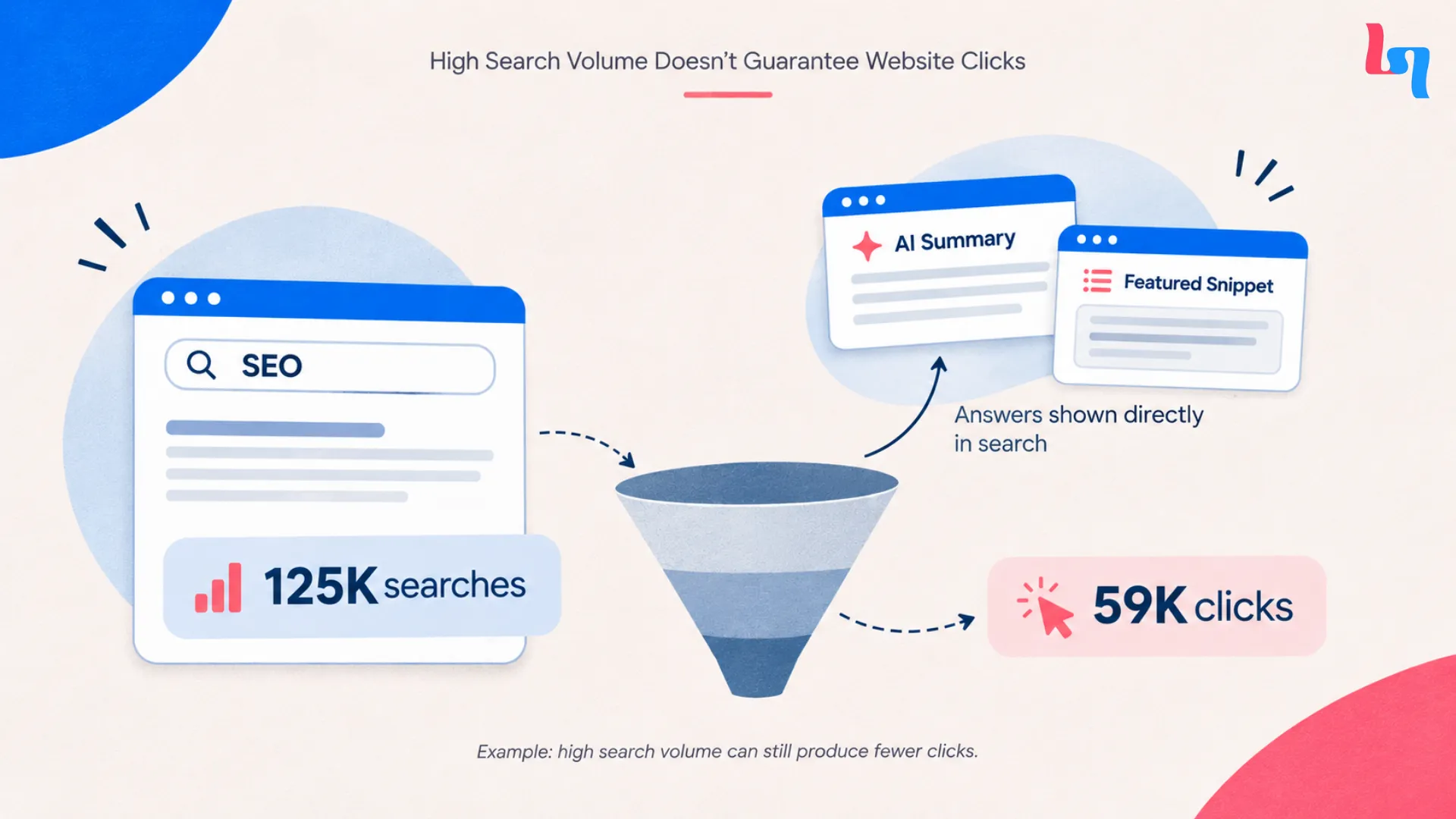
Sometimes you can get a definition, brief explanation or featured snippet and AI summary.
This means there will be a difference between search volume and traffic potential.
To give an example, Ahrefs explained in September 2026:
They found that for the keyword ‘SEO’ they had around 125,000 searches per month but only 59,000 clicks.
These are just estimates based on keyword tools.
However, it helps to know.
You may have spent much time getting your keyword ranked for a popular information query but actually not get as much traffic as expected.
I would check what the actual search results are for your keyword.
Are people clicking through to long-form content? Are they seeing AI answers or other search features? What kind of pages are getting organic traffic?
Just one factor to consider.
More Organic Traffic May Not Produce More Qualified Leads
Imagine a B2B data consulting company publishing a detailed article about data analytics.
The page attracts thousands of visitors because the subject has wide appeal.
But the company doesn’t sell basic analytics training. It provides enterprise data architecture and migration services.
Many readers may find the article useful without needing anything the company offers.
This is where content performance can become misleading.
Marketing reports may show growing traffic, stronger rankings and improving engagement.
Meanwhile, the sales department receives very few suitable inquiries.
I wouldn’t conclude that the content has no value. It may help build awareness or introduce potential customers to the company.
But if the objective was to generate qualified B2B leads, the article should be judged against that objective.
The important question is whether the topic attracts people whose problems the company is equipped to solve.
Why Can Low-Volume Keywords Be Valuable for B2B Businesses?
A lower-volume keyword often describes a more specific problem.
Consider these searches:
| Broad Search | More Specific B2B Search |
|---|---|
| Cloud Computing | Enterprise cloud migration cost |
| Data Analytics | Data warehouse migration consulting services |
| HR software | HR software integration for manufacturing companies |
| Manufacturing automation | MES implementation services for automotive suppliers |
Wider keywords may have a higher volume of traffic.
More specific keywords can give additional context to what you are looking at.
If someone is looking up how much it costs to move to the cloud in an enterprise setting, they may already be considering the cost implications of this project.
If someone is looking into MES implementation, services they may be comparing different providers for their manufacturing need.
It doesn’t guarantee that they will buy, but it gives more opportunity to create content around real questions.
This is important as B2B buyers tend to do a lot of research.
According to a survey by Gartner in March 2026, 67% of B2B buyers said they preferred an experience where they didn’t interact with a sales rep, and 45% said they used AI in their last purchase.
This makes me feel that there is a stronger case to create content around specific questions.
If a company is researching an expensive software implementation, they may want to know if it will work with their existing systems, how much it will cost, how long it will take and any operational risks.
This means they may not want to contact the sales team until they have this information.
Although these questions may not have huge volumes of traffic, they can still be important from a business perspective.
Not all low-volume keywords will be worth targeting. There may be low volume of traffic because it is irrelevant, too niche or not the way buyers would search.
Specific keywords help with understanding intent, but you still need to check if there is demand.
High-Volume vs Low-Volume Keywords: Which Can Generate Better Results?
Let’s say you are a B2B software company.
You’ve written two articles:
A general-purpose article on a popular subject, and one focused around a particular issue they face during implementation that prospects often ask your sales team about.
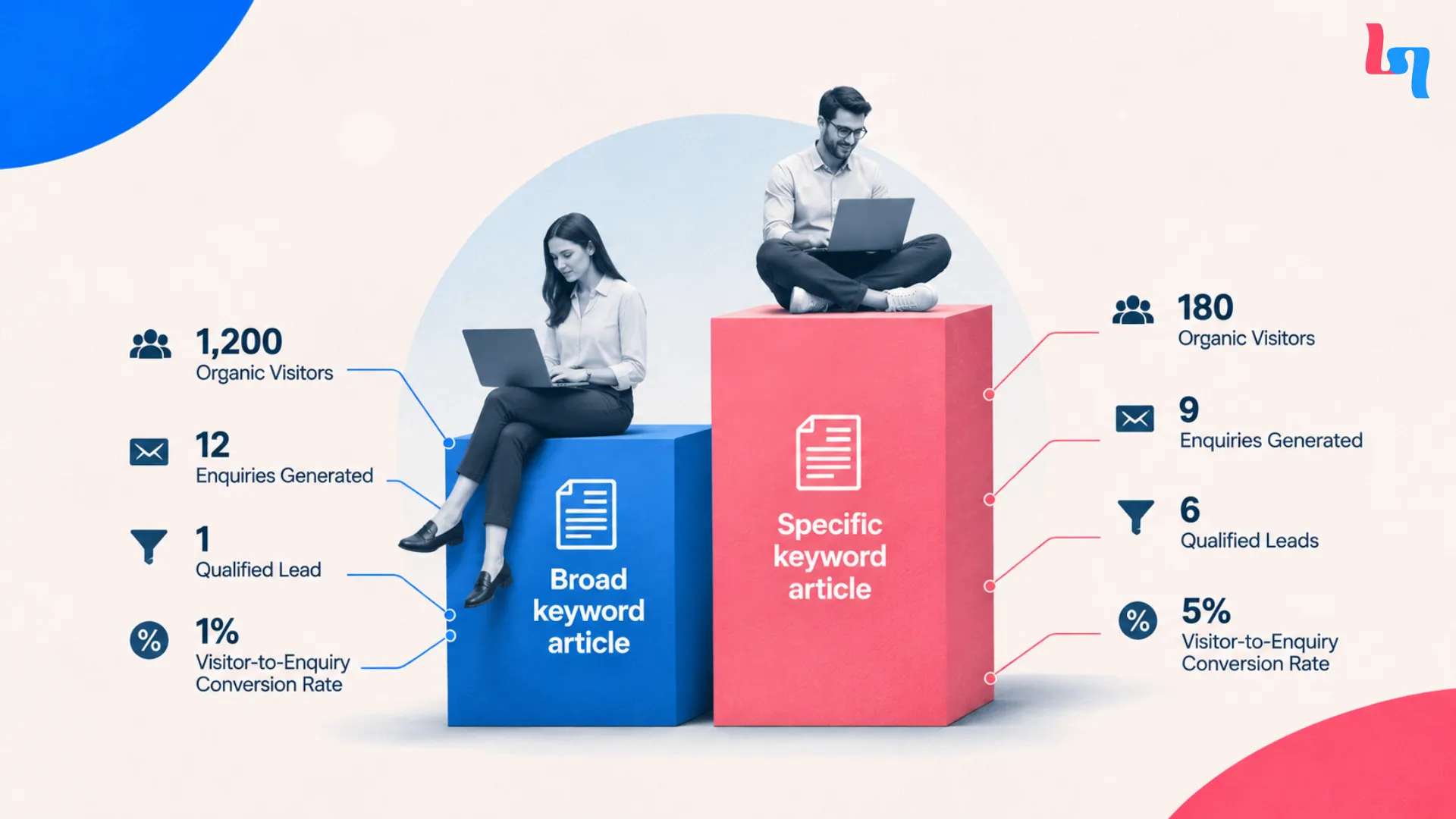
After 6 months, you compare how each performed:
| Metric | Broad Keyword Article | Specific Keyword Article |
|---|---|---|
| Organic Visitors | 1,200 | 180 |
| Enquiries Generated | 12 | 9 |
| Qualified Leads | 1 | 6 |
| Visitor-to-Enquiry Conversion Rate | 1% | 5% |
These are just examples.
The general article gets a lot more traffic.
But the specific article gives you more quality leads.
Because it talks about a problem that is a perfect fit for your product and target audience.
The visitor will have a much clearer reason to look into your offering.
But if you’re only using monthly organic traffic to judge your content…It looks like the first article wins.
However, once your sales team start looking at the enquiries, they’ll see that the second article has brought in more quality opportunities.
I’d want to make sure both your marketing and sales teams know this.
Traffic can show you how visible you are but quality leads will let you know that you’re also reaching the right people from a business perspective.
I would still take those quality leads and look at how they become sales opportunities and customers before I made a final decision on ROI.
How I Would Choose the Right Keywords for B2B Content
I wouldn’t list all of the keyword suggestions in order of popularity.
Start by focusing on your business.
Understand What Problems Customers Are Trying To Solve
Start by looking at your sales process.
What questions do your prospects ask when they have an initial call?
What problems are they facing that make them look for an outside provider?
What information do they seek before they approve a purchase?
For example, if you are a cloud consulting company, your prospects may often ask about downtime during migration, security requirements and implementation costs.
These are great content ideas as they are related to issues they will face when purchasing.
I would then look into how people are searching for these issues.
Intent vs Relevance
Think about what someone searching for your keyword is expecting to find.
If they search “what is data governance?” they likely want to know what it is.
If they search “data governance consulting services” they may be looking for providers.
While it would be beneficial to create content for both of these searches, the intent of each page will be different.
Ask yourself if the keyword naturally links to a service/product.
If you are forced to add a clunky sales paragraph to link your content to your business then it may not be a strong business keyword.
A good B2B content marketing strategy should provide your prospects with the information they need to identify their problem or compare solutions.
Examine the Search Results Before Choosing a Topic
While you can get an indication of how many people are searching for a term and how hard it will be to rank using a keyword research tool, I would always search the term and see what is on the first page of results.
Is the page a service page, blog article, comparison or industry report?
What questions have they answered?
What information is missing?
If there is already detailed technical advice on the current results then writing another general overview is unlikely to add much.
However, a better article may include a checklist of how to implement, cost comparison or example of how to make a decision that is relevant to the company’s buyers.
Ahrefs mentions in their March 2026 guide to keyword strategy that when choosing which keywords to focus on, you should think about the traffic, relevance to your business, difficulty to rank and search intent rather than just the search volume.
This is the type of analysis I would carry out before approving the content calendar.
Build a Mix of Broad and Specific Topics
I wouldn’t base an entire B2B content strategy on low volume keywords.
General topics are still useful.
Writing a detailed article on enterprise data management can help you introduce a key topic and link to more specific content.
You may have articles that talk about migration risks, compliance, and vendor assessment.
The articles should be complementary.
Using internal linking will help the reader to find specific answers.
This is particularly useful if you start your research on a wide topic and want to increase engagement with the solution.
Should B2B Companies Avoid High-Volume Keywords Completely?
No.
If a high-volume keyword fits with your target audience, is achievable to rank for and your topic supports your marketing goal, then it could be a great keyword.
If you’re a well-known software company, then ranking for a general category might make sense.
You could also position yourself in front of your potential customers, through an educational article.
However, don’t automatically assume that high search volume is a good reason to invest.
Broad topics can be good for increasing awareness, whilst specific topics might be better for specific questions.
Your content strategy should take this into consideration.
How Should B2B Companies Measure Keyword Performance?
Once published, we will look at whether the keywords we have chosen are correct.
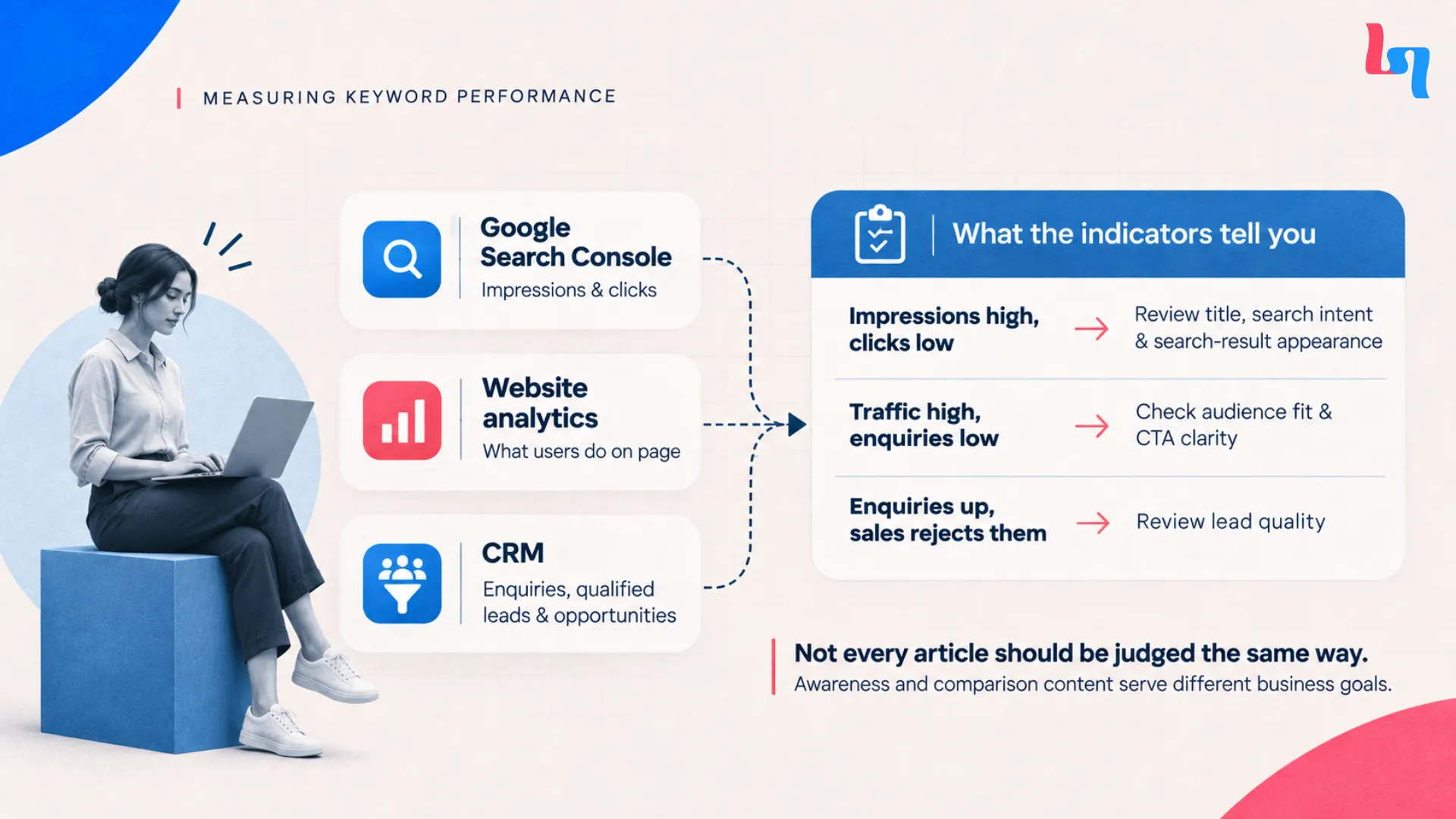
We can look into Google Search Console to see what search terms you’re receiving impressions and clicks for.
We can also look at your website analytics to give us an idea of what users have done once they have landed on your page.
CRM can also tell us how many enquiries, qualified leads and opportunities we are getting.
We will look at the indicators.
If your article is receiving impressions but few clicks, we will look at the title, search intent and what is appearing in the search results.
If your article is receiving traffic but few enquiries, we will look at whether you are targeting the right audience and if there is a clear call to action on the page.
If your article is generating enquiries but they are not being accepted by sales, we will look at the quality of the leads.
The aim is not to have every blog article driving sales, but to understand what your articles are doing for your business.
An awareness article and comparison article will have a different purpose, so would not be judged the same way.
Conclusion: Choose Keywords for Your Customers, Not Just Search Volume
High-volume keywords aren’t a bad investment by default.
They become a poor choice when businesses select them without considering search intent, competition and commercial relevance.
A keyword attracting thousands of searches might help build awareness.
Another receiving only a few hundred searches might answer the exact question a prospective customer asks before choosing a vendor.
I would rather build a content strategy that connects those opportunities than chase the biggest number in a keyword research report.
At Banter Marketo, the decision I’d focus on is whether a keyword can bring the business closer to the audience it wants to reach.
Because, when a blog starts generating traffic, the next question shouldn’t simply be how to attract more visitors.
It should be whether those visitors are the people the business actually wants to work with.
Frequently Asked Questions About High-Volume Keywords
- Are high-volume keywords bad for SEO?
No. High-volume keywords can attract useful traffic. I would only avoid them when they don’t match the business’s audience, search intent or realistic ranking opportunities.
- What is a good keyword search volume for B2B SEO?
There’s no fixed number. A keyword with 100 monthly searches could be valuable for a specialised B2B service, while a keyword with thousands of searches may attract irrelevant visitors.
- Do low-volume keywords convert better?
Not always. More specific searches can indicate clearer intent, but conversion depends on the audience, content, offer and website experience.
- Should I target high-volume or low-volume keywords first?
I would prioritise keywords that match customer needs and offer realistic ranking opportunities. A mix of broad and specific topics can work well.
- Why does my blog get traffic but no leads?
Your content may be attracting people who aren’t looking for your services. I’d review search intent, visitor behaviour and whether the article answers commercially relevant questions.
- Does keyword difficulty matter more than search volume?
Both matter, but neither tells the whole story. I’d also examine the search results, business relevance and potential value of the visitors.
- Can a low-volume keyword bring significant traffic?
Yes. One page can rank for several related searches, so its total organic traffic may exceed the estimated volume of its primary keyword.
- How do I know if a keyword is valuable for my business?
I’d check whether it reflects a problem your target customers face, whether you can create useful content around it, and whether the resulting traffic contributes to meaningful business outcomes.