

As a B2B marketer, you’ve finally found someone who ticks all of those boxes! They are in your target industry, their revenue and number of employees match your criteria, they have a decision-maker with a marketing budget. Everything seems perfect, so you send across your proposal.
However, the prospect doesn’t respond to your request.
It may still be worth pursuing the account because, say, the marketing lead left the company, the organization’s revenue dropped, or it invested heavily in a competitor’s solution.
These are just a few examples of changes in the business that could impact your deal.
Months later, you may find out from a third party that the marketing director at the organization has changed, it expanded their operations to a new territory, and they ramped up lead-generation initiatives. And, unfortunately, it purchased the services of an agency that offers a similar solution.
So, what went wrong?
The prospect initially seemed like a perfect fit for the given time, but there wasn’t enough information about the company to understand their current priorities.
The lead was good, but it was a missed opportunity because the timing was off. This is the thing with B2B lead generation.
The problem is that companies can waste a great deal of time looking for target companies that fit the ideal customer profile, without actually thinking about what these companies are doing at the moment.
Sure, it is important to find the right prospect, but how can you know that they are actually in need of your services?
Any good B2B lead generation strategy has to factor in both these elements: it has to give you leads on companies that fit the target profile and are showing some level of interest and intent to buy.
This is what B2B buying signals are all about.
Essentially, these are the signals that suggest that some change is happening within the company, for example, they could appoint a new executive, announce the entry into a new market, or make a big investment in a specific business area.
None of these necessarily mean that the prospect is looking to buy your services, but they can give a good push to your sales reps to reach out and start the conversation.
According to Gartner’s 2025 B2B buyer research, 73% of B2B buyers actively avoid suppliers that target them with irrelevant messages and outreach.
That is why simply finding companies that fit the target profile is not enough to get you results; your message has to be relevant to the prospect in terms of their current buying journey. But how can you do that without knowing what signals your target companies are sending?
How can you utilize B2B buying signals to find better sales leads?
Distinguish Fit Signals From Intent Signals
One of the most common mistakes that B2B sellers make while prospecting is relying only on ideal customer profiles (ICP).
Finding companies that fit the ICP is part of the process. However, determining whether it is the right time to sell is another, no less important task.
This is where fit and intent signals come into play.
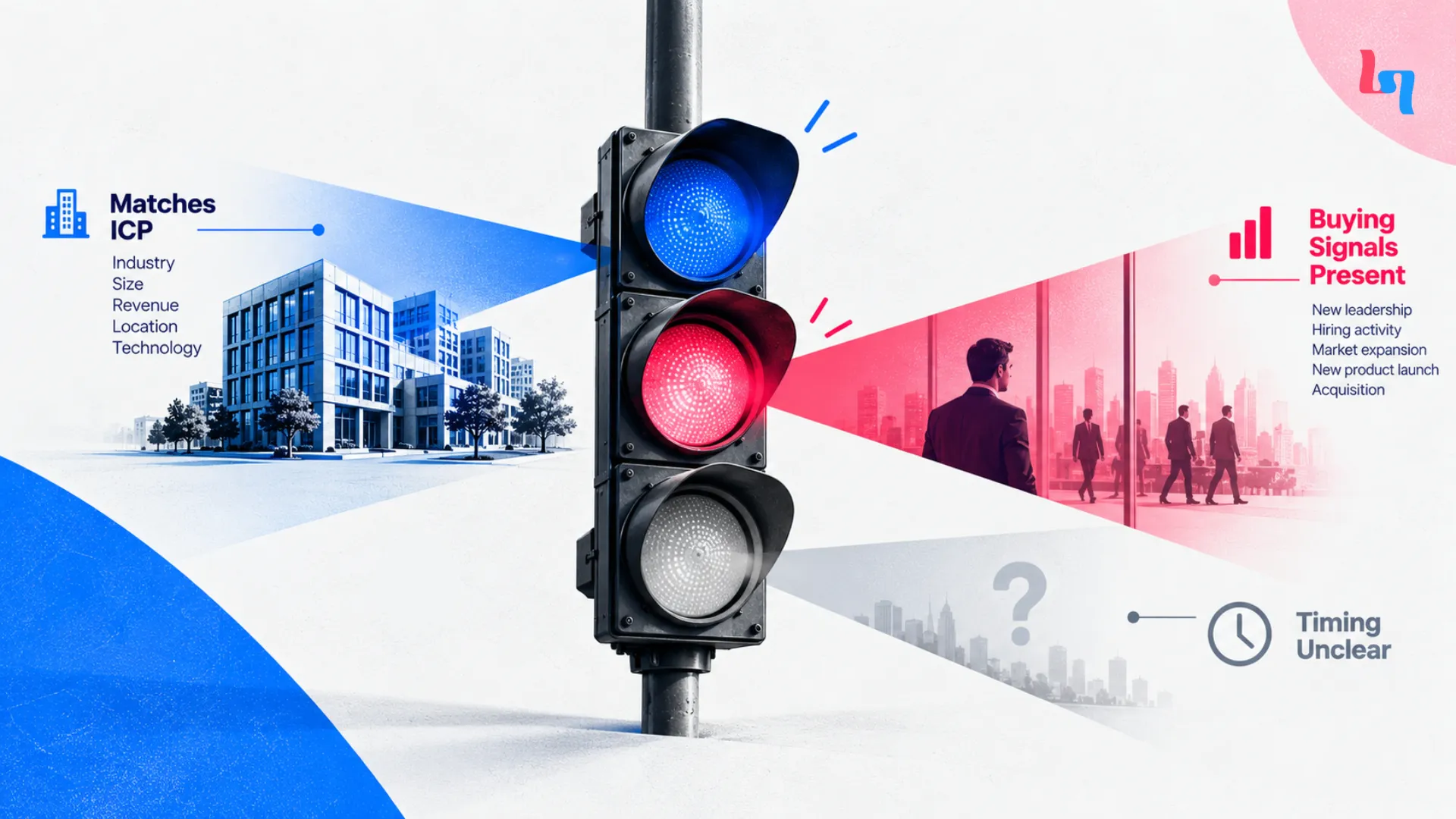
Fit signals help you identify the companies that fit your ICP, while intent signals are used to determine the timing.
Fit signals are data points that provide information regarding whether the target company fits the ideal customer profile.
In particular, the signals include information related to the company’s industry, size, revenue, location, technology, and business model.
While fit signals contribute to having a better understanding of the target company, they do not indicate whether it is the right time to sell.
Intent signals, however, can provide more relevant information.
In particular, this type of signal can be used to detect any changes within the target company, such as the appointment of a new chief marketing officer or expansion into a new market.
Another example includes an increase in the demand generation budget, an acquisition, or the launch of a new product. Similarly, information regarding companies that have shown some interest in their products and services can be helpful.
Let me give you an example. Let’s imagine that you work in an SEO agency and you are targeting B2B technology companies.
On your prospecting list, you’ve found a software company with 300 employees that fits your ICP.
However, in your research, you discover that the organic traffic to the company’s website is consistent, but there is nothing indicating that the company is thinking about expanding.
Should you prospect this company and try to sell your services to them?
Let’s continue with our example and imagine that the company hired a new VP of Marketing, started hiring new demand generation professionals, and launched a new product line.
Is it safe to say that the company is interested in hiring an SEO agency now? Can you contact them and try to sell your services?
In Gartner’s 2025 B2B buyer research, 73% of B2B buyers said that they actively avoid suppliers that target them with irrelevant outreach, and 61% prefer to make purchases without the involvement of a sales representative.
This means that your outreach won’t be welcomed if you don’t know what your prospect is interested in.
I think it’s safe to say that for me, intent and fit are two different things. Fit tells me which prospects to target, and intent tells me which prospects to prioritize.
However, I would not consider companies suitable for the “considered” or “interested” bucket merely because they show intent.
I would need to understand their buying intent and analyze if there is any buying signal coming from them. Gartner mentions that intent analysis should be based on multiple signals rather than one.
I agree that it isn’t enough to rely on just one action, and that’s why I would analyze potential intent signals and prioritize prospects based on those signals.
Monitor Hiring, Leadership Changes, Funding, Expansion, and Launches
You do not necessarily need to wait for a company to call you or drop you a line to understand whether they may need your services. Sometimes you can identify potential clients based on some of their recent activities.
For example, the company may have hired new workers, welcomed new executives, secured funds, expanded its operations, or launched a product.
I would keep an eye on five key activities that a company undertakes which signify that they may need my services.
Of course, not all changes within an organization mean that they will turn to me for help. I would keep an eye on the following five activities:
- Hiring Activity
For example, if a company starts hiring demand generation specialists, it can mean that it wants to ramp up its marketing efforts. If I am in the marketing automation consulting industry, it will be a good idea to research the company to learn wjhether they will need my services.
Perhaps the new demands generation specialists will require automation consulting. There are several questions I can ask to determine that.
First and foremost, the company may need to invest in new marketing automation tools. Second, there may be certain marketing processes that they will need assistance with.
Therefore, I would follow up on the news about the new job opportunities in the company to see if there are any additional clues about the business’s requirements.
In this case, I would also benefit from cross-referencing the information about new hires with the company’s other activities to get a clearer picture.
For example, if the company launches a new product, it may need consultants in different areas.
- Leadership changes
The company has just hired a new CMO or Chief Revenue Officer. They will most likely take a closer look at the agencies they are currently working with.
They might analyze the tools and metrics they use to measure success and whether their current strategy is helping them reach their revenue goals.
Does that mean they are looking to replace their agencies? Not necessarily.
I would take a closer look at what the new CMO is planning to change and whether there is a place for my services there.
According to Gartner’s 2026 technology buying research, of buying initiatives that encountered unhealthy conflict had also experienced a change in purchase-team leadership.
While this stat only refers to 49%, it still represents a considerable percentage of reasons why the CMO could be interested in my services.
- Funding Announcements
The company has received new funding. Now, it most likely wants to expand. But how can I know for sure where they want to expand first?
More people might mean more salespeople are needed. The company might want to release a new product. They might want to explore the option of new markets and reach out to more customers.
Or maybe there is no specific reason, and the company is not looking for any new agencies.
I would keep an eye on news regarding the company and see whether they announced any new vacancies or products and services they are planning to introduce.
- Expansion Activity
When a company opens up a new market, acquires another office, or expands its sales team, it could require a different approach to generate new business.
For example, a company that is expanding internationally might need help with international SEO, localized content, and lead gen to target customers in that market. Or marketing automation to scale its demand gen efforts as it grows.
The questions I ask myself before approaching a prospect are: Where are they expanding? What challenges are they anticipating in this new market?
Do they have any marketing team or budget in the new region?
Depending on the answers, I would decide whether it makes sense to offer my services.
- Product Launches
One of the most anticipated activities in companies is a product launch. The thing is, building a product is one thing, but getting people to actually buy it is a whole different and challenging endeavor.
Depending on what the company might need help with, landing pages, product positioning, competitive analysis, and even marketing automation to nurture leads until they are ready to buy.
Let’s say I am reaching out to a cybersecurity company that has an enterprise security product and is about to launch while also hiring a regional sales team.
If I provide B2B demand generation services, I can check their website and strategy to see whether they have the tools to successfully launch the product.
I could also provide some Banter Marketo content marketing case studies as an example of what I did for similar clients in the past. However, I would still need to personalize the examples according to the prospect’s needs.
According to Gartner’s research on B2B buyer uncertainty, buyers with moderate to extreme uncertainty were 78% less likely to have a high-quality deal.
That said, not every company that launches a product, takes part in an IPO, or acquires a new office will require the services of an outside agency.
However, it does help to understand what buyers care about rather than assuming they are ready to make a purchase.
For my part, the next step would be to research recent news about the company, new hires, job openings, any recent funding, and other relevant events that signal what their intentions might be.
Identify First-Party Intent Through Website and Content Interactions
Company news is a great source of information about the internal situation of the business. However, sometimes it is useful to take into consideration the interaction of the company’s potential clients with its website and content.
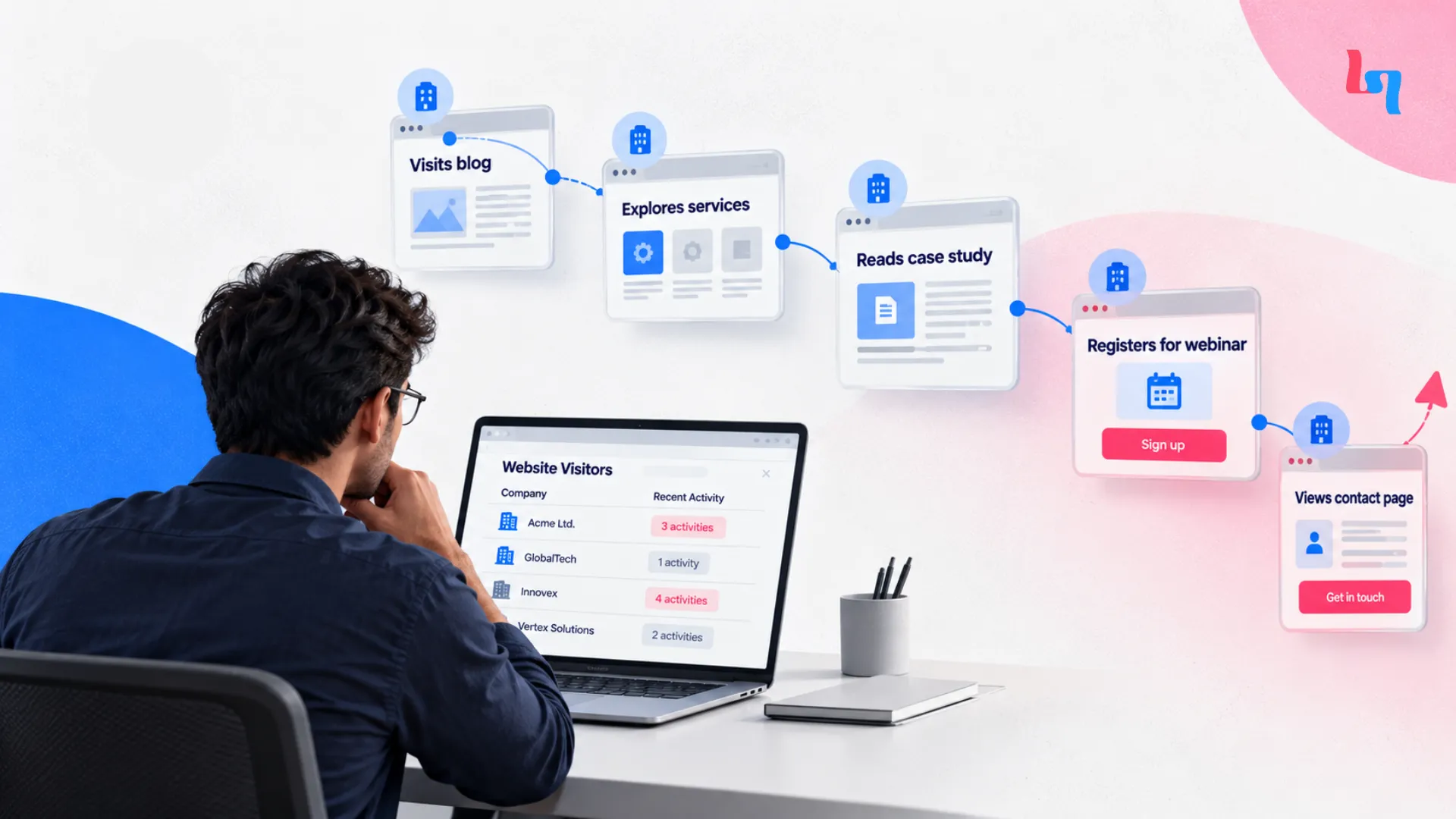
This is called first-party intent data, and it may include website tracking, email tracking, webinar registration, and tracking of downloadable content.
It goes without saying that such data may be collected only with the clients’ consent and in accordance with privacy laws and regulations.
Personally, I would focus on the long-term relationship between the customer and the company and track the interactions of the customer with the website.
For instance, the customer’s first-time visiting your blog does not necessarily mean that he or she is interested in anything you are posting.
However, if the same client goes to the services section to research the offerings of the company, reads a case study, and shows interest in the contact page, this may indicate that the customer may need your services.
For example, if a customer working in the sphere of business-to-business (B2B) reads an article on lead generation on your website agency, and after some time, another employee of the same organization reads the case study on the B2B services page, the blog post on improving the quality of leads, and signs up for your webinar on this topic.
If these actions can be connected to a particular company in the privacy settings allowed by the law, the agency can research the company in more detail and, therefore, have a better idea of who its potential client is.
What users are downloading or reading on your website can also indicate their interests to some extent.
Users who have downloaded a beginner’s guide are probably seeking information and solutions to address an emerging need.
In contrast, those who are browsing the implementation options or have booked a consultation service are likely to be at the buying stage.
However, you should not consider these users as warm leads ready to purchase your services.
I would use the information to develop a content marketing and SEO strategy for my business.
For instance, I could create educational content and blog posts about industry-specific problems and solutions or case studies and service pages to collect more information about prospects’ needs and wants.
On the other hand, website analytics tools are not perfect and may fail to track all the visitors or identify their needs and interests.
Moreover, I would avoid using any personal identifying information to track anonymous users browsing my website.
Therefore, I would only use the data I have access to and assume that the user’s anonymity does not indicate their actual identity or interests.
Combine Multiple Signals Before Prioritizing Outreach
One buying signal alone doesn’t always tell you much. A company might hire a new executive but continue working with the same vendors. It might receive funding for something unrelated to your services.
Even someone visiting your website could be there by accident.
That’s why I would look for more than one signal before deciding whether to reach out.
Let’s say you offer B2B content marketing services. You notice that a company you’re interested in has hired a new marketing director. It’s worth paying attention to, but is that enough reason to send a sales pitch? Probably not.
Now, suppose the same company is launching a new product, hiring content marketers, and publishing articles for a market it recently entered.
Looking at these changes together, it seems the company may be putting more effort into content creation and its go-to-market plans.
But that doesn’t necessarily mean it needs an agency.
I would first find out whether the company is building its own team, looking for outside support, or simply trying something new.
Instead of using every company update as a reason to reach out, I would focus on the following three criteria:
• Business change – has something happened that may create a new need for my services?
• Relevance – is something that has changed relevant to an issue my services can solve?
• Engagement or intention – has the company shown some interest in my services based on some signals I can collect legally?
Using these criteria, it would be possible to prioritize outreach efforts and focus more on those companies that show emerging need and interest.
Even if a company fits my ideal customer profile (ICP), I would not try to contact them if there had been no recent development. Thus, the company would not be excluded just because it is an ICP but has not demonstrated any recent interest.
In these terms, the approach to qualifying companies for outreach may be summarized. It is not sufficient merely to collect the maximum number of signals.
Rather, it is important to assess the value of each signal in terms of the likelihood that a company may be interested in considering my services. In this case, the focus of the effort would shift from quantity to quality.
The goal is to identify those companies that have a demonstrated need and interest in my services.
Score Signals by Relevance, Recency, and Strength
Finding buyers’ signals can be useful in identifying prospects. The challenge is that not all signals are equal. Some may be strong, while others may just provide the initial contact information.
A company can announce something that seems great on paper, but one should evaluate whether this means there is a need for the services one provides.
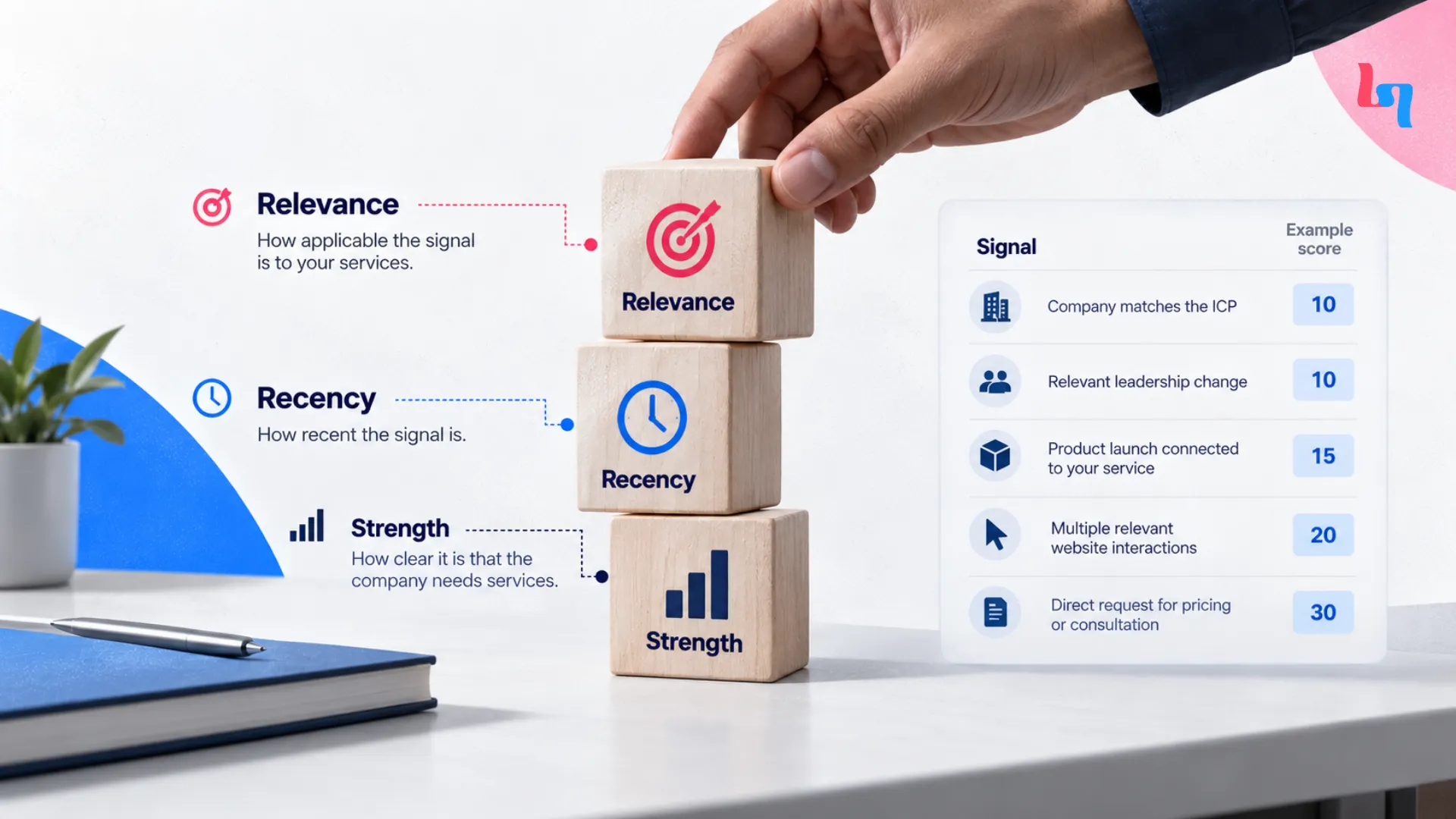
I would consider relevance, recency, and strength when determining which companies to research and contact first.
Relevance refers to how applicable the particular signal is to the services I am offering. In the case of marketing operations manager job opening at a company, it would make sense to look into it if I am offering marketing automation consulting. It may not be relevant to a website designer.
Recency refers to how recent the signal is. It is understandable that recently launched products are more likely to bring a prospect than those launched a year ago. At the same time, some of the signals that took a while to appear might still be relevant.
Strength is how obvious it is that the company needs services. In some cases, one can identify that a company needs assistance even when it only announces a job vacancy.
On the other hand, if they have sent out requests for proposals or questions regarding pricing, it is a stronger indication that they are looking for a service provider.
Here is an illustrative scoring model:
| Signal | Example score |
|---|---|
| Company matches the ICP | 10 |
| Relevant leadership change | 10 |
| Product launch connected to your service | 15 |
| Multiple relevant website interactions | 20 |
| Direct request for pricing or consultation | 30 |
These weights are just examples, not industry benchmarks. I would adjust them based on my team’s sales data and conversion rates.
I would also consider how recent each signal is and lower the score when the information becomes outdated.
But a high score doesn’t mean it’s time to send an email.
Before reaching out, I would check where the information came from, look for anything that might suggest otherwise, and make sure there’s a good reason to contact the company.
Turn Buying Signals Into Useful, Personalized Outreach
Finding a buying signal is one part of the puzzle. But knowing what to say with this signal is another.
The last thing I would do is send a generic message congratulating the company on the news. I think it’s great to congratulate someone, but why should that affect their interest in my services?
Instead, I think it’s worth focusing on the implications of this news for this company and finding a way to have a conversation about related problems.
I mean, if the company is B2B software and has launched a new product, it would be worth reaching out and saying something like “Congrats on launching your new product! One challenge I’ve seen with other B2B companies after launching a new product is differentiating them from the competition.
I’ve seen some success using comparison content and search demand to highlight a company’s competitive edge; would something like that be of interest for you as you continue to grow this product?”
That way we’ve tied it back to them and their needs, without assuming what they might need.
I think this approach is much better: it gets their attention by relating to their news, instead of using their news as a launch pad to try and sell my service outright.
Let’s imagine that the company needs to hire a new demand generation team.
Instead of telling them about my services, I would present a few ideas about the demand generation synergy of content, paid campaigns, and sales qualification.
But suppose the person came to our service pages several times and asked for more information about our services.
In that case, my follow-up call would be more relevant since the person already showed interest in our services.
I would also consider the audience and ask myself what they might need and if we already provided that information.
Therefore, in the case of Banter Marketo, I might tell them about our digital marketing services or give them a link to a case study if they asked for more information about our services.
After all, the point of outreach is not to sell the prospect but to provide them with information that will give a good impression of the company and encourage them to communicate further.
Measure Signal Quality and Resulting Opportunities

A buying signal strategy is only valuable to an organization if it improves the performance of sales decisions.
While tracking the quantity of collected signals may help in choosing the course of action, it will not indicate whether the outcome was positive.
In this case, I would analyze the quantity of closed deals with the companies on the prioritized list, the percentage that got qualified on the sales team’s outreach, and the number of those that became paying customers.
Additionally, I would compare these indicators against similar prospects missed due to the old prospecting method.
For instance, if a sales development team used five key metrics to select one hundred companies to target, I would compare them to another hundred businesses that the reps would traditionally contact.
However, I would also consider the percentage against the ICP, the number of contacted prospects, the type of correspondence, and the timing to determine if the buying signals have value.
Here are a few metrics I would track to determine the effectiveness of the approach:
• Positive response rate: the percentage of prioritized but interested prospects out of the total number of prioritized leads
• Meeting-to-opportunity rate: the percentage of meetings that led to a qualified sales opportunity
• Opportunity conversion rate: the percentage of sales opportunities that resulted in closed deals
• Time to opportunity: the average time it took for a company to go from being prioritized to a qualified sales opportunity
• Pipeline contribution: the number of sales opportunities contributed by the approach, taking into account the percentage of pipeline that could be attributed to buying signals
I would track what factors contribute most to the result and determine if some signals combine to produce better results than others.
For instance, does the approach work better when there is an increased headcount in the marketing department of a growing company? Or can website visits indicate a stronger buying interest in one particular product than another?
Depending on the results, I would change the prioritization of the leads and revise other assumptions about what constitutes a buying signal to get progressively better results.
For a more in-depth perspective on measuring the outcome of your efforts, you may want to consult Banter Marketo’s guide to content marketing metrics and ROI.
Depending on the results, I would change the prioritization of the leads and revise other assumptions regarding what constitutes a buying signal in order to achieve progressively better results.
Stop Chasing Perfect-Fit Accounts and Start Understanding Timing
Sometimes, even a perfect fit for your ideal customer profile may not be interested in your product or service.
On the other hand, a company that has recently changed leadership, begun to acquire new markets, or launched a product may have new needs that your services can address.
So, I will not only look at companies that fit my ideal customer profile. Do they have any recent news, and am I interested in what they are doing?
Does it seem like a good time to reach out?
For me, it’s all about being less concerned with getting in front of everyone who could possibly benefit from my services and more about truly understanding what the company I am targeting is all about.
Don’t get me wrong: ideal customer profiles are not useless – we just have to recognize that timing is at least as important as fitting a prospect into an ideal customer profile.
If you are getting the right companies on your radar but have difficulty getting past the first round of introductions, we can help you.
Our Banter Marketo’s digital marketing services can help you zero in on the right companies and get your messages in front of key decision-makers at highly targeted companies with a more focused B2B lead generation strategy.
Frequently Asked Questions About B2B Buying Signals
1. What are B2B buying signals?
B2B buying signals are signs that a company might be interested in a product or service. They can include hiring new employees, entering new markets, or actively looking for solutions to a business problem.
2. How do you identify B2B buying signals?
Start by following company news, job openings, leadership changes, and activity on your website. These can give you a better idea of what a company needs and whether it’s a good time to reach out.
3. What is the difference between buying signals and intent data?
Buying signals suggest that a company might have a business need. Intent data focuses more on what the company is researching, such as specific topics, products, or solutions.
4. How can buying signals improve B2B lead generation?
Buying signals help you spend less time chasing leads that aren’t ready. Instead, you can focus on companies showing signs of a potential need and reach out with a more relevant message.
5. How can you track B2B buying signals?
You can keep track of company announcements, hiring activity, leadership changes, and visits to your website. CRM and sales intelligence tools can also help you bring this information together.
6. Can buying signals predict when a company will purchase?
Not always. Buying signals can tell you when a company might be interested, but they can’t confirm when a deal will happen. Budget, internal priorities, and approval processes still play a big role.
7. How many buying signals should you look for before contacting a prospect?
There’s no fixed number. If someone directly asks about your services, that’s usually a good reason to follow up. But if you’re only seeing signs like new hiring or company expansion, it’s worth doing a little more research before reaching out.