
B2B marketing content may perform well on Google, attracting plenty of views.
However, if you’re not seeing qualified leads, the problem may come down to how your potential customers are searching.
Many people may be using the Google AI Overview to research their enterprise software solution or they may be using ChatGPT to compare vendors and visiting only relevant companies.
This brings a new challenge to B2B marketers.
How do you create content that performs well in Google Search, but is also useful in AI search?
I don’t believe you need to stop doing SEO, or create separate articles for each AI search, but instead create B2B content that answers the right questions, shows your expertise and provides useful information for the buyer.
How to Create B2B Content That Performs Well in Google and AI Search?
Google is still an important way to discover business solutions.
According to an analysis by EMARKETER in May 2026, 57% of B2B decision makers in the US use search engines as part of their early research (Jan 2026 survey).
However, just because you are showing up in search doesn’t mean you will get people to your site.
With the Google AI Overview, people may be able to get the information they need from the summary in search. An analysis by Ahrefs in Feb 2026 looked at 300,000 keywords and found that the average CTR for the top page was 58% lower when showing up in the AI Overview.
This doesn’t mean that all websites will suffer from this; however, it does show that you need to look at your visibility in search and traffic.
AI chatbots are also becoming part of the research process.
According to the 2026 AI Search Insight Report by G2, 51% of B2B software buyers and decision makers are starting their research with an AI chatbot more often than Google (based on a survey of over 1,000 people).
However, 80% still use Google at some point.
This shows that people are not necessarily moving away from traditional search.
They may be using ChatGPT to get an idea of what solutions are available, then looking at Google to research the companies, and individual sites to see what they can offer.
Therefore, you need to create content that helps with multiple stages of their research.
Start by knowing what they want to know.
Understand Buyer Search Intent for B2B Marketing Content
Keyword research is a great place to start when looking at SEO. However, you won’t know why people are searching for certain keywords.
You may have high-volume keywords that will give you high impressions but not many potential customers.
Alternatively, you may have a more specific question with low search volume but comes from someone who is looking to invest in a solution.
Let’s say your company provides enterprise cloud migration services.
A potential customer may search:
1.Why do cloud migration projects go over budget?
2.How much does it cost to migrate a legacy application?
3.Is cloud migration better than Application Modernization?
4.What should an enterprise cloud migration assessment include?
All of these are related to the same service but are at different points in the research process.
The first shows a concern, the second is cost-related, the third is comparing options and the fourth could show the buyer is looking to involve a service provider.
I would structure this information differently to create articles discussing the general benefits of cloud migration.
With AI search, this becomes even more important as buyers will have detailed questions.
A buyer may ask ChatGPT whether a manufacturing company should migrate its legacy ERP system.
A generic article about cloud computing would not be very helpful. However, an article that discusses integration dependencies, downtime, security needs, and risks of migration would be much more helpful.
I would also look at what is currently available on Google.
Are the best pages guides, comparisons or vendor pages? Does Google show an AI Overview? What important information is missing?
This helps you identify where you can add real value.
The goal would be to target the question behind the keyword rather than using it throughout the article.
Create Content That Answers One Clear Buyer Question

Now you’ll need to decide what type of content you want to create.
Not all topics will need an in-depth blog post.
You may want to create a comparison, ‘how to’ guide, checklist or case study.
A buyer might want to know how much it costs to implement, how scalable the platforms are, what integration is required and any governance issues when comparing enterprise data platforms.
A buyer looking into data migration risks may benefit more from a technical checklist.
A buyer looking into service providers may prefer to read a case study.
I’d match this to what the reader is trying to decide.
You also need to think about whether there is already a page on your website answering this question.
If your SaaS business has articles around reducing implementation costs, reducing costs of deployment and keeping your software rollout on budget, but they all have similar recommendations, then you may not gain anything from creating another version.
First, ensure that each page is answering a unique question. If they are different topics, make sure that it’s clear to your audience why each page is useful.
If not, it may be more useful to improve one comprehensive page.
You’ll want to follow traditional on-page SEO best practice.
Use a descriptive page title, clear H2 headers, a logical URL and include your keywords in a natural way.
You’ll also want to answer the main question quickly. Don’t waste paragraphs talking about common issues within the industry.
For more information on these basics, you can read our guide on how to write SEO friendly blog posts.
However, don’t use keyword stuffing or heading structures as a replacement for providing a useful explanation.
Your page should provide what your page title suggests.
Structure Your Content So Readers Can Understand It Easily
The organization will make it easier for people to find what they’re looking for, and will provide search engines with a clear understanding of what your article is about.
However, not every article needs to be written using short paragraphs or a Q&A structure.
Even Google’s guidelines on Generative AI Search in 2026 show that the publisher doesn’t need to use AI formatting or segmented blocks of content.
As long as the article provides useful information and is explained well, If you were writing about whether to modernize a company’s data warehouse, you may start off by explaining how important data analytics is in a business.
However, if the reader is considering upgrading, they’ll likely know this already.
What they want to understand is whether their current system is providing them with what they need.
Are reports taking longer to produce? Is it becoming costly to maintain? Are there any issues with integrating with newer tools or are they having issues with governance?
These are areas you could look at.
You can also talk about scenarios where it may not be necessary to upgrade, and continuing to use the current system.
I would approach this in the same way with comparison articles.
Let’s say a company wants to know whether they should build an AI application themselves or buy an existing solution.
There are a few factors that you should consider here, including data security, resources available, ease of integration, and maintenance.
For example, how sensitive their data is, their resources, how complex integration could be and how much work maintaining the application would be.
You can make this easier by putting your research into a table:
This provides enough information so that your reader knows what options they have, and what would be best for their business.
Use Original Expertise and Reliable Research to Strengthen Your Content

In B2B purchases, it is rare for one individual to make the decision.
According to the Forrester State of Business Buying 2026, a typical business decision has 13 internal stakeholders and 9 external influencers.
While not everyone will sign off on the purchase order, there can be many individuals who play a part in influencing whether an investment will go ahead.
A department head may be keen to invest in a certain platform because it solves an issue they have. However, finance may be concerned about ROI.
IT may have concerns around integration, and procurement will want to compare the contract to other options.
These issues are not necessarily product-related, but are just different ways of looking at the investment.
Research by Gartner in May 2025 shows that 74% of B2B purchasing teams had unhealthy conflict.
However, those who reached consensus were 2.5x more likely to say they had a high-quality deal.
This means that content has to change for marketers.
We need provide not only people with reasons why a solution will be useful to them, but also provide them with information so they can use it in their internal discussions.
This means knowing who will be involved and what they need to know.
Make Your Content Relevant to a Specific B2B Audience
Many B2B sites will have generic statements.
Although this can appear very professional, it does not clearly communicate who you are providing your services to.
For example, a tech consultancy may say they help businesses unlock their digital potential.
However, stating they help manufacturing companies integrate their production systems with enterprise analytics platforms makes it clear to the reader what you offer and to whom.
A survey by Semrush in July 2026 found that 53% of people using AI at work recognised a vendor in the AI-generated responses which were highly relevant to their use case.
While this does not show that there is a specific AI ranking factor, it does show how important it is to be relevant.
This means that throughout your content you should clearly state who you are targeting, what business problem you are solving and how you are solving it.
For example, if a healthcare organisation is looking at software, they may be more focused on how it can help with patient data and integrating into clinical systems.
However, if a manufacturer is looking at similar technology, they may be more focused on ensuring their production is uninterrupted, connecting their equipment and having reports.
Your content should reflect what they are concerned about.
This will be much more useful than stating that all products/services are suitable for all businesses.
Check Technical SEO and Website Accessibility

Even the most well-researched content won’t be found by crawlers.
Before diving into using advanced AI search techniques, it’s worth checking the technical aspects of your website.
Google mentions that content that appears in generative AI search experiences will need to meet Google Search fundamentals and be eligible to show up with a snippet.
This means you should ensure that your pages are:
Indexable.
Canonical links.
Content is accessible and can be displayed.
Important content is available through internal links.
ChatGPT Search has a separate consideration.
According to OpenAI’s crawling documentation, OAI-SearchBot helps to find websites in ChatGPT search. If you’re looking to find your business in ChatGPT search, you’ll want to make sure that your public pages are accessible by this crawler.
OAI-SearchBot is a different crawler to GPTBot (which covers content that may be used to train AI models) so they are separate.
While giving access to crawlers does not guarantee that they will cite your content, if they cannot access your content then it may not appear in search results.
Check the links between your related pages.
For example, if you have an article about the issues with workflow automation, you may want to link to pages that explain requirements for integration, challenges with implementation, and your relevant services.
This helps users to carry on their research and find your content.
We have an article on content marketing and SEO that explains why these activities work well together.
Having your content technically accessible and having useful internal links will give a stronger foundation than trying to optimise for unproven AI search shortcuts.
How Should You Measure B2B Content Performance in Google and AI Search?
Useful, but limited.
A page may be featured in an AI response, but no clicks may have occurred.
Someone may find your company by using ChatGPT, then search for them and visit your site on Google.
A visitor may read a few articles and then reach out to the sales team.
This makes it harder to understand how well you’re performing.
Start by looking at Google Search Console to see how many impressions and clicks there are for relevant searches. Pages being shown in search.
In 2026, Google included generative AI performance reports in Search Console. This gives more insight into generating traffic in their AI-powered search.
For ChatGPT Search, OpenAI notes that some traffic will refer using utm_source=chatgpt.com. This can help to understand how much traffic they are generating.
However, do not solely rely on these metrics to measure your success.
Look at which pages are generating quality enquiries, consultations, demo bookings and sales.
For visibility in AI answers, create a consistent set of questions from real research done with customers.
Does your business appear? Are your pages mentioned? Is the information correct?
As responses can vary with AI, you should not consider this a consistent rank.
The important thing to look at is whether you are seeing improvements in relevant discovery and if it’s helping drive results
Improve Existing Content Before Publishing More
When a B2B website needs better visibility, publishing additional articles may seem like the obvious solution.
But I would first review what the company has already published.
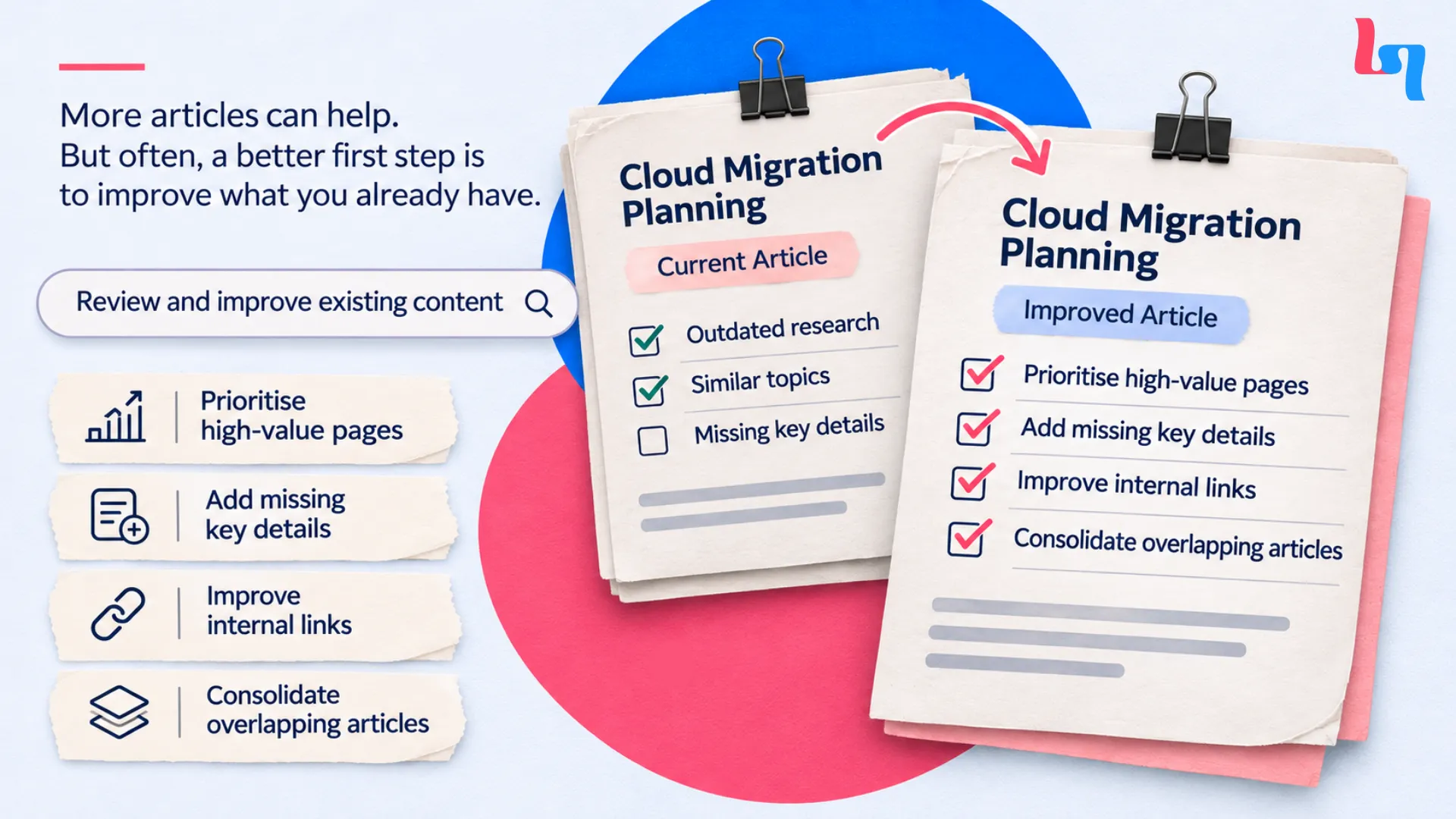
Some articles may cover similar topics. Others might contain outdated research or lack the practical detail buyers need.
An existing page about cloud migration planning, for example, may explain project timelines and costs but overlook application dependencies, rollback procedures or operational disruption.
Adding those considerations could make the article considerably more useful.
I would prioritise pages that already receive relevant impressions, address important customer questions or support services the business wants to promote.
Then I would examine whether the content answers the question completely, includes reliable evidence and provides a logical next step.
Sales teams and subject matter experts can help identify gaps because they regularly hear the concerns that buyers raise before making decisions.
This is also where I would look for opportunities to consolidate overlapping articles or improve internal links.
The goal isn’t simply to make old content longer.
It is to make each page more accurate, relevant and useful than it was before.
Conclusion: Optimise B2B Content for Better Buying Decisions
Google Search and AI-generated answers are changing how B2B buyers discover and evaluate information.
But the underlying requirement remains familiar.
Buyers need clear explanations, reliable evidence, and enough context to compare their options.
For me, effective B2B content optimisation begins with understanding those needs.
That means answering specific questions, contributing genuine expertise, maintaining technical accessibility, and measuring results beyond rankings.
The real goal isn’t just to appear in Google or AI answers. It’s to help the right buyers make more informed decisions.
Before creating another article, I’d start by reviewing what potential customers already ask and whether the website answers those questions properly.
Frequently Asked Questions
- How do I optimise B2B content for Google and AI search?
Start with the questions your buyers ask. Write useful answers, include relevant examples, support important claims with reliable sources and follow basic SEO practices.
- Do I need separate content for AI search?
Usually not. A well-written article can serve readers coming from both Google and AI search. Separate pages are useful when they answer genuinely different questions.
- Can my website appear in ChatGPT Search?
Yes. Public website pages can appear in ChatGPT Search. Make sure OAI-SearchBot can access them, although this doesn’t guarantee a citation.
- Are keywords still important for B2B SEO?
Yes. Keywords help identify what buyers are searching for. However, understanding the intention behind a search is more useful than repeating the same phrase throughout an article.
- How can I measure whether my content is working?
Track relevant search visibility, website traffic and AI referrals. More importantly, examine whether your content is contributing to qualified enquiries, demo requests and sales opportunities.