Imagine you are the owner of a B2B IT service company.
Your company has a good website, a strong sales team and a few loyal customers.
The majority of customers are acquired via word of mouth and you now want to begin generating leads through your website.
Your marketing manager recommends using SEO strategies to improve your website’s ranking on Google.
This will also help create content that is relevant and to attract potential customers.
Your sales director suggests:
What if we used Google Ads to get our business in front of people who are searching for the services we provide?
You decide to trial Google Ads.
After a month of running the Google Ads campaign you have had 600 clicks and 30 enquiries. The marketing report looks good.
However, when the sales team looks into the enquiries only 6 of the companies fit your ideal customer profile. The other companies don’t have large budgets, aren’t looking for the services you provide or aren’t ready to purchase.
You are now spending money to drive traffic to your site but it isn’t generating enough quality leads.
Would you have had better results using SEO? Or is the issue that your Google Ads campaign needs more targeting?
This is where the debate begins.
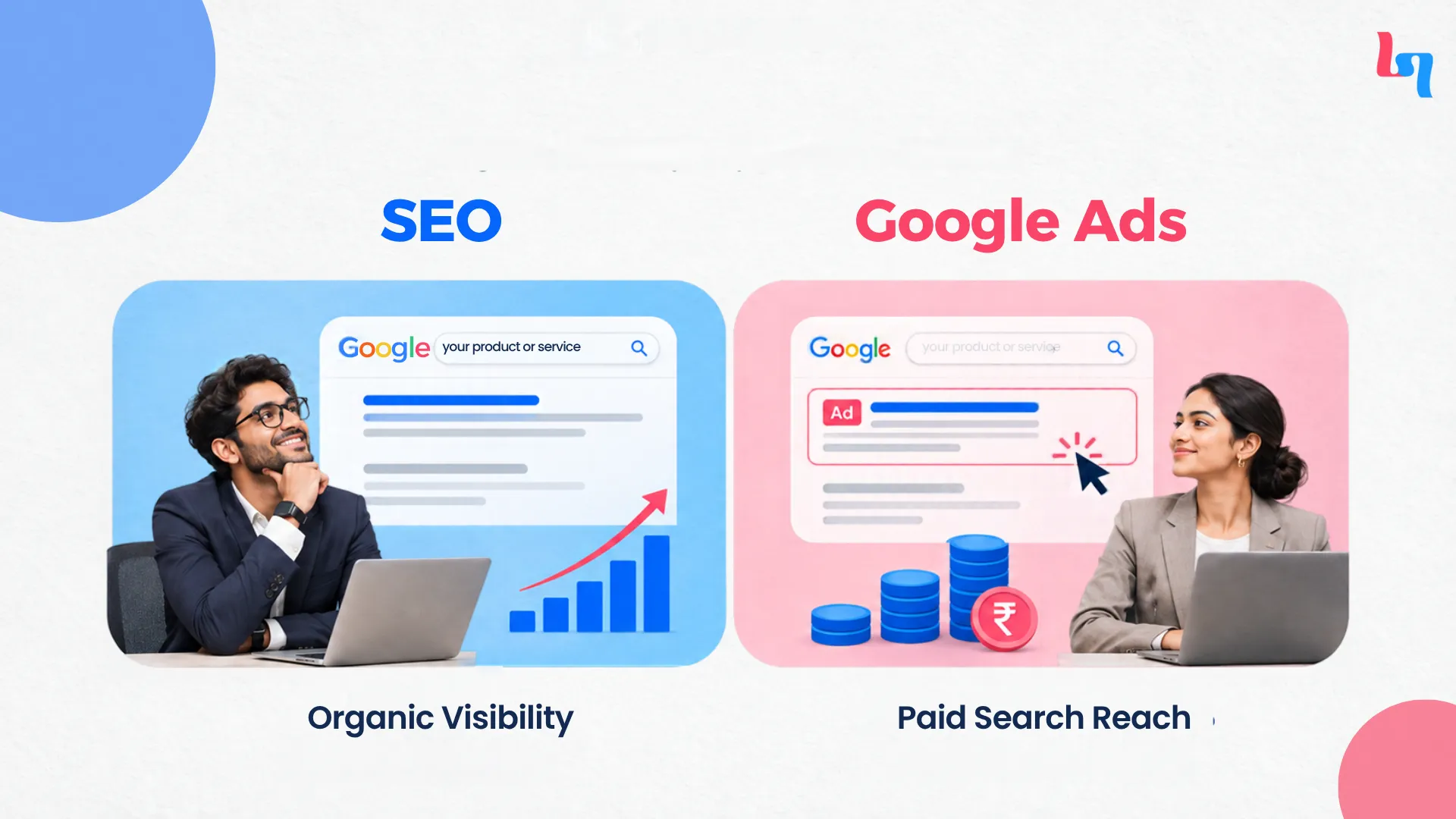
Both SEO and Google Ads can help to get your business found on Google Search. However, there are differences in costs, time required, targeting and long-term value.
I wouldn’t just decide between the two options based on how quickly one will get your business found and how much organic traffic the other will provide.
Instead, I would consider what your business requires, how customers search for your products/services and which option can provide quality leads to pass to sales.
SEO vs Google Ads: What’s the Main Difference?
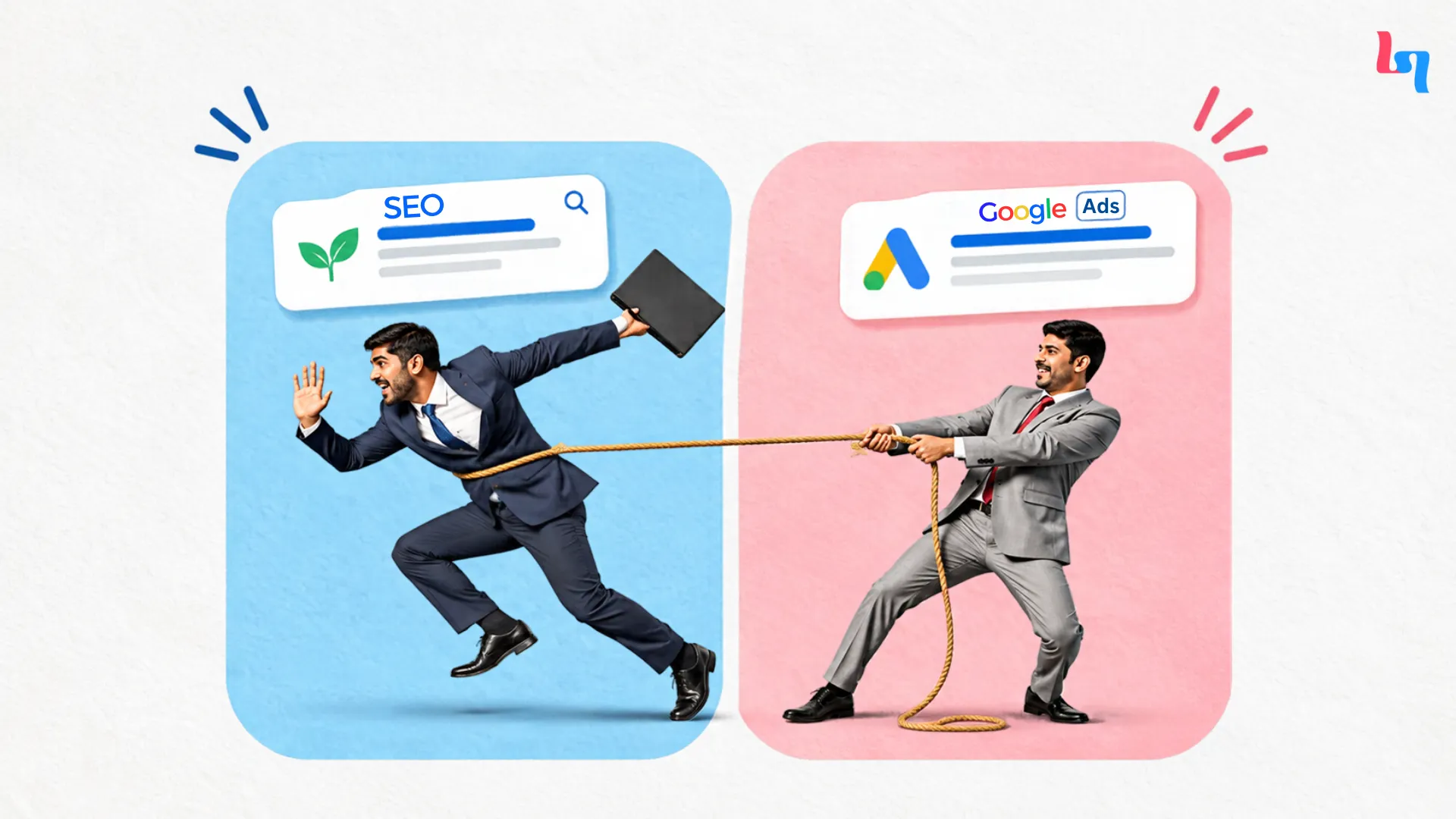
Search Engine Optimisation (SEO) is improving your website so that it can be found in the organic search results of Google.
Google Ads is a paid advertising service.
If someone searches for “enterprise cloud migration services”they may see some paid ads.
A company using Google Ads will be able to bid for these paid ads.
Another company may appear in the organic search results as Google has decided their page is relevant.
Both companies want to attract the same customer but are doing it in different ways.
According to Google’s SEO Starter Guide, SEO helps search engines understand what is on a website and helps people find relevant pages.
Google Ads uses an advertising auction to decide which ads will appear based on factors such as bidding, relevance and quality of ads.
There is no guarantee you will get a customer using either of these methods.
SEO vs Google Ads: Quick Comparison
| Factor | SEO | Google Ads |
|---|---|---|
| Visibility | Organic search results | Sponsored advertisements |
| Main Cost | Content, technical work and optimization. | Advertising spends and campaign organization |
| Results | Usually develop overtime | Ads can appear sooner |
| Cost per click | No direct charge for organic clicks | Usually charged per click in Search campaigns |
| Targeting | Based on search relevance and website content | More direct campaigning targeting controls |
| Long-term value | Pages can continue attracting visitors | Paid visibility depends on active campaign |
| Best Suited for | Building organic visibility and answering buyer questions | Testing and capturing existing search demand |
The key difference is how the channels are using your marketing budget and what you get out of it once people visit your site.
How Does SEO Work for B2B Businesses?
Let’s say your business provides cybersecurity consulting services.
You would like to rank for the search term ‘cybersecurity services’.
However, people may be searching for jobs, courses, software or consultancy.
While you will increase your traffic, how many of these people will actually be interested in your service?
I would start by considering what questions people might ask.
If a CIO is looking to have a security assessment done, they may search for terms such as ‘Cost of implementing’, ‘Requirements for compliance’, and ‘Difference between security assessments’.
This helps you to understand what the buyer is looking for.
SEO will involve creating useful pages.
This could be optimizing your service pages, creating helpful articles, fixing any technical issues and making your content easy to find.
For example, on your consulting website you may want a detailed service page, a guide to implementation and a case study.
Each page will have a different purpose.
At Banter Marketo I would look to identify what searches would be relevant to your business.
Organic traffic can be valuable if you are getting the correct people to your site.
Having 500 relevant people visiting your site could be much more beneficial than 5,000 people who have no reason to purchase your services.
How Does Google Ads Work for B2B Lead Generation?
Google Ads can help businesses bid for paid placements when users search for products/services.
Let’s say we’re running a cloud consultancy and we want to target businesses that are looking for someone to help with their AWS migration.
We can create a search campaign that targets those relevant business searches.
When someone does a relevant search, Google will run an advertising auction to help decide if our advertisement will show and where.
We can set budgets, locations, control our keywords and edit our ads.
However, just because we’re paying more doesn’t mean we’ll get better results.
Google explains in their ad quality guidelines that the relevance of your ad and landing page can impact how well your ad performs.
Let’s say we have an ad that says ‘Enterprise Cloud Migration Support’.
Someone clicks on it because they want to know what we can offer, how long projects will take and how much migration will cost.
However, when they click through, they are taken to our homepage which has generic statements about digital transformation.
They don’t ask any questions and leave.
Even though the keyword was relevant and the ad performed well, the website didn’t answer their questions.
This means that I would not only check how many clicks our Google Ads campaign gets.
I would look at what the visitors are doing once they’ve clicked through and whether they are asking the right questions.
Google Ads can help you get relevant visitors to your website quicker; however, you need to convince them to take the next step.
SEO vs Google Ads: What Are the Key Differences for Businesses?
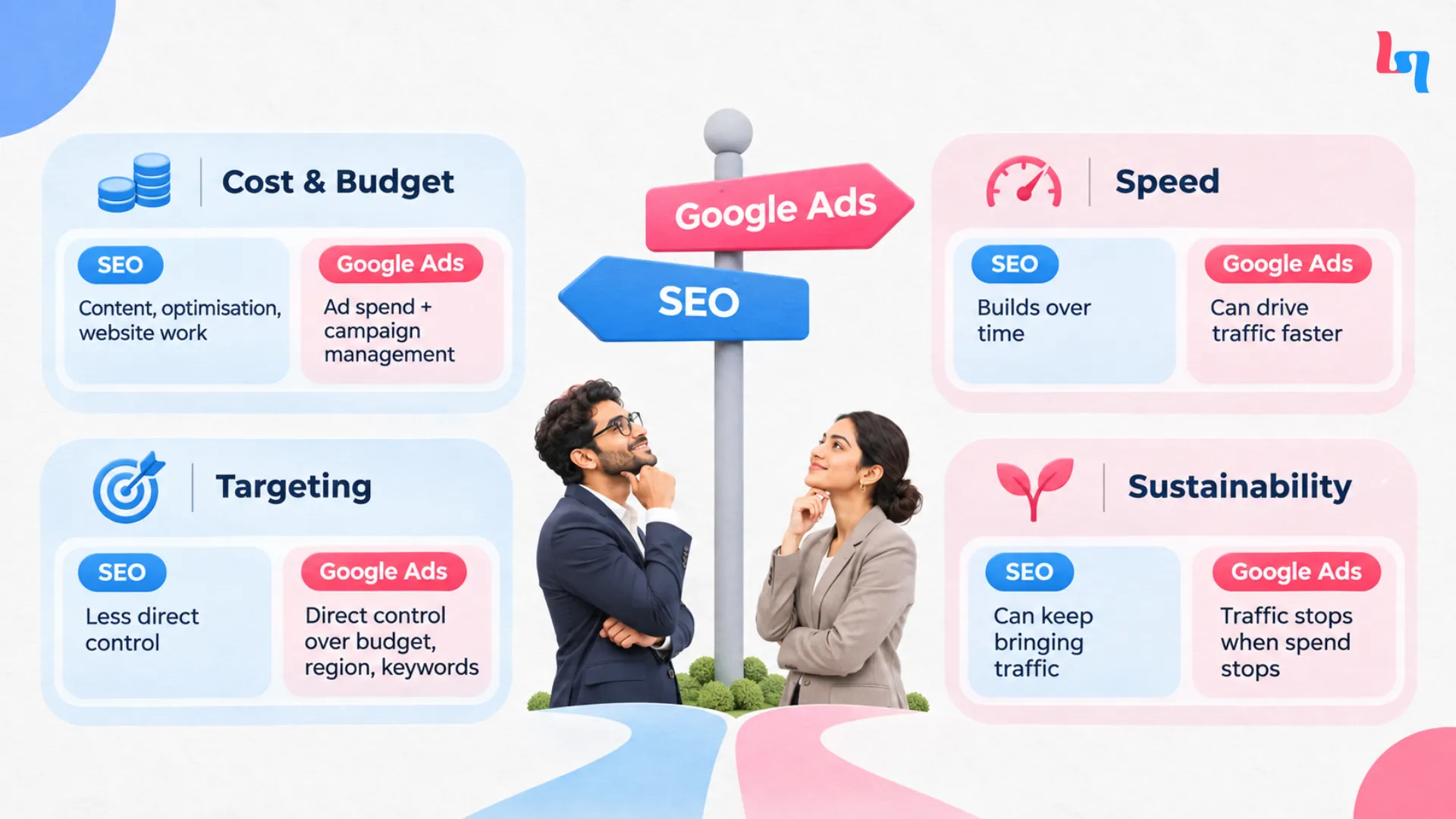
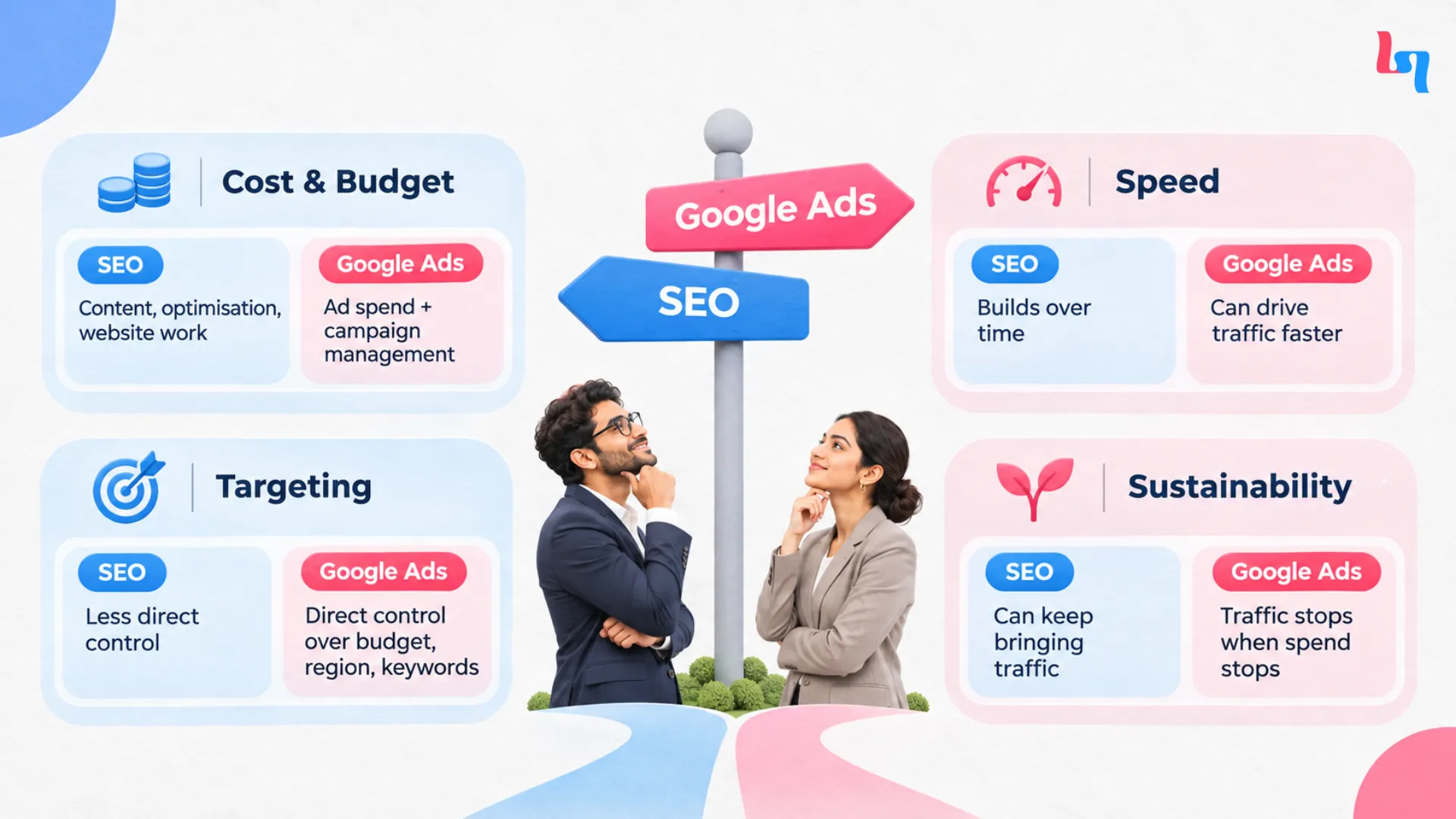
Cost & Budget
A common misconception is that SEO is free to use since there are no advertising costs for organic traffic.
However, while the traffic itself is free to generate from a media perspective, there are costs involved.
Keyword research, content creation, technical optimisation, website improvements and monitoring will all be required.
Google Ads is a more transparent cost.
With standard Google Search ads, you will be charged for each click on your ads.
Costs will depend on a range of factors such as competitiveness, bidding and quality of ads.
The total cost of both methods should be calculated, including management, content and landing page costs, to determine which method provides the best return.
How quickly results can be seen
Once set up and approved, Google Ads can start driving traffic to your website.
SEO can take longer to generate traffic.
If your website is brand new, there may be a considerable work to get your service pages to gain any real organic traffic.
However, this is not guaranteed.
Google Ads can generate traffic and enquiries within days, but qualifying those leads and converting them into customers may still take weeks or months.
For B2B companies with long sales cycles, u should consider how long it takes to drive traffic versus customer acquisition.
Targeting
Google Ads provides a high level of direct control over many aspects of your campaign. You can target specific regions, budgets and keywords.
If you only serve enterprise clients in the US, you can tailor your campaign to suit.
SEO does not offer such a high level of targeting.
While you can create content for a specific audience or region, Google will decide when and where your pages show.
This may be an issue if you are targeting a specific industry, or have a limited budget for advertising.
Sustainability
If you stop spending on your Google Ads campaign you will no longer receive traffic from this source.
With SEO, if you already have a service page or article, you may continue to receive organic traffic.
However, this is not guaranteed.
Competitors can improve their websites, rankings can change and content may need updating.
SEO can provide a more sustainable source of traffic, whereas Google Ads provides more control.
SEO vs Google Ads: Which Generates Better Qualified B2B Leads?
This is the question I would ask.
The first buyer searched for ‘what is cloud migration’ while the second searched for “enterprise cloud migration consulting company”.
The first might be doing some research into their business problem whereas the second might be in the process of researching service providers.
While both may become customers, they are unlikely to require the same content.
SEO can be used to target people at different stages of their journey with informative articles, comparison pages and detailed service pages.
Google Ads can be used to target those who are searching with more immediate needs.
We should not automatically assume everyone who comes via a paid search will be looking to purchase and everyone who comes via organic will be researching.
The intent of the search is more important.
Gartner conducted research into B2B buyers in May 2026. They found that 67% of buyers surveyed preferred a buyer journey with no interaction with sales representatives and 69% preferred to validate AI-generated information with sales representatives.
They want to do their own research but may need to have a conversation with you to make an important decision.
This is relevant for both SEO and Google Ads.
When someone visits your website, can they understand what you can offer, assess your services and determine if you’re the right provider for them?
I would look at how many relevant enquiries and sales opportunities you’re generating.
SEO vs Google Ads: Which Costs More in 2026?
It will depend on your industry, location, competition and target audience.
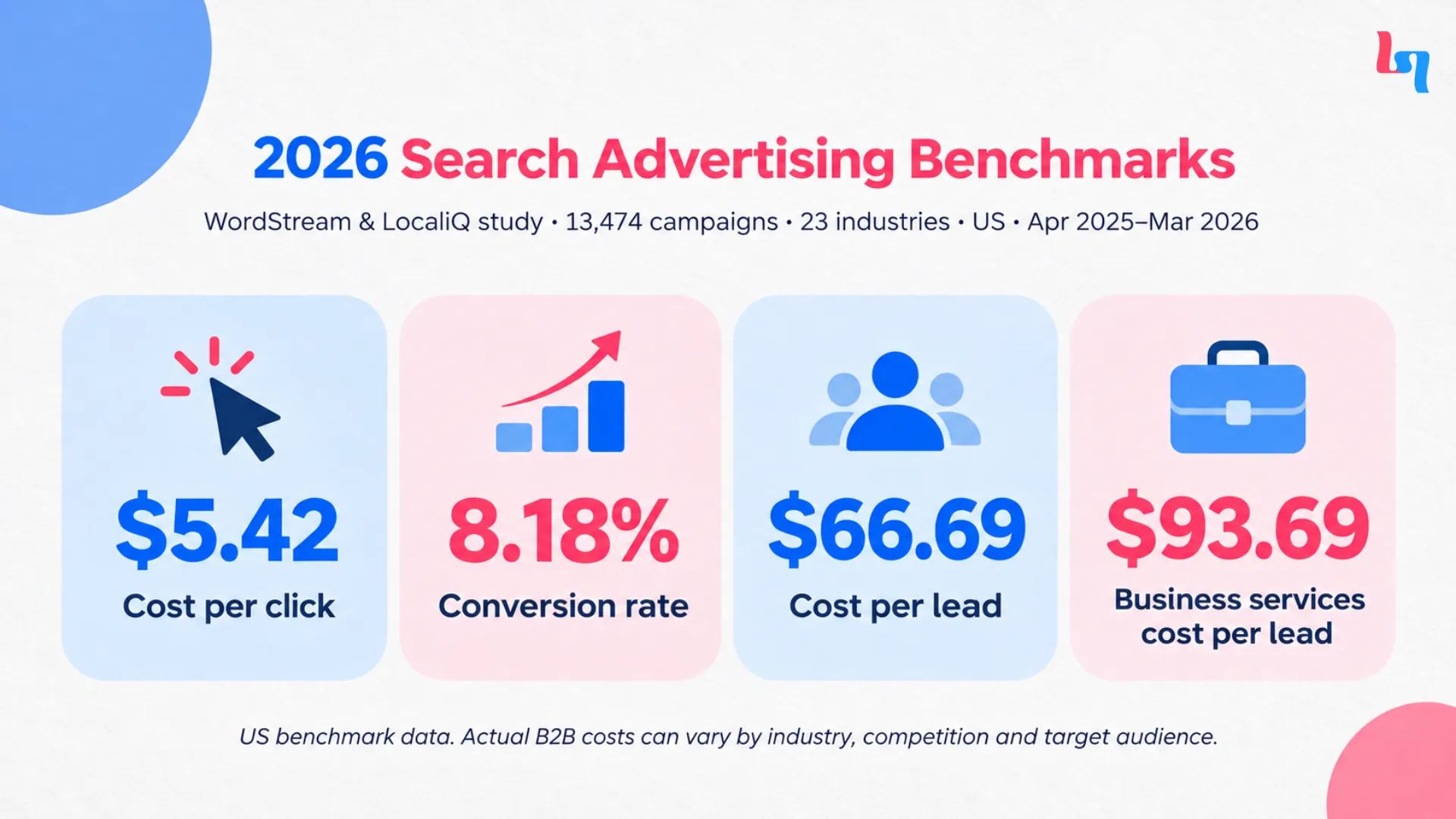
However, WordStream and LocaliQ have conducted research into the current benchmarks of search advertising in 2026.
They looked at 13,474 Google and Microsoft search advertising campaigns in 23 different industries based in the United States between April 2025 and March 2026.
This report found that on average:
· Cost per click: $5.42
· Conversion rate: 8.18%
· Cost per lead: $66.69
· Business Services Cost per lead: $93.69
Note that while these are averages, they were calculated using median values to avoid outliers.
The research was specific to the United States and therefore not a prediction for B2B companies in India.
If you are a niche consultancy firm, your costs could be completely different.
The other thing to consider is that conversions in Google Ads do not necessarily mean sales qualified leads.
People may complete the form but may not have the budget, authority or immediate need to purchase.
This can give you a false impression of a low cost per lead.
SEO will also incur costs. However, there is no general cost per organic click.
I would look at how much you are investing overall and the quality of leads you are getting.
How Should You Calculate the Actual Cost Per Qualified Lead?
Let’s return to our hypothetical IT services company.
Suppose its Google Ads campaign produces these results:
| Campaign metric | Result |
|---|---|
| Advertising spends | ₹1,20,000 |
| Website Clicks | 600 |
| Enquiries | 24 |
| Sales-qualified leads | 6 |
| Additional campaign management cost | ₹30,000 |
Ad spend: ₹5,000 per enquiry.
Plus, campaign management: Total cost ₹1,50,000.
Only 6 meet sales criteria.
Total cost per lead: ₹25,000.
If one of those leads become a customer, then the cost of marketing to acquire them is ₹1,50,000 (excluding sales).
These are just example numbers.
Is this a reasonable cost?
If they have high gross profits on this new customer, then yes.
But if it is a low value service, it may be hard to justify.
For SEO, I would use the same calculation. The cost of creating the content, technical work and managing it would all be included. Over a decent time period.
I would not be comparing one month of ad spend vs 6 months of SEO and declaring a winner.
The goal is to understand how much we are spending to get the right customer and if they are worth it.
When Should B2B Businesses Choose SEO, Google Ads, or Both?
When would it be best to use SEO?
SEO would be best used if there is time in the business to improve your organic visibility and your customers regularly look up information.
For example, if you offer engineering services, having technical blogs, in-depth service pages and case studies can all be useful.
This can answer many of your customers questions throughout their lengthy buying process.
Also, if your website does not have any useful information, or has technical issues.
When would it be best to use Google Ads?
Google Ads may be a better choice if you want to test demand for a new service, or want to target those searching for your service.
Let’s say you offer cybersecurity services and you have a new specialised assessment service.
If people are searching for this service, using paid search can help you test out these search terms.
You can start with a niche campaign and look at the quality of the leads you are getting before increasing your spend.
When would it be best to use both?
You may not want to see SEO and Google Ads as mutually exclusive.
By using paid search, you can see what commercial search terms are bringing in the right prospects.
This can then help with your SEO content.
Similarly, you can see what topics are worth trying with paid search from your organic search data.
Google do confirm that your organic search will not improve from using paid search (Paid and Organic Search).
This means that by using both you will have better coverage on search. You are not paying to improve your organic ranking.
How can you measure ROI from SEO and Google Ads?
Your marketing report may show that your organic traffic is increasing and spend on advertising is decreasing.
But is this actually driving revenue?
You can connect search marketing to sales.
For example, Google Search Console can provide information on your search queries, impressions and clicks.
Google Ads will also provide information on how much you are spending on ads and conversions.
Using Google Analytics 4 can help provide more insights on how people are interacting with your site. Your CRM will also show you how many of your enquiries are converting into qualified leads and customers.
Look at cost per qualified lead, sales opportunities, customer acquisition and revenue.
If you are investing in B2B content marketing, look at which articles are helping your buyers understand their problems and solutions.
They may have come to your business through the organic article, but have come back via another channel to request a proposal.
Although it won’t be perfect, connecting your marketing and sales will help you get more meaningful insights to inform your decisions on where to invest.
Practical 90 Day Plan For SEO and Google Ads
If I was looking to use SEO and Google Ads for your B2B business, I would do the following:
Day 1-30: Research
Identify your ideal customers, most valuable services and common questions people have.
Audit your website, service pages, SEO and conversion tracking.
Ensure you’re providing a reason for people to get in touch before spending money on driving traffic.
Day 31-60: Optimize & Test
Optimize your pages for relevant SEO, and create content around common questions.
If you have the budget, create a targeted Google Ads campaign, around relevant searches.
This will help you understand what queries are bringing in the right type of leads.
Day 61-90: Analyse
Compare your visibility in search, quality of leads, cost of campaigns and early sales.
Ask your sales team what type of leads they would want to focus on.
Optimize your keywords, improve poor landing pages, and decide what you should invest more in.
Whilst 90 days may not be enough to prove a long-term ROI from SEO (especially if you have a long sales cycle), it will give you a better foundation to make your next investment decision.
Frequently Asked Questions About SEO vs Google Ads
1. Is SEO better than Google Ads?
Not always. SEO is useful for building organic visibility over time, while Google Ads can bring visitors sooner. I’d choose based on your budget, goals and how quickly you need leads.
2. Is SEO free or paid?
SEO doesn’t charge you for organic clicks, but you still pay for content, technical improvements and optimisation. So, it isn’t completely free.
3. Does Google Ads improve SEO rankings?
No. Paying for Google Ads doesn’t improve organic rankings. However, advertising data can help you understand which keywords attract relevant visitors.
4. Which gives faster results, SEO or Google Ads?
Google Ads can generate traffic sooner because you don’t have to wait for organic rankings. SEO generally takes longer, but neither guarantees immediate sales.
5. Which is cheaper for B2B businesses?
It depends on your market and results. I would compare the cost of generating qualified leads and customers rather than just looking at advertising spend or website traffic.
6. Can I run Google Ads without SEO?
Yes. You don’t need organic rankings to advertise. However, your landing pages still need to explain your services clearly and encourage visitors to enquire.
7. Why am I getting Google Ads clicks but no leads?
Your targeting may be too broad, or your landing page may not answer visitors’ questions. I’d review search terms, the offer and the page before increasing your budget.
8. Can SEO and Google Ads work together?
Yes. Google Ads can help test which searches produce relevant enquiries, while SEO can build organic visibility around useful topics over time.