
You Founder Gets Thousands of Impressions but No Customers!
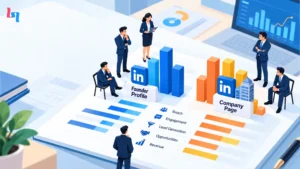
Founder post on LinkedIn gets 20,000 impressions but customer story on Company Page only gets 2,000.
During Marketing review, Founder post gets all the attention. Upon looking at the Lead generation for Sales, three potential customers looked at services on the Company Page, whereas the Founder post was mostly generating conversations with Industry.
This is an example but it captures a problem I have noticed in B2B marketing. I often see people celebrate numbers without checking what those interactions actually produce.
Edelman’s B2B Thought Leadership Report, based on research involving nearly 3,500 professionals, explores how expert content influences purchasing decisions.
The real value for businesses investing on LinkedIn comes after engaging with a post. To know who is interested in your company and what leads them to sales.
Founder Profile vs Company Page: Why Buyers Visit Them for Different Reasons
The Founder of the software development company often writes about engineering decisions, product errors and learnings from enterprise projects on LinkedIn. As a result, readers become familiar with the Founder’s knowledge and approach.
While the recognition may make a tech leader want to look into this company, you’ll need to know a bit more about the development team, services, tech skills and past work before entering into any contracts.
Having a personal profile will give an insight into who runs the business. Whereas having a company page will show visitors what they can offer.
I like to have different roles for each account.
| Area | Founder Profile | Company Page |
|---|---|---|
| Primary purpose | Demonstrate expertise | Explain business capabilities |
| Content | Experiences and professional opinions | Services, products and customer evidence |
| Communication | Direct professional conversations | Official company information |
| Buyer interest | Who is behind the business? | Can this company meet our requirements? |
| Main limitation | Relies on individual participation | May attract less personal interaction |
This distinction should guide a company’s LinkedIn marketing strategy.
A technical founder will attract engineers and tech leaders, whilst a case study library may attract decision makers.
This can help marketers identify what metrics they should look out for. From the founder account, you can check how relevant the conversation and professional network is.
From the company page, you can check how good the questions are, website traffic and customer interest.
Although these accounts don’t necessarily have answers to all of these questions, buyers will have different questions at different stages in their journey and both accounts can provide answers to those.
Why a Founder’s Experience Can Attract More Attention Than a Brand Announcement

This is very familiar to most professionals.
You’ve got a SaaS business that provides a cost management tool for cloud using businesses.
Instead of discussing the new feature your Founder explains why you see increased costs when you scale your engineering teams in the cloud, what architectural decisions lead to higher costs and how to find out.
Both posts are on the same topic but the founder gives some useful information to those who may not ever become customers.
I think this is where personal knowledge can come into play with B2B marketing. The reader gets to understand the reasoning behind decisions.
Metricool’s 2026 LinkedIn Study found that personal profiles achieved a 63% higher average engagement rate than company pages, although company content was shared more often.
The numbers will suggest that different engagement will happen on each account.
Of course, it will need to be the correct people.
A post from a founder talking about startup funding may receive more engagement from investors and entrepreneurs. An article on how to implement an enterprise software solution may not receive as much engagement but will target potential customers.
I would look at the organisations that are represented in the audience and what questions they are asking.
A conversation with a relevant technology leader may offer more commercial value than hundreds of reactions from professionals outside the target market.
Buyers May Trust the Founder Without Being Ready to Trust the Company
A founder has written a detailed blog on how organisations can avoid unauthorised access of sensitive systems.
This is helpful for the CTO to start doing their research. Whilst the founder does come across as knowledgeable and knowledgeable, there are more things to consider when purchasing software.
The Security team will need to look at the architecture and access. The Legal team will review data protection and Procurement will review the terms.
Research summarized in The Starr Conspiracy’s B2B buying committee benchmarks explores how different stakeholders participate in business purchases.
If you are selling a complex product, you can make it easier for people to find resources to help them. Customer stories, product guides and implementation details can help people answer questions.
There often seems to be an assumption in marketing that trust comes down to the individual. A buyer may respect the knowledge of the founder but may be unsure how the organisation can deliver.
A convincing founder won’t make up for lack of customer evidence, vague product information and unanswered questions.
You need to show you can back up what you’re committing to.
This becomes especially important when the person who first discovers the business isn’t the person authorized to approve the purchase.
A Customer May Discover You Today and Contact Sales Months Later

An HR director is looking into recruitment costs and reads a founder’s post about how bad screening can cause good candidates to be rejected.
This helped me understand the issue but we weren’t going to invest in recruitment software.
A few weeks later we were having issues with our recruitment timescales. I remembered the conversation and looked at the business’ case studies.
I shared this information with my team and set up a demo.In this journey the final inquiry comes through the website. Without information the marketing team may never connect it to the founder’s original post.
The 95-5 Rule from the LinkedIn B2B Institute suggests that approximately 95% of potential buyers in a category aren’t actively purchasing at a particular moment.
Whilst this is an overarching marketing concept, it’s useful in understanding why a conversion may not happen straight away.
Founders will often post about an issue worth looking into. This can then be followed up with research from the company, information about their product, and feedback from customers so that the buyer can look into different solutions.
I’ll look to understand how the prospect found out about your business. What did they research? And what prompted them to reach out to sales?
This becomes particularly useful if you have a longer sales cycle.
Someone reading your article may not have the budget or permission to make a purchase for months. However, using content can help build recognition.
More LinkedIn Impressions Don’t Always Mean More Sales
A B2B software company looks at its LinkedIn stats monthly and notices that the founder’s LinkedIn profile has more impressions than their company page.
They’re considering putting more into personal branding but looking at sales data it may be worth looking at the company page too.
If every month it looked like this:
| Performance Metric | Founder Profile | Company Page |
|---|---|---|
| LinkedIn impressions | 20,000 | 6,000 |
| Relevant inquiries | 24 | 14 |
| Qualified opportunities | 6 | 7 |
| Closed deals | 2 | 3 |
| Average deal value | ₹4 lakh | ₹4 lakh |
| Revenue from closed deals | ₹8 lakh | ₹12 lakh |
The founder reaches more than three times as many people, yet the company page is associated with more closed business.
Six of the founder’s 24 inquiries became qualified opportunities, producing a 25% conversion rate. The company page converted seven of its 14 inquiries, giving it a 50% rate.
That difference deserves investigation before changing the marketing budget.
The founder’s audience may include professionals who enjoy the content but aren’t responsible for purchasing decisions. Company-page visitors may have already researched the software and arrived with specific requirements.
Content topics and sales follow-up could also influence these outcomes.
I would examine the questions prospective customers raised, their purchasing responsibilities and the time required to convert an inquiry into a sales opportunity.
Hootsuite’s social media analytics guide explains how performance can be evaluated using different measurements rather than relying entirely on engagement.
For a B2B company, that means separating popularity from commercial value.
The numerical comparison also has a limitation. A customer attributed to the company page may have discovered the business through the founder weeks earlier.
That’s why the next step is understanding which interactions contributed to the sale rather than declaring one account the winner based on a single report.
How to Connect LinkedIn Activity With Actual Sales Revenue

A potential customer reads a founder’s post about software implementation costs. A week later they search for the company, visit their website and ask for a demo.
This gets logged into the analytics report, but no mention of the previous interaction on LinkedIn.
Companies often have to make decisions based on limited data which means that some great content will seem like it isn’t working.
Start by isolating the links that are being shared via founders profiles and company page.
Google Analytics’ campaign URL documentation explains how UTM parameters identify the sources and campaigns that bring visitors to a website.
The company page could use company content as its campaign value.
This enables marketers to see which sources are driving traffic.
Next it is important to link inquiring leads on your website to CRM data. This will ensure that you have an insight into where each ‘quality’ lead came from, when they inquired, what their business requirements were and the status of their opportunity.
Ask a simple question during the Sales Discovery process. How did they initially hear about your company?
Some customers may mention that they saw a post from a Founder, or heard about it through discussion in their industry or that someone recommended it to them. This won’t be tracked through your website.
When this is combined with your CRM data you can identify if this was a lead directly from the source or an opportunity influenced by previous content.
This also stops marketers trying to claim full credit for the same sale through multiple channels.
A reputable report should show what you know, what has been reported and what you can’t be sure of.
Posting the Same Content Twice Doesn’t Give Buyers Twice the Value
A company releases a post about new software they have developed for financial reporting. The founder is asked to republish the exact same post.
This will target two audiences however the message will be the same.
It would be more beneficial to have different topics relating to the same problem your customer may have. For example the founder could talk about the problems faced when trying to produce month end reports due to having several unconnected spreadsheets in the finance department.
They can talk about how reconciliation mistakes can occur due to confusion of roles and decisions that can be made to avoid delays.
The company then can show how their software can help with this by providing a single place to store all financial data and reduce manual tasks.
Those looking to understand the problem will find the founder’s post helpful whilst others wanting to look into solutions can look into the product.
I would structure the content to do this.
| Content Theme | Founder Profile | Company Page |
|---|---|---|
| Industry developments | Explain business implications | Publish relevant research |
| Customer problems | Share firsthand observations | Explain possible solutions |
| Product improvements | Discuss decisions behind them | Demonstrate functionality |
| Customer success | Explain lessons learned | Present documented results |
| Technical topics | Discuss implementation decisions | Provide detailed resources |
| Company announcements | Add leadership perspective | Communicate official information |
This approach requires more planning than reposting announcements, but it also creates more useful material.
Sales conversations are a good place to find topics.
If customers repeatedly ask how long an implementation takes, a founder can explain the decisions affecting delivery schedules. The company can publish an implementation guide showing its actual process.
A well-planned social media content strategy should connect these topics to the information customers need at different stages of their research.
Each piece can stand on its own while helping interested readers explore the subject further.
A 90-Day Experiment to See Which LinkedIn Account Brings Better Leads
When a company isn’t sure whether to invest more in founder content or its company page, I would begin with a 90-day experiment.
The objective is to understand which activities attract relevant professionals, create sales conversations and justify the effort required.
Days 1–30: Establish Your Starting Point
Begin by identifying the companies and job roles most likely to purchase your services.
A cybersecurity provider, for example, might focus on technology executives, security leaders and compliance professionals at mid-sized enterprises.
Review three months of historical performance to establish how both accounts currently perform.
Alongside impressions and engagement, examine website inquiries, relevant conversations and qualified sales opportunities.
Choose three subjects that reflect genuine customer concerns, such as access permissions, software vulnerabilities and regulatory requirements.
Days 31–60: Test Different Content Approaches
Publish three founder posts and two company-page posts each week as an initial experiment.
Keep the broader subjects comparable while giving each account a distinct presentation.
The founder might discuss decisions made during a security implementation. The company could explain the technical controls involved and publish supporting documentation.
Track responses, especially questions from people working at organizations that match your ideal customer profile.
Socialinsider’s 2026 LinkedIn Benchmarks can help you compare posting frequency and engagement with broader platform performance. Sales results, however, should determine what you continue publishing.
Days 61–90: Examine the Sales Results
Compare the inquiries generated through both accounts, the number becoming qualified opportunities and the work involved in maintaining each publishing schedule.
Review whether the content attracted relevant buyers and whether those conversations developed into serious product evaluations.
For businesses with lengthy sales cycles, 90 days may not produce enough completed deals for a reliable revenue comparison.
Use the early evidence to improve the next publishing cycle, while continuing to track opportunities until their outcomes are known.
Should a Startup and an Enterprise Company Follow the Same LinkedIn Strategy?
A consultant selling business advisory services often wins clients because of their personal experience and judgment.
Prospective customers want to understand how the consultant thinks, what problems they’ve solved and whether they would be comfortable working together.
For this type of business, the founder’s personal profile can play an important role in customer acquisition.
An enterprise software company operates differently.
Its customers may involve procurement teams, IT departments and finance leaders before approving a purchase. They need documentation, customer references and confidence that the organization can support a long-term contract.
The company’s LinkedIn presence must reflect those requirements.
I would allocate marketing resources according to how the business sells.
| Business Situation | Suggested Priority |
|---|---|
| Independent B2B consultant | Founder expertise and professional relationships |
| Early-stage SaaS business | Founder visibility supported by company evidence |
| Growing technology company | Founder, leadership and company content |
| Enterprise software provider | Product credibility and specialist expertise |
| Established B2B organization | Multiple professional voices and company-led campaigns |
There’s also the question of how a founder-led approach works as the organization grows.
If every useful industry discussion depends on the founder, the company’s visibility can become tied to one person’s availability.
Developing additional professional voices can reduce that dependence.
An engineering leader might explain technical decisions, while a customer success specialist shares lessons from implementation work.
Sprout Social’s employee advocacy resources discuss how organizations can involve employees in communicating professional expertise.
This gives potential customers access to specialists who understand different aspects of the business.
It also allows founders to concentrate on subjects where their experience offers the most value.
Dreamdata Used Employee Expertise to Influence Closed-Won Deals
B2B attribution company Dreamdata provides an example of how personal expertise can support company marketing.
Instead of depending entirely on corporate posts, Dreamdata encouraged employees to share professional insights through LinkedIn videos and promoted selected posts with Thought Leader Ads.
According to LinkedIn’s Dreamdata case study, the employee advocacy activity generated more than 300,000 impressions in one quarter.
Advertisements featuring employees recorded engagement rates three to four times higher than brand-led advertisements.
Dreamdata also reported that 83% of closed-won deals were influenced by Thought Leader Ads.
This represents reported advertising influence rather than proof that the advertisements independently caused those purchases.
What makes the example useful is the connection between knowledgeable employees, targeted distribution and sales reporting.
Rather than simply repeating company announcements, employees contributed expertise that could interest potential customers.
Although the case involved employee advocacy rather than a direct comparison of founder and company-page performance, it illustrates how individual voices can support broader business marketing.
Sometimes Your Customers Can Explain Your Value Better Than You Can

Australian legal technology company Smokeball wanted prospective customers to understand how its software performed in real working environments.
Instead of relying entirely on product advertisements, the company worked with representatives from Empire Legal to share video testimonials about their experience using the software.
Those posts were promoted through LinkedIn Thought Leader Ads.
According to LinkedIn’s Smokeball customer advocacy case study, the campaign achieved twice the video view rate and 8.7 times the completion rate compared with an earlier video campaign using the same footage.
Cost per view decreased by 50%, while return on advertising spend increased by 186%.
These results belong to that particular campaign and shouldn’t be treated as typical performance.
What interests me about this example is the role customers played in explaining the product.
A founder can describe why software was developed, and a company can demonstrate how it works. Customers can discuss what happened after implementation.
Their experiences may help other buyers evaluate whether the solution suits their requirements.
For B2B businesses, credible customer evidence can therefore be useful across both personal and company content.
Conclusion: Which LinkedIn Account Deserves More Investment?
A founder can introduce potential customers to a business, while the company page helps them evaluate its capabilities.
Neither should be judged by impressions alone.
At Banter Marketo, we believe marketing investment should be connected to qualified inquiries, sales opportunities and revenue.
The decision becomes clearer when businesses understand which content attracts relevant buyers and what helps those buyers move toward a purchase.
Frequently Asked Questions
Is a founder profile better for B2B leads?
It can attract relevant professionals and initiate conversations, but results depend on buyer quality.
Can company pages generate customers?
Yes. They support product research, customer validation and lead generation.
Should both accounts publish identical content?
Use complementary perspectives instead of repeating posts.
How can businesses measure LinkedIn revenue?
Combine UTM tracking, CRM records, customer feedback and sales reporting.
Which account should startups prioritize?
Founder expertise can lead early marketing efforts, supported by credible company information.