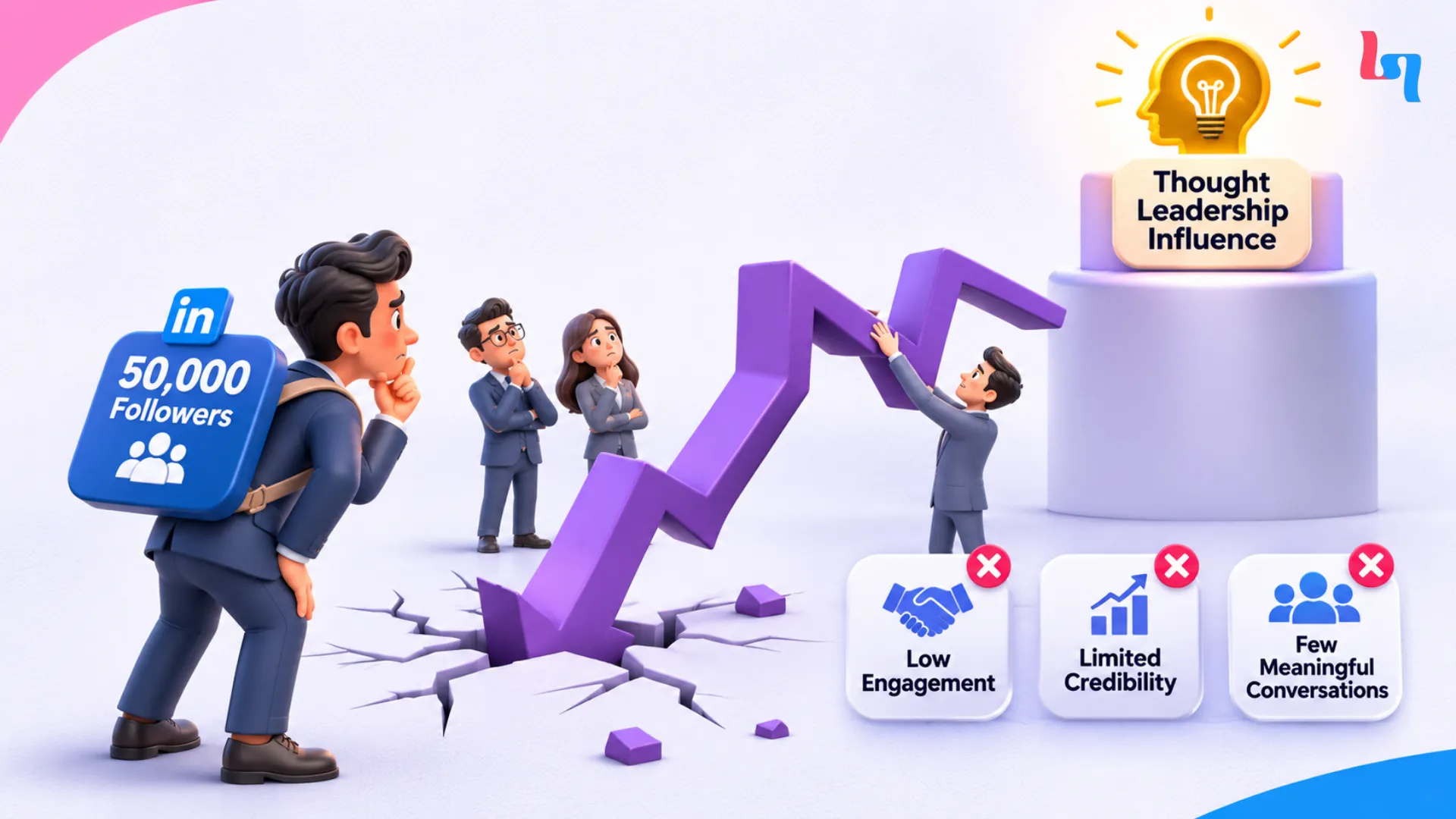
Your CEO has 50,000 LinkedIn followers. Every post gets hundreds of reactions, the audience keeps growing, and the marketing reports look impressive.
Then a potential client says something unexpected during a meeting.
“I’ve seen your CEO’s posts. What are they known for?”
Suddenly the number of followers isn’t so impressive.
I often wonder how many executives could confidently answer that question. Thousands of people may read their posts, but how many could recall a specific insight that reflects their industry expertise?
Remove the name and photograph from your CEO’s last 10 posts. Would you still recognise their perspective, or could those posts have been written by almost any business leader?
Having a following on LinkedIn is one thing. Becoming known within your industry as an expert is another.
A solid thought leadership strategy from your CEO will bridge this gap by understanding what your 50,000 followers really mean.
Why 50,000 Followers Don’t Necessarily Make a CEO Influential

Consider a typical marketing review.
A CEO shares a photograph from an industry conference. The post gets 2,000 likes, plenty of congratulations, and a few new followers. Everyone’s pleased.
The following week, the CEO discusses why rising cybersecurity budgets aren’t always translating into lower business risk. That post receives just 35 likes
If your team are looking for engagement then the conference photo will win.
But five of those reactions could come from CIOs at companies the business wants to reach.
I would want to know more about the second post. What did those executives find interesting?
Did they share their own experiences? Did anyone continue the conversation?
The photograph helped people notice the CEO. The cybersecurity discussion gave a few relevant professionals a reason to consider what they had to say.
Both have a place, but they’re not doing the same job.
Being Recognized Isn’t the Same as Being Trusted
Think about the executives you follow on LinkedIn.
Even though you may know them and like reading their opinions, how many would you actually seek out advice from?
That’s where the difference between visibility and credibility becomes important.
A cybersecurity CEO announcing an award may attract attention from the industry. But explaining how to prioritise security investments when budgets are tight gives IT leaders something they can use in their own decisions.
The second gives readers something they can use.
According to LinkedIn’s thought leadership research, 71% of surveyed decision-makers say fewer than half of the thought leadership they consume provides valuable insights.
That’s a worrying figure for anyone investing time and money in executive content. If readers are already seeing plenty of opinions that don’t help them, publishing more of the same is unlikely to change much.
A Growing Audience Can Hide an Important Problem
Suppose the CEO gains another 8,000 followers in 3 months. The marketing report shows strong growth, but I’d want to look a little closer before celebrating.
Who joined the audience?
If the majority of your new followers are job seekers, workers, students or other content creators then it could be helping you with hiring and networking. This is a positive outcome.
But if the company wants to sell enterprise software, the team also needs to know whether more CIOs, CFOs, and operations leaders are discovering the CEO.
Who are these people? What companies do they work at? Has anyone mentioned this post in meetings with customers?
This won’t produce a single measure of success, but it can reveal whether the audience is becoming more relevant to the business.
Are the People You Want to Reach Actually Reading?

Consider the CEO of an enterprise automation company.
Their leadership stories attract comments, career advice performs well, and company milestones receive plenty of congratulations.
The business is struggling to get to CFOs and operations directors who are facing increasing costs, manual processes and slow implementations.
Those buyers aren’t necessarily looking for another motivational post. They’re trying to understand how to make their operations work better.
A CEO can publish enjoyable content and still have little connection with the problems their potential customers are facing.
Why I’d Read the Comments on a Post With 40 Likes
Let’s say the CEO publishes two articles.
The first shares leadership advice and receives 500 reactions. The second explains why automation projects sometimes fail to produce the savings promised at the beginning. It attracts just 40.
But among those 40 are operations directors talking about problems they’ve experienced in their own companies.
If I were managing this account I would be interested to hear what they’re talking about.
Are they seeking clarification? Are they giving examples that the CEO would understand? Is there an opportunity to dig deeper into the issue?
I wouldn’t start treating everyone who comments as a sales lead. That would miss the point.
I’d use the discussion to understand whether the executive’s ideas are reaching people who deal with the problems the business solves.
That’s one reason a thoughtful LinkedIn marketing strategy needs to consider the people behind the engagement figures.
Sometimes the Most Important Readers Stay Quiet

In B2B sales, the person who first shows interest isn’t always the person who approves the purchase.
An operations director might be excited about new software, but the proposal still has to make sense to finance, IT, and procurement.
Finance will examine the potential savings, IT will evaluate integration risks, and procurement will review the contractual terms.
Even if everyone agrees there is a problem, they may not agree on how to fix it.
The 2025 Edelman–LinkedIn B2B Thought Leadership Impact Report examines the role of hidden buyers in purchasing decisions. It also cites earlier research suggesting that more than 40% of B2B deals stall because buying groups struggle to reach internal agreement.
Those stakeholders might never comment on a CEO’s LinkedIn post. Some may not even follow the executive.
But if the content addresses the financial, operational, and technical concerns involved in their decisions, it may still be useful when they encounter it.
What Would Someone Say Your CEO Is Known For?
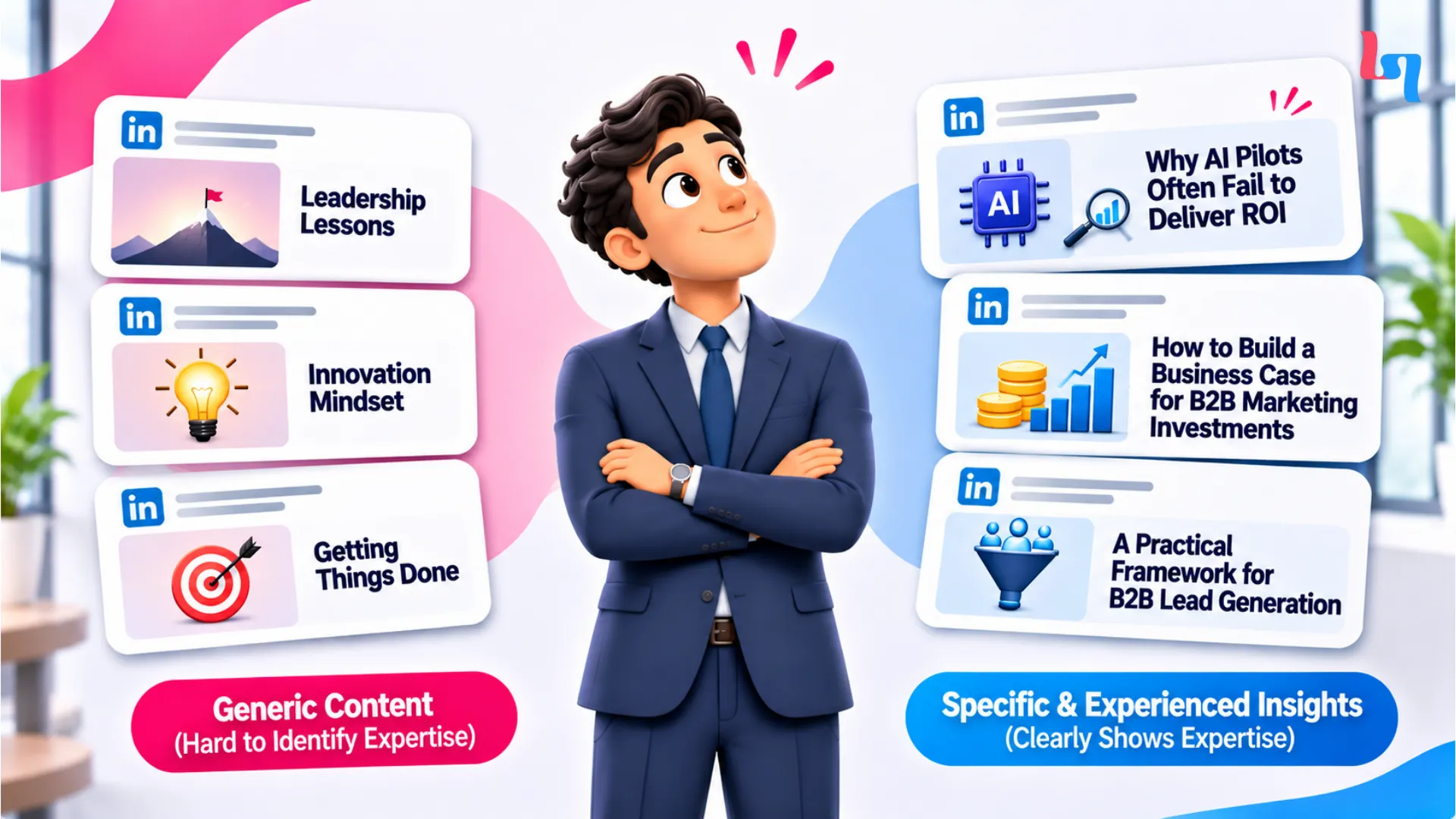
Ask your colleague to tell you about an executive that they follow on LinkedIn. They will likely say something like:
“They’re really inspiring.”
“They share some great tips for being a good leader.”
Whilst these are not necessarily bad answers, they do not give any insight into how much the executive knows.
Now compare those responses with: “That’s the CEO who explains why companies struggle to move AI projects beyond the pilot stage.
In the second example, the person’s name is connected to a specific industry problem. That’s the kind of association I’d want executive content to build.
Try Removing the CEO’s Name From Their Posts
Here’s something worth trying before planning another month of content.
Pick 5 recent LinkedIn posts from the executive, remove their name and a photo, then show these to an expert in this industry.
Ask them what this writer seems to know a lot about.
If they struggle to identify a clear area of expertise, examine what the posts actually communicate.
In this case the CEO may have written about leadership, innovation and success and personal development but not given too much information on decisions made or challenges overcome.
The exercise won’t measure how widely recognised the CEO is, but it will reveal whether their content communicates a distinctive area of expertise.
Why So Much Executive Content Sounds Familiar
Imagine two CEOs writing about AI.
The first explains that artificial intelligence will transform business and companies must adapt.
The second discusses why an AI project can perform brilliantly during a demonstration and still fail to improve profitability.
They explore who approved the project, how the expected savings were calculated, and what happened when nobody took responsibility for delivering them.
I’d be more interested in reading the second article.
Not because the first CEO is wrong, but because the second has given me something specific to think about.
LinkedIn’s research found that 77% of surveyed decision-makers preferred subject-matter experts discussing specialized topics over senior executives speaking broadly about business. The same research found that 81% wanted ideas that challenged their assumptions.
A CEO doesn’t need to manufacture a controversial opinion. They already have years of experience making decisions that other professionals may find useful.
The challenge is bringing that experience into the content.
How I’d Build a CEO Thought Leadership Strategy
When developing a CEO’s LinkedIn strategy, posting frequency isn’t my first concern.
But rather I would like to understand what issues they struggle to answer, what decisions they have reversed and what improvements they see in their industry.
This is usually far more interesting to discuss than just asking them to provide 5 lessons.
Start With Problems the CEO Knows Well
A logistics CEO may understand very well why providing cheaper options can increase overall costs in the supply chain.
A fintech founder will understand just how challenging it can be to scale your payment infrastructure in new markets whilst adhering to local compliance.
Both of these can provide value to other business leaders.
What issues do you regularly encounter in client meetings? What are common misconceptions around this?
That gives us material connected to the executive’s work rather than whatever happens to be popular on LinkedIn that week.
Decide What People Should Associate With the CEO
A technology executive could write about AI, cybersecurity, cloud computing, hiring, and digital transformation.
But perhaps their deepest expertise is helping organizations understand cloud spending.
In that case, I’d rather see them explaining why companies underestimate the ongoing costs of cloud migration than publishing another broad opinion about digital transformation.
A simple positioning statement helps keep that focus:
I help [audience] understand [business problem] through [specific experience].
For a CEO of cloud tech, this could be helping CIOs understand the financial and operational implications of modernising.
This is not intended to be a motto for your business, but just a reminder for your team of what you want to be known for.
Explain What Happened, Not Just What You Believe
Your CEO may have an opinion that companies should take their time when embracing new technologies.
While this is a fair opinion, it is quite a general one.
Consider a CEO explaining why they delayed a technology implementation after discovering that the projected savings hadn’t accounted for employee training costs.
This gives the reader some background information.
If they cannot share any customer details, using anonymised examples or clearly defined hypothetical examples can also help explain the principle.
Research has a place too. According to the 2021 Edelman–LinkedIn B2B Thought Leadership Impact Study, 80% of surveyed decision-makers preferred thought leadership that included third-party data from trusted sources rather than relying solely on proprietary company insights.
But I’d be careful not to let the statistics take over the article. Readers should still be able to hear the executive’s thinking.
You Can Return to a Subject Without Repeating Yourself
Suppose a CEO writes about cloud cost management.
One week, they discuss why unused infrastructure quietly increases spending. Another week, they explain the effect of long-term vendor contracts. Later, they examine why choosing the cheapest provider can create additional expenses.
The articles are connected, but each adds something different.
I’d choose 3 themes based on the CEO’s experience and explore them through customer questions, decisions, industry developments, and lessons from past projects.
Over time, that can help people associate the executive with a particular area of knowledge.
Pay Attention to What Readers Remember
After a few months, I’d speak with a small group of customers and industry contacts who have encountered the content.
I’d ask what they remember reading and whether any idea helped them look at a business problem differently.
It’s possible that a post with thousands of likes barely comes up, while a technical article continues appearing in customer conversations.
That’s useful feedback. I’d rather use it to plan the next few articles than automatically repeat whatever received the most reactions.
What Should a CEO Actually Write About?
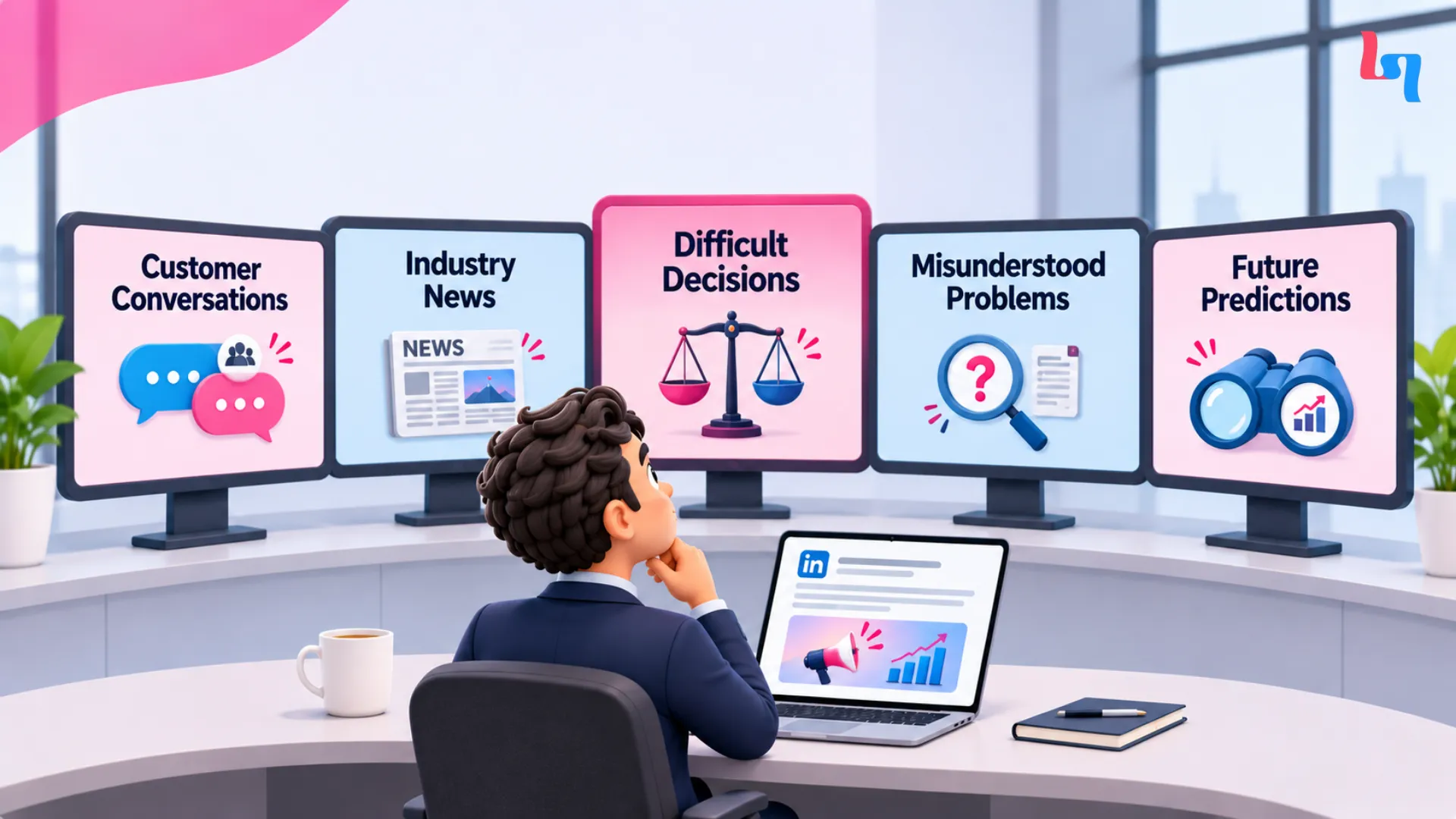
Some of the strongest content ideas emerge from everyday business conversations.
Imagine a customer asking a CEO to recommend another software platform.
After discussing the problem, it becomes clear that the company already has capable systems. The issue is that nobody agrees on who owns the data moving between departments.
There’s a useful article in that conversation.
The CEO could explain the reasons why investing in further technology isn’t always the answer and what businesses should look at.
Turn Industry News Into Something Useful
When new technologies are released there tends to be a lot of articles about the features.
What they may need is someone who can explain what it means for their organization.
A manufacturing CEO could discuss how automation changes maintenance schedules, workforce training, and production planning.
The news starts the conversation, but the executive’s experience helps readers understand the decisions ahead.
Talk About Decisions That Were Difficult
Maybe the CEO decided against doing anything major because your team couldn’t commit to delivering it.
Perhaps you also decided against hiring new people despite increased customer demand.
It’s good to explore why this decision would be made. I’d be interested to know what other options were explored and what affected their decision.
That tells readers more about the executive’s judgment than another article listing the qualities of a good leader.
Write About Problems Customers Misunderstand
A CEO with experience of this can explain why several customers feel that hiring more staff will help them.
They may discuss how having vague processes creates extra work when you have more people on your team and what needs to change before employing new staff.
Readers facing similar issues can consider whether the explanation applies to them.
Make Predictions Without Exaggerating
The CEO could explain why another software purchase won’t resolve a problem rooted in unclear data ownership.
They can talk about the tasks that are simpler to automate and the areas you need a human touch for. As well as what areas your organisation should look at when re-designing a process.
This is a more realistic approach to the topic and provides some useful insight.
| Familiar topic | A more specific CEO perspective |
|---|---|
| Five leadership lessons | Why I delayed hiring despite increasing customer demand |
| AI is transforming business | Why an AI pilot can succeed without improving profitability |
| Customer satisfaction matters | What repeated customer complaints revealed about onboarding |
Sometimes the best way to share these ideas on LinkedIn isn’t for your CEO to draft them. Often it will start with good questions that lead to some valuable content.
That’s an important part of creating social media content that still sounds like the person whose name appears on the post.
Can Thought Leadership Help When Someone Is Ready to Buy?
Imagine a CFO trying to understand why cloud costs keep rising.
Over several months, the CFO reads articles by a technology CEO covering cloud budgeting mistakes, infrastructure costs, and the financial risks of switching providers.
The CFO may not need outside help immediately. But the articles could be useful while they work through the problem.
Later, when the company begins exploring external support, that executive’s name may already be familiar.
It’s an illustrative scenario, not a guarantee that articles will generate sales. Still, it shows why content can have value beyond the week it was published.
Most Buyers Aren’t Looking for a Supplier Today
The LinkedIn B2B Institute’s 95-5 rule suggests that around 95% of potential B2B buyers aren’t actively purchasing at a particular moment.
This isn’t an exact science.
Some companies can be stuck with using the same software vendor or professional services company for many years.
They will have read articles and discussed changes within the industry, which would allow them to form opinions.
If the CEO constantly talks about the issues they are facing, then they may well be known before any buying project starts.
One Purchase Can Involve Several Priorities
Think about a company considering new enterprise software.
The CIO wants to know if it integrates well and is secure. The CFO will want to know what the financial benefits are. The COO will worry about disruption.
All of these concerns could be valid.
But if the CEO understands these then they can talk about the compromise involved rather than just the features of the product.
Buyers Want to Understand the Company Behind the Product
The 2024 Edelman–LinkedIn Thought Leadership Impact Report, based on nearly 3,500 management-level professionals across 7 countries, found that 73% of decision-makers considered thought leadership a more trustworthy basis for assessing an organization’s capabilities than conventional marketing materials and product sheets.
Whilst an article will not replace a product demo, technical evaluation or price discussion.
It can offer insight into how the company’s leadership deal with the challenges that you are looking to overcome.
How Would I Measure Whether a CEO’s Content Is Working?
After six months, follower growth, impressions, and engagement should be easy to review. But those figures only tell part of the story.
I would also like to know what has happened outside of LinkedIn.
Did anyone mention an article during a sales call? Have people from relevant companies begun participating in discussions? Do customers associate the CEO with the expertise we’ve been trying to communicate?
These aren’t always easy things to measure, but they’re worth investigating.
Look at Who’s Participating
When a post attracts comments, I’d read them before looking at the total.
Are people discussing the issue? Do they work in industries the company serves? Are they asking questions which indicate they have encountered similar issues?
Not everyone will interact with your article and LinkedIn analytics will not give you insight into every person who is relevant to your article.
Talking to sales teams and customers can help give you some valuable insights.
Ask People What They Remember
I’d choose a few customers or industry contacts and ask what subjects they associate with the CEO.
I wouldn’t give them a list of answers.
After several months, I’d ask again and compare what they said.
If their answers begin reflecting the expertise the content has focused on, that’s encouraging. It doesn’t prove LinkedIn alone caused the change, but it helps us understand how the executive is being perceived.
Keep a Record of Relevant Business Conversations
I’d ask the sales team to document any time a prospect mentions an article or something the CEO has mentioned.
Also document any quality inbound leads, useful referrals and opportunities where content was used.
A simple report could include:
| What to track | What I’d want to learn |
|---|---|
| Relevant engagement | Are the right professionals participating? |
| Recognition of expertise | What do people associate with the CEO? |
| Qualified enquiries | Is the content encouraging relevant contact? |
| Sales conversations | Which ideas are prospects mentioning? |
| Pipeline influence | Where did content contribute to an opportunity? |
Not Every Sale Can Be Traced Back to a Post
Imagine someone reads an article, attends a webinar, exchanges emails with the sales team, and becomes a customer four months later.
It wouldn’t make sense to claim the original LinkedIn post generated the entire sale.
According to Edelman’s 2024 analysis, only 29% of surveyed thought leadership producers could connect business wins or leads to specific activities, while 19% reported having no measurement process.
I’d document the role content played without trying to turn every interaction into a precise ROI figure.
What I’d Change in the First 90 Days
If a CEO already had 50,000 followers but wasn’t known for anything specific in their industry, I wouldn’t begin by asking them to post more often.
I’d begin by listening.
The First 30 Days: Understand What’s Already Happening
I’d read the last 20–30 posts and look for patterns.
Are the same broad leadership ideas appearing repeatedly? Are there examples that reveal the CEO’s experience? Do the subjects connect with problems the company’s customers face?
Then I’d speak with the executive about difficult decisions, recent client meetings, and issues they believe their industry needs to discuss.
I’d also ask a few customers what they associate with the CEO.
That should give us a clearer idea of which subjects deserve attention.
Days 31–60: Publish From Experience
I’d build a calendar around 3 connected themes and schedule short conversations with the CEO to collect ideas.
Two or three substantive posts a week could be a reasonable starting point, depending on the material available.
Some discussions may be better suited to longer articles. Developing SEO-friendly blog posts around executive knowledge gives people another way to discover those insights.
During this period, I’d pay particular attention to which topics encourage thoughtful conversations from people in the industry.
Days 61–90: See What People Took Away
By the third month, I’d review the conversations happening around the content.
Have relevant professionals asked questions? Have customers mentioned any articles? Can people describe the CEO’s expertise more clearly?
If the content isn’t generating meaningful discussions, I’d revisit the themes and look for stronger examples from the CEO’s experience.
Ninety days won’t establish industry authority on its own, but it can reveal whether the content is communicating the executive’s expertise more clearly.
A Post With 2,000 Views Can Still Start an Important Conversation
Let’s go back to our CEO who has 50,000 followers.
They’re getting an average of 25,000 views on their posts. They’re gaining more and more followers.
Another executive has only 4,000 followers and their posts are averaging 2,000 views.
One afternoon, a potential customer sends them a message.
“I read your article about cloud migration costs. We’re facing something similar. Could we talk about your approach?”
It is just one message, so we cannot say it proves that the smaller account generates more revenue.
What matters is that a potential customer remembered the executive’s perspective and connected it to a problem worth discussing.
A CEO with 50,000 followers could achieve the same outcome, potentially on a much larger scale.
What I would want to see more of is people recalling the expertise of the account holder, rather than having less followers.
Conclusion: What Should People Remember About Your CEO?
I wouldn’t tell a CEO to stop growing their LinkedIn audience. Having more people discover their ideas can create worthwhile opportunities.
But I’d want those ideas to show what the executive has learned and why that knowledge might help someone facing a business problem.
At Banter Marketo, we approach executive positioning by connecting a leader’s experience with the questions their intended audience is trying to answer.
So before celebrating the next follower milestone, I’d ask:
If someone mentioned your CEO during a business meeting tomorrow, what would they say that person understands particularly well?
I’d want the content to give them an answer.
Frequently Asked Questions About CEO Thought Leadership
What is CEO thought leadership?
CEO thought leadership involves sharing industry knowledge, professional experience, and informed perspectives that help others understand complex business challenges and decisions.
How can CEOs build thought leadership on LinkedIn?
Talk about the challenges you have overcome, the choices you have made and the learning you can give to others within your industry.
How many LinkedIn followers does a CEO need to become influential?
There is no set number. Having a small amount of quality decision makers could be more valuable than having thousands of followers with no connection to your industry.
How is CEO personal branding different from thought leadership?
Personal branding shapes how people perceive an executive. Thought leadership demonstrates the knowledge, judgment, and experience behind that reputation.
How do you measure executive thought leadership ROI?
Track relevant audience engagement, qualified enquiries, customer feedback, and sales opportunities influenced by executive content.
How long does it take to build industry authority on LinkedIn?
Within 90 days you can begin to get clearer positioning but building a reputation for your expertise will take longer depending on what you are sharing and who you are reaching.