
The marketing team celebrated 1,200 likes. Three weeks later, the founder wanted to talk about the post that got just 20.
The first post had performed brilliantly on LinkedIn. Everyone was happy, and someone suggested creating more content like it.
The second barely made the monthly report.
But during a sales call, a potential client mentioned reading that second post. It had caught their attention because their company was dealing with the same problem.
Now the founder wanted to understand why a post with so little engagement had started a business conversation.
I’ve often thought about situations like this when looking at how businesses judge LinkedIn performance.
When you’re talking about impressions, followers and engagement rates it is easy to forget to ask the real questions. Are the people you want to work with even seeing your posts?
You might have lots of likes for your posts but if you are in the B2B space this doesn’t necessarily mean they are helping you win new customers.
Why 1,000 LinkedIn Likes Can Be Less Valuable Than 20

Imagine that your cybersecurity consulting article discusses the top five habits of successful entrepreneurs. This is an easy topic for everyone to relate to. The article gains traction as students share and content creators comment on it. Soon it has gained 1,000 likes.
A week later, the same consultant writes about something much more specific: why companies should review privileged access before buying another security monitoring tool.
That post gets just 20 likes.
But look at who responds. There are IT directors, security professionals, and people responsible for protecting enterprise systems.
For someone selling cybersecurity consulting, that’s an audience worth understanding.
The first post might have introduced the consultant to hundreds of new people. There’s nothing wrong with that. The second, however, deals with a problem that potential customers may already be trying to solve.
And that’s where the comparison gets interesting.
So, What Does a LinkedIn Like Really Tell You?
It really doesn’t tell you that much!
They may have liked your post because they agreed with it, liked your writing style, or just found the topic interesting.
It is not necessarily an indication that they are looking for your services. I always find it helpful to consider what the purpose of the post was to begin with.
If a founder wants to introduce themselves to a new industry, reaching a broad audience can be helpful. But if a technology consultancy wants to attract companies planning complex infrastructure projects, it needs to know whether those companies are responding.
That’s why I believe a good content marketing strategy should begin with the business objective. Otherwise, teams end up celebrating numbers without knowing what those numbers have contributed.
Who Is Actually Engaging With Your LinkedIn Posts?
Let’s say you offer consulting services to help manufacturers reduce downtime.
You write a post about leadership which gets 800 likes. Then you write a post explaining why factories have recurring issues with their equipment and only 35 people like it.
On the surface, the leadership post looks like the winner.
Of these 35 reactions, you’ll see that there are some key people included such as:
Plant Manager, Head of Maintenance and Operations Director.
People who understand the pain points of production delays, machine failure and maintenance costs. You are much closer to your target audience.
That’s why I wouldn’t judge the two posts using the same number alone. When working out who a B2B company should reach, I usually start with the kind of customer it wants.
Let’s take a Cloud Infrastructure Consultancy. Their target market may be CTOs and Engineering Directors in a company with 100-1000 employees.
Knowing this can help your marketing team to look at the data to gain more from their engagement.
LinkedIn’s official analytics documentation explains that available post analytics can include details such as job titles, industries, companies, and seniority levels.
It isn’t perfect but will give some information on who is reading your post. You can start to understand if you are reaching people in the right industries and roles.
Comments can provide even more information.
A comment such as ‘Great insights!’ provides very little information. Whereas an Engineering Director commenting ‘We’re going to Kubernetes and having issues avoiding service disruptions. How would you approach this?’ provides real value.
They don’t have a budget or project yet but you now know much more about their situation.
Interestingly, some of the people involved in deciding which company gets hired may never comment at all.
Your Next Customer Might Be Reading Without Reacting

Let’s think back to the last time your company invested in some high-cost technology.
It was likely that more than one person had a say in this decision.
Your CTO may have narrowed down a list of vendors, but you would also need finance approval for the budget.
Procurement checked the contract. Senior management wanted to understand the risks.
And each person had different concerns.
Now imagine a cloud consulting firm publishing a detailed LinkedIn post about the hidden costs of poorly planned infrastructure migrations.
A CTO might find it technically useful. A CFO might be more interested in the financial risks. Someone from procurement could come across the same article while researching the vendor.
None of them needs to like the post for the information to be useful.
There’s research that helps explain why this is worth paying attention to.
The 2025 Edelman–LinkedIn B2B Thought Leadership Impact Report studied nearly 2,000 professionals involved in business purchasing.
According to LinkedIn’s analysis, 55% of hidden buyers use thought leadership when evaluating vendors, almost the same as the 56% reported for target buyers.
The research also found that 63% of hidden decision-makers in its US sample spend more than an hour each week consuming thought leadership.
That caught my attention because many LinkedIn content strategies are built around reaching the obvious buyer.
A technology company speaks to the CTO. An HR consultancy addresses the CHRO. A finance technology business targets the CFO.
Those people are important, of course. But purchasing decisions often involve others who aren’t the company’s primary sales contacts.
This is an important lesson to learn as a founder. As you write about technical topics, think about whether you can help others outside your immediate audience understand why a technical decision will impact the business.
When discussing data governance, relating it back to how bad data quality could impact your financial reporting or operations will help more people.
Whilst you don’t have to sell your technical posts, you must ensure that anyone who could influence the purchase can understand your thought process.
Why LinkedIn Engagement Doesn’t Always Mean Someone Wants to Buy
I’ve noticed how easily we connect online interest with business interest.
We start to view this person as a lead because they have liked 3 posts. A senior executive has commented and all of a sudden we think we may have an opportunity.
Sometimes yes but more often they are just enjoying the conversation.
Let’s take a SaaS consultant who writes about customer churn.
This is a great post, and whilst it may indicate that the customer success manager is enjoying the role it does not give us any indication that the company suffers from retention issues.
One of our VPs of Customer Success mentions that they are having issues understanding why their customers leave after onboarding.
The conversation becomes more specific.
A few days later, the VP sends a message explaining that the company is reviewing its retention processes and wants to understand how other businesses have handled similar situations.
At this point, there’s a business issue worth discussing.
Notice how the nature of the interaction changes. The discussion moves from a general topic to a particular problem inside an organization.
That doesn’t guarantee a consulting project. The company may still be exploring its options.
But it’s far more useful information than knowing the VP liked five posts.
I would also not disregard non-senior staff interactions. They may be a good source of useful content by an individual who knows about the issue and communicates with their department head.
It is important that you understand what they are looking to achieve and if you have a real reason to continue talking.
And sometimes, that reason doesn’t appear until months after someone first reads your content.
Why a LinkedIn Post Can Bring Business Months Later
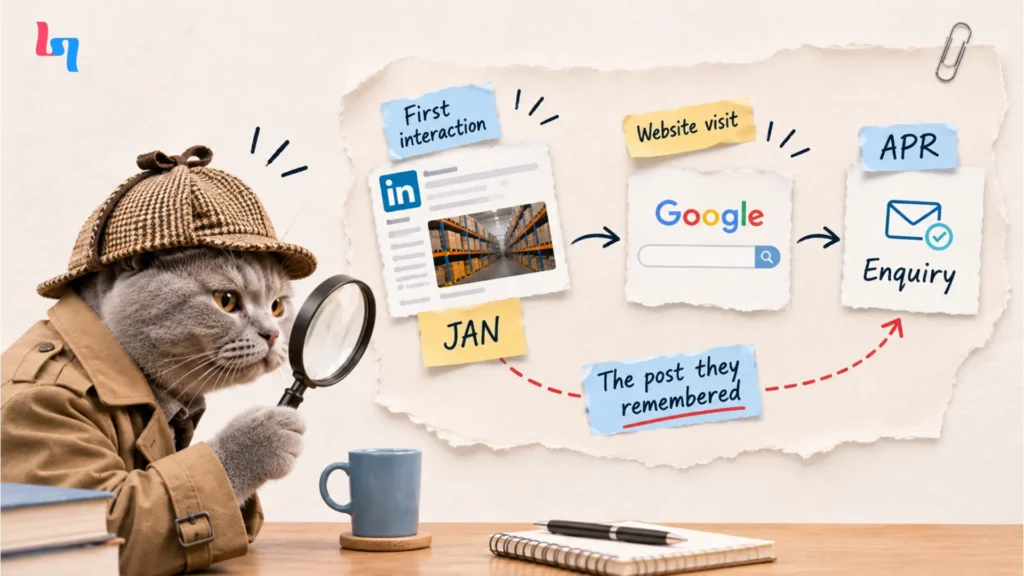
Imagine a logistics software company publishing an article in January about reducing warehouse picking errors.
An operations leader reads it while looking through LinkedIn. The explanation makes sense, but their warehouse is running smoothly, so they move on.
Three months later, the company opens two new warehouses. Order volumes increase, and picking errors start causing delivery complaints.
The operations leader remembers the article, searches for the company, and visits its website.
From the analytics dashboard, that visit may appear to have come from Google. The original LinkedIn post might not receive any credit.
But it could have been the reason the company came to mind.
This is a hypothetical example, of course, but it reflects an important feature of B2B purchasing. People often research problems well before they have the budget or approval to act.
The LinkedIn B2B Institute’s 95-5 Rule suggests that around 95% of potential category buyers aren’t actively purchasing at any given moment.
The research also gives some examples of long buying cycles, stating that 75% of companies purchase new computers every 4 years and 80% switch banks every 5 years.
Whilst this does not apply to all industries, the message can be easily understood.
They aren’t going to switch their technology partners or invest in high cost equipment just because they read an useful LinkedIn post.
It can take 6 months for someone to get approval to budget for cloud conversations, or a manufacturing director can look into automation for a year before a decision is made to invest.
During that time, they’re learning. They’re comparing different approaches and building opinions about which companies understand their problems.
That’s why I wouldn’t expect every LinkedIn post to produce an enquiry within a week.
Some content will reach people who are ready to discuss a project. Other posts may help future customers become familiar with the business.
If you only look at what happened immediately after publishing, you could miss the value of content that people remember later.
How I Would Measure LinkedIn Content Beyond Likes
I like to see more than just the headline metrics in a LinkedIn performance report.
Whilst it’s important to know how many impressions and engagements you’re getting, there are still a few more questions to answer.
Who saw your content? Did they show any interest in the issue? Was it mentioned during a sales conversation?
You don’t need expensive tools to get answers to these questions. A lot of the information will be available with some basic knowledge of where to look.
Start With the People You’re Reaching
Say a B2B software company publishes a post that receives 8,000 impressions.
Instead of immediately comparing it with the previous week’s posts, I’d look at the available audience demographics.
Are people from the target industry seeing it? Does the audience include professionals working in the right functions? Are company sizes fairly similar?
You won’t know every reader of your content but you can get an idea of what topics are attracting your target audience by looking at a few posts. Some categories will be very general but it will give an idea.
Then I’d examine what people did after seeing the content.
Suppose a technical post received 25 likes, 12 saves, and four sends.
Those additional actions are interesting. But I wouldn’t assume everyone who saved it intends to buy something.
Save could be a sign they want to come back to the post, Send could be your colleague sharing it with their team.
The purpose here is to collect more information. We aren’t trying to give everything a commercial value.
Bring Your Sales Conversations Into the Picture
Here’s one area where many companies can really improve.
In your discovery call ask the prospect how they found out about your business.
Allow them to answer in their own words.
Maybe they will say something like “I have seen your founders posts for a while. The one about cloud cost visibility was useful because we’re struggling with something similar.”
That tells you the content played some part in the conversation, even if the enquiry came through the website.
I would add this to your CRM with the business challenge of the prospect and any specific article/post they mentioned.
If you are using posts with external links then adding UTM codes will also help identify LinkedIn traffic.
However, you shouldn’t necessarily attribute all of the sale to a single post. The customer could have talked to a colleague, watched a webinar and had multiple visits to the website.
It is more useful to know how the different interactions helped them decide.
Give Your Content More Than a Day to Prove Itself
A post’s first 24 hours can tell you how people responded when it appeared in their feeds.
They don’t necessarily tell you whether the subject will be useful to the business over time.
I’d review performance over 30, 60, and 90 days, looking for patterns across similar content.
Maybe technical case studies regularly start conversations with engineering leaders. Perhaps general industry commentary gets more reactions but fewer detailed responses.
Those findings can help decide what to publish next.
A well-planned social media marketing approach should bring content planning, audience feedback, and sales observations together instead of treating each post as a separate success or failure.
A Simple Way to Judge Your LinkedIn Posts
If I were reviewing a month’s content with a B2B founder, I’d avoid creating a complicated reporting model.
I’d start with five questions and score each from 0 to 5.
| What I’d Check | Score |
|---|---|
| Did people from our target audience engage? | 0–5 |
| Did the responses lead to useful discussions? | 0–5 |
| Did the post show our knowledge of a specific business problem? | 0–5 |
| Did anyone contact us about a related requirement? | 0–5 |
| Can we connect the post to a documented sales opportunity? | 0–5 |
| Total Possible | 25 |
This is a suggested internal scorecard, not a formula that predicts revenue.
A post might score highly for expertise and audience fit but receive no points for immediate enquiries. That’s perfectly reasonable when the goal was to explain a complex subject to future customers.
They can be used to see how posts with similar aims are being scored.
After a few months you should start seeing some patterns.
For example if you notice that operational case studies are regularly getting good questions then maybe you should publish more of them.
General leadership posts might be getting good levels of reach but not really linking to any areas of expertise within the business so they could still be included in the calendar but not at the cost of losing specific topics.
The scorecard gives the team a starting point for those decisions.
What the 20-Like Post Might Actually Be Worth
Let’s return to the two posts from the beginning.
Imagine a technology consultant reviewing these results at the end of the month.
| What happened | Leadership post | Cloud cost post |
|---|---|---|
| Likes | 1,200 | 20 |
| Relevant decision-makers visibly engaged | 3 | 8 |
| Qualified enquiries attributed | 0 | 2 |
| Sales meetings attributed | 0 | 1 |
The leadership post received far more public attention. It may have introduced the consultant to people who didn’t know them before.
The cloud cost post attracted a smaller group, but two people contacted the business about relevant requirements, and one went on to a sales meeting.
Now there’s a reason to investigate what worked.
Was the topic particularly timely? Did the post explain something potential customers were struggling to understand? Or did it present an approach that differed from the advice they usually encounter?
We can use these questions to create a couple of new blog posts.
Maybe one on unexpected cloud costs, who is responsible for infrastructure spend, and common mistakes when looking to reduce costs within a company.
If related posts continue generating useful discussions, the business has a stronger basis for making them part of its regular content.
And if they don’t, that’s useful information too.
What Should B2B Founders and CEOs Write About?

One thing I would avoid is building an entire LinkedIn presence around broad statements that almost everyone agrees with.
Take this line: “AI is transforming business operations.”
It’s not incorrect. But if I’m a business owner trying to work out where AI could help my company, I’ve learned very little from reading it.
Now imagine the same founder writing:
“Before automating invoice approvals, I’d identify which exceptions still need human review. Otherwise, we could end up processing incorrect transactions faster.”
That’s much more useful. The writer has raised a practical concern and explained how they would approach it.
For B2B founders, this kind of content helps potential customers understand how they think.
Talk About the Decisions Your Customers Are Making
A manufacturing CEO can explain how a cheap part for a manufacturer can lead to increased costs in maintenance.
A cloud consultant may explain who they should allocate the cloud costs to before investing in additional optimisation tools.
A cybersecurity specialist could examine the access risks that appear when employees begin using AI agents.
You may already be talking about these topics within the industry.
We are aiming for simplicity here so that anyone reading will understand the issue.
Share the Reasoning, Not Just the Advice
Explain why you are recommending something.
When talking about migrating to the cloud, a cloud consultant can state when migration makes sense. They can also explain why they would review the application architecture and licensing first.
A founder looking to hire technology staff can explain why automated testing is useful for large volumes of applicants but requires some human oversight.
This gives the reader something to take from the post and in the correct places challenge them.
If you are using examples from projects always include real results (if you have permission) or state it is a hypothetical scenario.
Let Your Profile Continue the Conversation
Anyone who is interested in your post may want to find out more about what you do.
They shouldn’t have to guess what you offer from a vague profile.
If you often write about cloud governance then your profile should state the issues you help businesses with around the cloud.
Whilst you don’t need to sell at the end of every post, it should be easy for someone with a genuine requirement to find the information they need and get in touch.
Try This With Your Next 30 Days of LinkedIn Content
Before changing everything you’re publishing, I’d try a small experiment.
In the first week, take a look at what you have posted on LinkedIn recently and note down what topics generated interest from relevant industries, what generated good discussion and what was mentioned on sales calls.
The second week is for testing. Publish a few posts based on problems your ideal customers deal with regularly.
If you’re a SaaS consultant then you may write about reasons why people leave your onboarding process, or how companies are failing to pick up on early signals their product usage is dropping.
In the third week, Look at what they’ve written. Who has joined in? Has anyone mentioned issues they have within their company?
In the fourth week, You will now have something to compare with what you wrote previously.
Maybe the new posts received fewer likes but prompted better questions. Maybe one subject attracted people from a market you’ve been trying to reach.
Record what happened in a spreadsheet. Don’t rely on which post the team happens to remember.
Thirty days won’t tell you everything, particularly if your customers take months to choose a vendor. But it can help you identify what deserves more attention.
You can also examine B2B marketing case studies to see how different marketing activities are evaluated against their objectives.
Does This Mean LinkedIn Likes Don’t Matter?
Absolutely not!
If you’re looking to enter a new market or get your brand out to more people then a popular post can be very useful.
Sometimes a general insight will reach people that wouldn’t have found out about your business from a technical article.
And occasionally, those new readers become part of your professional network.
I wouldn’t stop tracking engagement. I’d simply avoid asking it to answer questions it wasn’t designed to answer.
Likes show one way people respond to a post. They don’t explain the entire journey from discovering a company to deciding to work with it.
The Best LinkedIn Post Isn’t Always the Most Popular
Think about that Monday morning report again.
One post receives 1,200 likes. Another gets 20.
It’s tempting to spend the next week trying to recreate the first result. But before deciding what to publish, I’d want to know what happened around the second.
Did someone from a target company ask a useful question? Did a prospect remember the topic during a meeting? Did it explain a problem better than the company’s other content?
Those answers might change the next month’s content plan.
An effective digital marketing strategy has room for both visibility and business-focused conversations.
So enjoy the posts that get a thousand likes. Just don’t overlook the quieter ones before finding out who was reading.
Sometimes the post your team almost forgot is the one a potential customer remembers.
Frequently Asked Questions
Do LinkedIn likes matter for B2B lead generation?
Yes, but likes don’t tell you whether someone needs your services. Check who’s engaging and whether those interactions lead to enquiries or sales conversations.
Why do my LinkedIn posts get likes but no leads?
Your content may interest people outside your target market. Write about customer problems, review who’s responding, and make your services clear.
Can a LinkedIn post with 20 likes generate business?
Yes. One relevant reader could become a customer. What matters is whether the post starts a useful conversation, not how many people liked it.
How can I tell whether decision-makers see my LinkedIn posts?
Check available audience demographics, including job titles, industries, and seniority. Also ask prospects whether they’ve read your posts, since many people never react publicly.
Which LinkedIn metrics should B2B companies track?
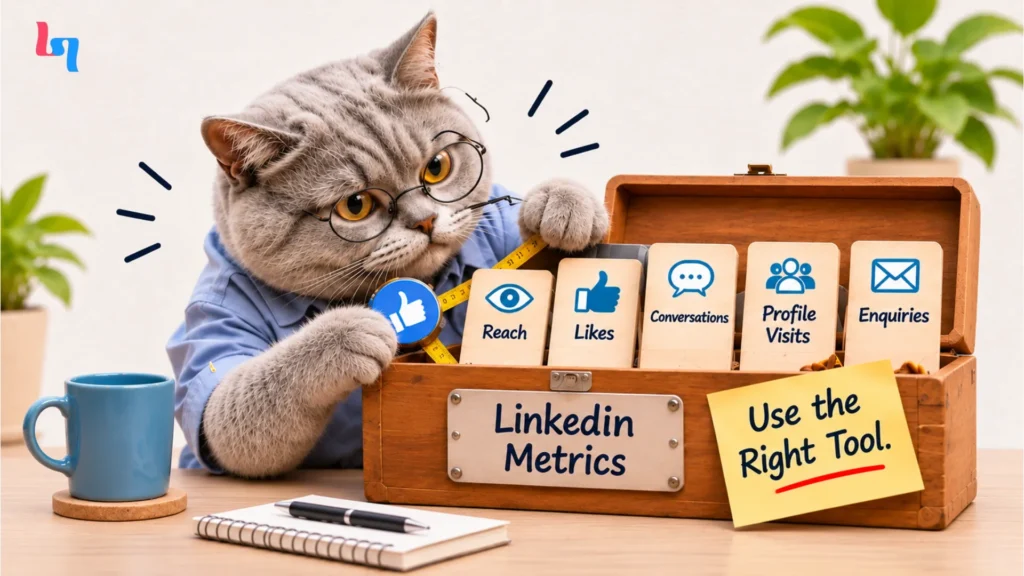
Track reach, audience demographics, comments, profile visits, website traffic, enquiries, and sales conversations linked to your content.