

B2B content attribution becomes difficult when buyers interact with several resources before making a purchase.
Consider a cybersecurity company that publishes an article on securing enterprise data. A prospect reads it, returns weeks later to explore a technical guide, attends a webinar and eventually requests a demo.
Six months later, the sales team has closed the deal. However, only the last enquiry is recorded in the CRM.
Whilst there was revenue generated, it is hard to know what content influenced this decision.
This is typical in B2B content marketing due to the multi-stakeholder process and long research period involved in purchasing decisions.
With the average B2B buying journey lasting approximately 6.7 months (Norwest’s B2B Sales & Marketing Benchmark Report 2025), it can be difficult to track which content influenced early on.
At Banter Marketo, I believe B2B content should be measured in ways other than website traffic and downloads.
I would recommend linking content engagement to quality leads, opportunities in the CRM and revenue.
However, why is it difficult to identify how content has actually impacted the business when multiple decision makers have engaged with various resources over a few months?
Why Is B2B Content Impact So Difficult to Measure?
The issue comes when you have buyers who go off on a journey to research.
They may have found your business through organic search, read a few articles, talked to colleagues and come back months later to request a demo.
As a result, there is no link between the content piece they originally interacted with and the sales opportunity.
Take the cybersecurity from above-they may have came across their first article that introduced them to the risk in enterprise data security.
However, the majority of the focus will be around the final demo request in the CRM.
The webinar, technical guide and conversations within the company will not be linked.
According to Gartner’s 2026 research, B2B buyers use an average of seven information sources during a purchase, while 67% prefer a sales-rep-free experience.
This shows how important it is for businesses to understand what is happening before prospects get into formal sales conversations.
Within Banter Marketo, I would look at the B2B content performance by looking at website analytics, campaign tracking and CRM data.
I would also look at what resources different people are engaging with and whether these interactions are happening before they become a qualified opportunity.
However, there will be interactions that cannot be captured and just because someone has viewed content does not mean they were influenced by it.
The aim is to create a realistic view of how much influence content had. But to do this we first need to understand what we mean by influence.
What does it mean for content to influence someone within a 6-month B2B sales cycle?
What Does Content Influence Mean in a Long B2B Sales Cycle?

Before we look at how content contributes to your revenue, it’s important to understand what “influence” means in the B2B context. In most cases, a buyer won’t make a purchase based on one article.
It’s likely that many people will engage with various sources of content over several months to come to a decision.
In the B2B world, content influence means that you can measure the impact your content has had on helping prospects research their problem, consider solutions, and move them along the purchasing journey.
However, this does not mean that the content was the reason for the sale.
Using our cybersecurity example, the prospect may have found the business via an educational blog.
The technical manager may have downloaded a guide to help them implement the solution. The procurement stakeholder may have read a case study. The company may have then asked to see a demo.
Each of these pieces of content may have contributed to the buying journey.
The first piece of content may have brought the prospect into your measurable marketing journey. This may be classed as “content sourced”.
The other content may have helped move the opportunity along. This may be classed as “content assisted”.
As long as the opportunity has engaged with relevant content and there is documentation around this, it can be added to your “content influenced” pipeline. This applies as long as your attribution criteria are clear.
At Banter Marketo, we would use joined-up content marketing and reporting to help understand how content is contributing. We wouldn’t attribute 100% of the deal value to every piece of content.
The aim is to understand how your content is supporting the buying decision without confusing correlation with causation.
Once this has been understood, you can look at how the prospect has engaged with content throughout the whole six-month sales cycle.
How to Map B2B Content Interactions Across Six Months Sales
Once you have defined which of your touchpoints are content-sourced, content-assisted and content-influenced touchpoints are, you can start looking at how your buyers are interacting with them.
B2B content attribution links recorded interactions across the buyer’s journey.
Using our B2B Cybersecurity example:
Month 1: A security leader finds an article on enterprise data protection using Google Search.
Month 2: They go back to read a technical guide on implementation.
Month 3: Another stakeholder downloads a vendor comparison resource.
Month 4: They attend a webinar and do more product research.
Month 5: The buying team asks to see a demo and read a relevant case study.
Month 6: The opportunity moves towards a purchase decision.
According to Forrester research into B2B buyers, 92% of buyers had a vendor shortlist already in place before starting their purchase journey, so it is important to look at those early touchpoints.
At Banter Marketo we use website analytics, UTM campaigns, content engagement and opportunity timelines from the CRM to create a picture of the journey.
Each entry should include the date of the interaction, content asset used, known contact/account and opportunity stage (where available).
With an integrated B2B content marketing strategy, we can use these to see which content assets help the buyer with their research and move them through the sales journey. However, we are not looking to credit every single interaction with revenue.
Next, we want to see which content interactions give us real evidence of buyer interest.
Identify the B2B Content Touchpoints That Actually Matter

,Once you know what content your buyer is engaging with over the six-month window, you can look at what content is having a real impact on their buying intent.
While a prospect may engage with your blog or the decision-maker may ask for a technical comparison, these are both quantifiable actions; however, they may not have much value to your business.
Let’s look at the example cybersecurity company again.
The security leader engages with an article about enterprise data protection. This is a great indicator that they have an interest in your business. However, this doesn’t indicate intent to buy.
Later on, in the first, month another stakeholder downloaded a guide on how to implement your solution, attended a technical webinar and looked up a vendor comparison.
This is a better indication that your organization may be considering solutions.
A study by SurveyMonkey found that B2B buyers were first engaged by sellers roughly 83% of the way through their buying journey in 2026.
This shows that it’s important to look at meaningful research activity.
At Banter Marketo, we would look at general engagement metrics (page views, social activity, etc.) but would also look at stronger indicators of buying intent.
This would include downloading relevant resources, frequent visits to solution pages, attendance of webinars and requesting a consultation.
However, we wouldn’t assume that someone downloading resources means they are ready to buy.
We would look at each engagement in relation to the prospect’s role, fit with the company, timing and activity within their CRM.
With a targeted B2B content marketing strategy, we would look to focus on touchpoints that help us understand how we are generating qualified opportunities.
However, this means nothing if we can’t link these touchpoints together.
How can we link our website analytics, campaign tracking and CRM data to create a reliable measurement?
How to Connect GA4, UTM Tracking, and CRM Data
Once there are meaningful touchpoints in your content, it can be tricky to bring them all together.
Say a buyer finds an article on Google, comes back via LinkedIn, downloads a technical guide and finally asks for a demo. If the marketing team can’t see how the content performed in relation to the sale, it’s hard for them to understand what’s working.
Let’s use our example cybersecurity company.
They are introduced to the data protection blog, then attend a webinar and finally ask for a demo. I would want to bring together the three pieces of information to understand the customer’s journey.
UTM parameters will help you understand what campaigns and content are being linked to drive traffic to your website. Google Analytics 4 (GA4) will provide you with clear, measurable data on your website.
This includes how your content is being used and how many leads are being submitted.
Google Analytics provides an official list of events. These include suggested events for lead generation such as generate lead, qualify lead and close convert lead.
This can help businesses to understand how far the customer has moved past the initial form submission.
In Banter Marketo I would look to create a consistent naming for campaigns. We’d combined with keeping the lead source information.
I would also ensure that there is a correlation between the content interactions and the contacts and opportunities in the CRM. We’d do this using reliable identifiers.
Before interpreting the results, I would look at the consent, duplicates and any missing tracking. GA4 cannot automatically identify all anonymous visitors or correlate the different stakeholders to the buying account.
The aim is to have a reliable source of information on the observable interactions.
Once these connections are established, the next question is how much credit each content interaction should receive.
That is where first-touch, last-touch, and multi-touch attribution become important
First-Touch vs Last-Touch vs Multi-Touch Attribution: Which Works Best for B2B?

Once we have integrated our web analytics and CRM data, we have to think about how to attribute credit to different touchpoints.
Over a 6-month B2B sales cycle it could be that if we attribute all the credit to one touchpoint, we are neglecting the resources used to help them understand their problem, research solutions and make a purchasing decision.
Take our cybersecurity example:
A security lead finds the company through an SEO blog in the first month. They attend a technical webinar in the fourth month and then request a demo after reading a case study in the fifth month.
First touch attribution would attribute the credit to the first touchpoint (the blog). Last touch attribution would attribute the credit to the last touchpoint recorded before conversion.
Multi-touch would distribute the credit between several touchpoints according to a specific model.
GA4 supports data-driven attribution (using data from conversion paths), however, the default reports do not include traditional first click or linear models.
This means it is important to look at the different attribution models you can use in your CRM.
At Banter Marketo, I would compare the different attribution models.
With integrated digital marketing performance reports, I would be able to see what content is bringing in the right buyers, helping them to research, and what content they are seeing before becoming a qualified opportunity.
I would also take into consideration any missing touchpoints and attribution windows.
A standard lookback window within GA4 may not capture all the touchpoints over a 6-month buying journey.
We are not trying to attribute all of our articles to closing the deal.
We want to understand how different resources are impacting the buying process.
Once we understand this, we can measure how many opportunities we are getting from content-assisted opportunities and how much value they are contributing to our pipeline and marketing ROI.
How to Measure Content-Assisted Pipeline and ROI
Now that you’ve seen how you’re attributing value from interactions with different pieces of content, the next step is to understand how well they contribute to valuable sales opportunities.
For example, a blog could help drive awareness of your business, while a webinar or case study helps the buyer consider the solution.
However, engagement and attributed pipeline value do not necessarily lead to revenue.
In our earlier example, the B2B cybersecurity company could have content that engaged multiple stakeholders over a 6-month period. This content could also help to drive 3 qualified sales opportunities worth ₹5 lakh each.
However, if all of these opportunities meet the influence criteria that the company has documented, then the total pipeline value influenced by content would be ₹15 lakh.
Again, this is potential value for the deals, not actual revenue.
The Salesforce Campaign Influence documentation explains how you can link opportunities to interactions with a campaign. This allows businesses to see how much influence their marketing is having on opportunities.
At Banter Marketo, I’d connect our content marketing activity to the opportunity data in the CRM to understand how many qualified leads we have, how many opportunities were assisted by content, how much pipeline was influenced and how much revenue was closed-won.
Each opportunity would only be counted once in the total pipeline influenced.
To calculate ROI, I’d look at the correctly attributed revenue and costs attributed to this and compare it to the investment we made in creating and distributing content.
I’ll make sure to document the assumptions we made about attribution.
What would this look like in practice? Let’s take a realistic example of a B2B SaaS business.
Common Mistakes in B2B Content Attribution
Even with GA4, UTM tracking and CRM data integrated, content attribution can lead to inaccurate conclusions.
For businesses with longer sales cycles (6 months), inaccuracies can siginificantly affect how their marketing efforts are reported.
Let’s take a look at our example cybersecurity SaaS business.
The CISO reads an education blog, the IT Manager attends a webinar and the Procurement leader reads a case study. Marketing attributes the entire deal value to each of these resources. So they’re saying they have influenced 15 lakhs of pipeline from one deal worth 5 lakh.
Double-counting revenue is one of the most important mistakes to avoid.
Another is using last touch only. This can mean that you’re missing out on the content that was used by buyers earlier on to help them understand the problem and solutions.
In addition, look for any inconsistencies in the UTM parameters used, duplicate contacts in CRM, members of the buying committee not being linked and incomplete offline engagement.
This can make it looks like one customer has multiple journeys.
What you track and the lookback windows you set up can affect GA4 attribution (Google).
This can be an issue when the content engagement happens months later.
A Practical 30-Day B2B Content Measurement Implementation Plan
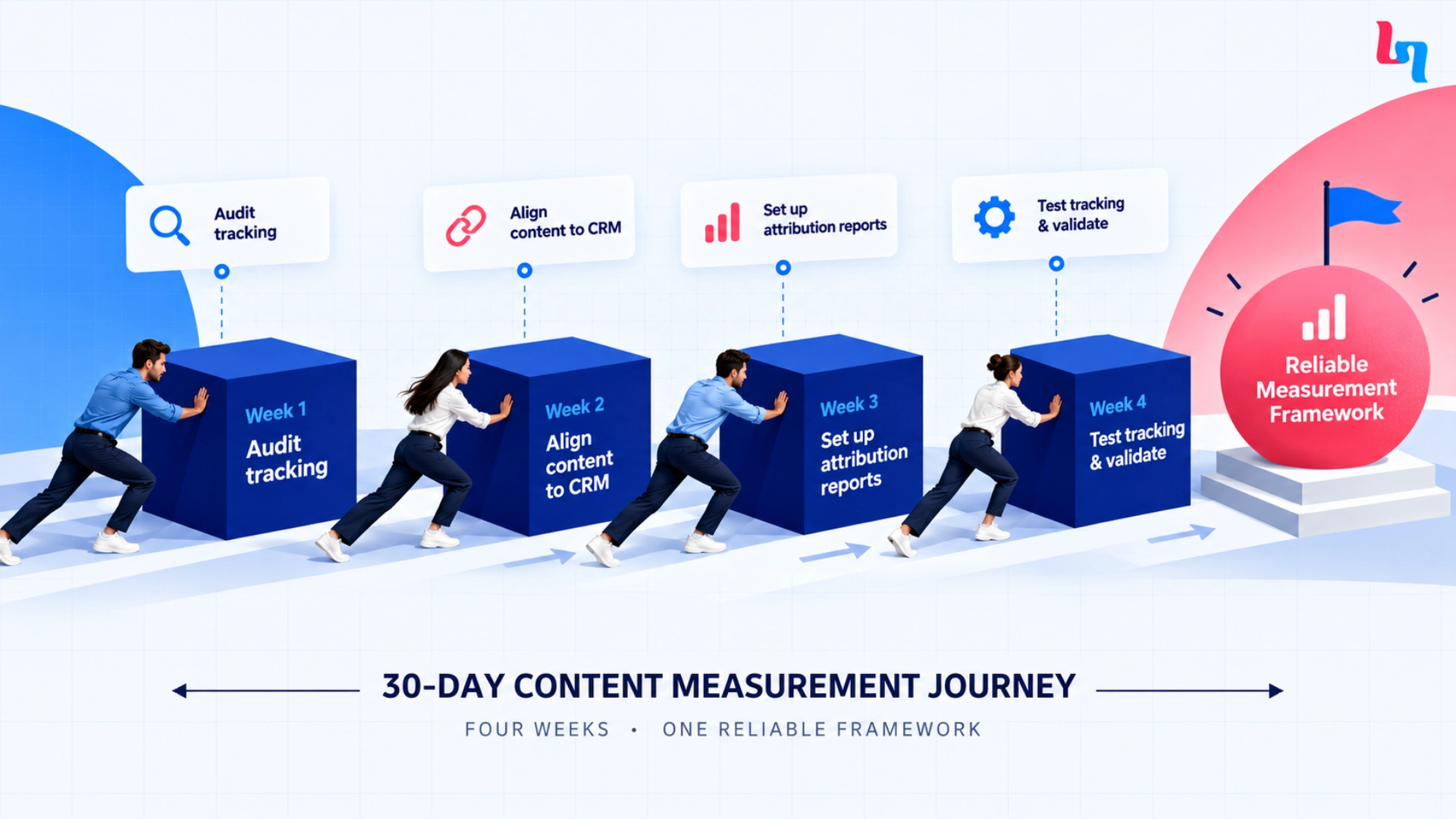
Now that we’ve identified some common mistakes with measuring content, I’d use the first 30 days at Banter Marketo to establish a consistent way of measuring the impact of content interactions to qualified leads and sales.
Week 1: Audit current tracking.
I’d look into the GA4 events, UTM tracking, CRM and current attribution reports to see where interactions are missing, duplicated and inconsistent campaign tracking.
Week 2: Align content to CRM.
I’d set up consistent campaign names, lead generation events and ensure there is a reliable way to track known contacts to content interactions and sales.
Week 3: Set up attribution reports.
I’d compare the different attribution models (first touch, last touch and multi-touch) to understand how to measure content influenced-pipeline and avoid double counting.
Week 4: Test tracking.
I’d ensure the tracking is accurate, look at the qualified leads, how they have moved through the pipeline and build a dashboard to show the connection between content engagement and real business impact.
The aim here is not to show that content has been influencing over the past 6 months within 30 days but to gain a reliable way of measuring content that can be used throughout the B2B sales cycle.
Ultimately, it’s not about assigning a revenue value to every interaction; it’s about showing what investments in marketing are really helping your business grow.
Conclusion: Measure B2B Content by Its Business Impact
The goal of content marketing within B2B is to understand how content can be used to influence buyers through their long sales journey.
At Banter Marketo, we believe that content should be effectively measured to show how early engagement can lead to quality leads, sales and ultimately revenue.
Using GA4, UTM and CRM data, we would look to understand how content can influence buyers without overstating its impact.
This isn’t about giving all content credit for revenue but understanding what content is helping to drive business opportunities.
If you have content that is attracting visitors but you are unsure how it is helping with sales, take a look at our digital marketing services to help understand how your content can be influencing the business.
Below are a few common questions we are often asked around measuring B2B content influence.
Frequently Asked Questions About B2B Content Attribution
- How do I track B2B content influence across a six-month sales cycle?
I would connect GA4, UTM tracking, and CRM data to follow recorded content interactions, qualified leads, and sales opportunities over six months.
- What is the difference between content-sourced and content-influenced pipeline?
Content-sourced pipeline originates from a recorded content interaction, while content-influenced pipeline includes opportunities that engaged with relevant content during the buying journey.
- Which attribution model works best for B2B marketing?
There’s no single best model. I recommend comparing first-touch, last-touch, and multi-touch attribution to understand how different interactions contribute to conversions.
- Can GA4 track the entire B2B buyer journey?
Not completely. GA4 tracks observable website interactions, but CRM integration and additional tracking are needed to connect known buyers, offline activities, and sales outcomes.
- How do I measure ROI from B2B content marketing?
I would compare content production and distribution costs with appropriately attributed revenue while tracking qualified leads, content-assisted opportunities, and influenced pipeline.