
A few months ago, imagine a technology founder sitting in his office, scrolling through LinkedIn between meetings.
He sees an article relating to automation within an enterprise. Comment threads have then been created which analyse where things have gone wrong. A number of high-level individuals are involved in these discussions.
As he scans the comments, the founder feels that he has faced the same issue.
Throughout his 12 year career he has managed companies, successfully navigated challenging situations and advised clients on costly in rupees tech related issues.
However, none of those commenting on the LinkedIn thread recognise him.
His own LinkedIn profile isn’t much help either. The headline says “Founder & CEO,” the About section lists his responsibilities, and his last post is a company anniversary update from three months ago.
Although he is experienced, he has not previously shared this information widely.
The premise is quite simple. Someone will compose material for you so that you can extend your network and ideally, attract new business leads.
Let us now follow our example founder Raj through his initial 90 days.
What Happens During a 90-Day LinkedIn Thought Leadership Engagement?
When using an agency for LinkedIn, you should understand exactly what service you are receiving.
An agency will typically offer strategic and research services along with copywriting, design and distribution. Analysis is also provided.
What involvement will the founder need to have?
While this is often quite involved, it does not always equate to a large number of hours.
An agency can post and plan content but has no knowledge of previous challenging client encounters again, this is something that you must share.
For this reason, responsibilities are generally split between the two parties.
| What the agency does | What you need to do |
|---|---|
| Research your market and improve your profile | Explain your business and ideal customers |
| Plan topics and prepare content | Talk about projects, experiences, and opinions |
| Write posts and design graphics | Check whether the content is accurate |
| Coordinate publishing and networking | Join important conversations |
| Review performance | Explain which enquiries are relevant |
Raj firstly thought about what he wanted to be recognised for. Then he researched what his audience were passionate about. Finally, he concentrated on developing discussions that could result in something.
Below is a breakdown of this process.
Month 1: Getting People to Understand What You Actually Do
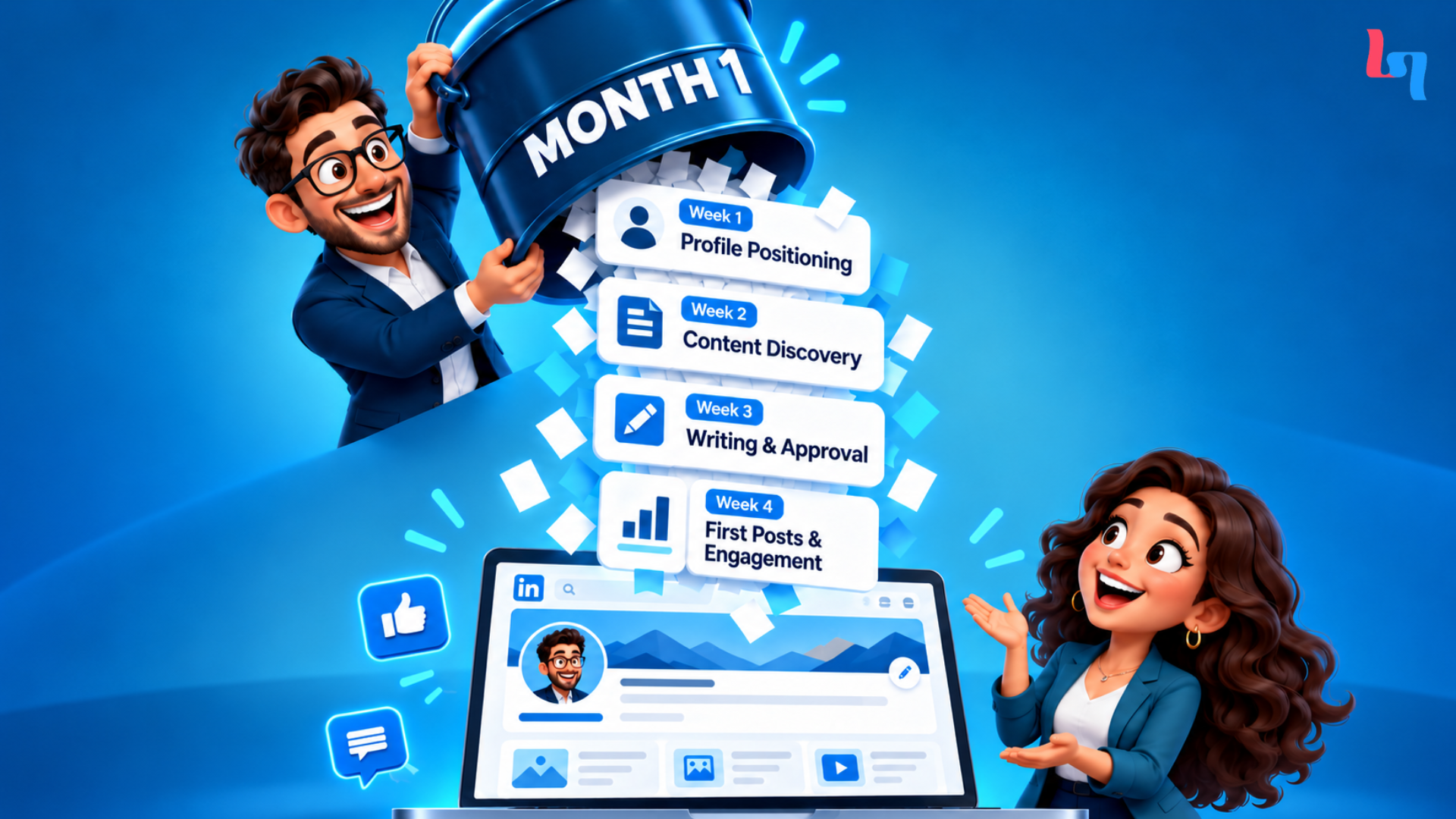
Week 1: Raj’s Profile Wasn’t Bad. It Was Just Forgettable.
At our initial meeting the strategist reviewed Raj’s LinkedIn profile.
It had a good image and the company details were accurate. The career information was also current.
What was lacking, however?
Despite having been involved in numerous enterprise automation initiatives, there was surprisingly little detail regarding the issues that Raj had resolved.
In fact, Raj’s strapline could have been used by many entrepreneurs.
The strategist then enquired about Raj’s key client base.
Typically i engage with companies of 500–5,000 staff. My key relationships are with CIOs, operations directors, and business transformation leads.
What are their main concerns?
Late delivery, poor system integration, and budget overruns. Staff also often have difficulty navigating complex processes.
Now there was added value.
The agency redesigned Raj’s LinkedIn profile to focus on the issues and Raj’s experience in overcoming them.
They also analysed his header, featured content, and recent posts.
Before making amendments, his current number of followers, profile impressions and post engagement were recorded. These statistics would allow an assessment of progress at the conclusion of the project.
By Friday, Raj’s LinkedIn profile effectively showed why someone might wish to engage with him.
Week 2: One Bad Customer Project Gave Them Five Content Ideas
Raj came prepared for the next meeting.
He had taken note of areas such as AI, digital transformation, leadership & emerging technologies.
I looked at the list and asked about a project that had failed.
Raj laughed.
“Which one?”
He started to explain how he implemented automation. The software was working fine but the client were still not happy.
There were three departments, each had their own approval process. There was no agreement on what steps were required and who was making the final decision.
Automation wouldn’t help with this issue.
The team first had to understand why the departments worked differently.
That became the basis for a LinkedIn post.
The writer also picked up several other ideas from the conversation. Raj had interesting opinions about project delays, vendor selection, and how companies calculate returns on technology investments.
They ended up with enough content for multiple posts.
The ideas were grouped into 4 themes by the agency. These were Automation, Issues, Decisions and Technology Investment.
A proper content marketing plan helps organize this material, so the founder isn’t asked to invent a completely new topic every few days.
Raj left that meeting realizing he didn’t need to become someone who constantly followed industry trends.
He already had plenty to talk about.
Week 3: The First Draft Sounded Good. Raj Still Rejected It.
I prepared 3 blog posts for review.
One discussed the need to redesign business processes in advance of automating them.
Raj read this.
While largely agreeing with it, he found the final point concerning.
It stated that business processes always require redesigning.
“I do not agree with this statement.”
While some processes are already effective, it can in fact be very appropriate to process them automatically. It is the processes that are not adequately investigated which present a concern and should not be automatically processed.
Then i adjusted my point of view.
I reviewed my remaining blog posts and replaced general statements with specific examples, which Raj would feel confident in supporting.
Graphic design was undertaken and the agency also ensured that all research-related statements were correctly referenced.
All the blog posts were finished by the end of the week.
Even though Raj had not authored them, he was content to address an audience of clients and promote the points made within.
Ghostwriting therefore needs to pass successfully this crucial evaluation.
Week 4: His First Posts Didn’t Exactly Take Off
His initial blog post received some comments.
Then a slightly increased number of comments was made on his second post.
Throughout the day Raj kept checking LinkedIn and questioned if perhaps he had spent his money in vain.
While the agency was not overly worried, they were keen to assess engagement levels.
One operations manager had asked a specific query in relation to managing divergent sign-off processes.
Raj answered using a real-life example.
Although the exchange was brief, it concerned an issue that Raj’s business does successfully address.
This was therefore interesting.
There is a good rationale for B2B companies are unable to solely analyse engagement to assess interest.
The LinkedIn B2B Institute’s 95-5 rule suggests that around 95% of potential category buyers aren’t actively purchasing at any given moment.
This research is based on B2B purchase and marketing rather than organic LinkedIn, but will help you understand how your content can be of value to a potential customer months before they need to go to a vendor.
Alongside publishing, the agency began researching people Raj wanted in his network.
The first month ended quietly.
No viral post. No sudden flood of leads.
But Raj’s profile looked better, he had several useful posts published, and people outside his immediate circle had started joining the conversation.
Month 2: Finding the People Who Might Actually Care
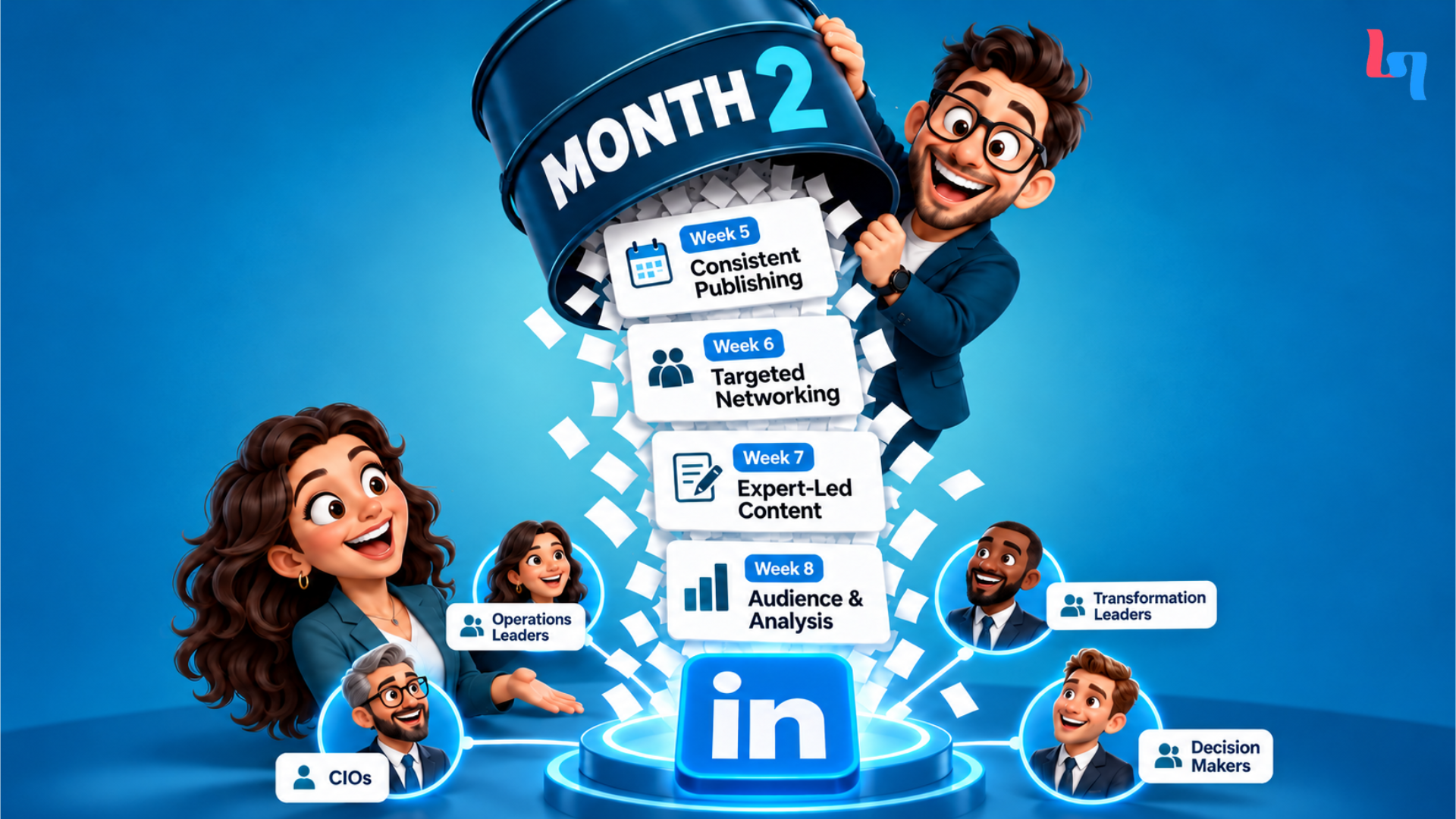
Week 5: Raj Got Busy, and LinkedIn Kept Moving
Raj had a difficult week at work.
Two customers needed urgent attention, he was traveling, and there was an internal review he couldn’t miss.
He had no time for another content meeting.
Fortunately, the agency had already collected enough material during the earlier interviews.
They used those notes to finish the next set of posts, prepared the graphics, and sent Raj the drafts together.
He reviewed them during a break between meetings.
The agency also kept a few approved posts ready for weeks when he couldn’t contribute fresh ideas.
This might sound like a small operational detail, but it’s one of the reasons businesses outsource content management.
An executive shouldn’t have to choose between dealing with an important customer and keeping their LinkedIn profile active.
The agency handled the schedule while Raj remained involved in approving what appeared under his name.
Week 6: His Network Was Growing, but Something Was Off
Raj had gained followers.
Naturally, he was pleased.
Then the strategist showed him who had started following.
There were students, job seekers, recruiters, technology enthusiasts, and professionals from industries his company didn’t serve.
Some of those connections could still be useful. But the audience wasn’t particularly close to the people Raj wanted to meet.
The agency started looking more carefully at company size, professional responsibilities, industry, and whether a connection was relevant to his expertise.
They focused on CIOs, operations leaders, and transformation executives.
They also considered people involved in purchasing decisions who weren’t obvious buyers.
According to the 2025 Edelman–LinkedIn B2B Thought Leadership Impact Report, 71% of hidden decision-makers have relatively little or no interaction with sales representatives.
A finance leader or procurement professional might influence an enterprise purchase without ever joining the vendor’s initial sales conversations.
Raj’s LinkedIn networking strategy needed to account for those people too.
Instead of trying to connect with everyone, the agency concentrated on professionals whose work had some connection to the problems Raj discussed.
Week 7: Raj Finally Published Something He Really Believed
During a content interview, Raj referred to an article that stated that productivity is always enhanced by further automation.
However, Raj did not agree with this view.
He has come across situations in which, despite businesses automating numerous processes, there was little change to the business as a whole.
Nobody had investigated whether these processes were even necessary.
Raj then provided an illustration of this.
When one department speeds up its processes, it may unintentionally increase the workload for another part of the organisation
This was developed into a blog post highlighting how to analyse the whole process to assess enhancements.
This was the most positive post that Raj had agreed to publish.
Unlike the article he had read this morning, Raj was sharing knowledge from his experience of working with clients.
The 2025 Edelman–LinkedIn report found that 86% of hidden decision-makers valued thought leadership that challenged familiar assumptions and offered fresh perspectives.
Not every executive needs a controversial opinion.
But when you’ve learned something that contradicts common advice, it’s often worth explaining why.
Week 8: The Smaller Post Was More Interesting
After two months the agency analysed Raj’s top performing content.
One had achieved 18,000 impressions and another only 2,300.
Naturally, Raj enquired about the more successful post.
The strategist then displayed the engagement data for each article.
Whilst the popular post had generated many brief responses, the less successful content had prompted in-depth conversations with three operational heads from relevant businesses.
Although these are sample figures, this type of analysis is common in B2B.
As well as wanting to analyse, Raj was keen to connect with people who experienced similar issues to those that his company specialised in.
Analysis was then undertaken to establish what subjects interested these people.
It was discovered that posts that provided more specific advice on application encouraged more valuable conversation than those which made more general technological forecasts.
As a result, next month’s content will continue to include wider industry related material however, there will be a greater emphasis on providing real world examples and analysing complex business issues.
Month 3: When a Few Conversations Start Going Somewhere
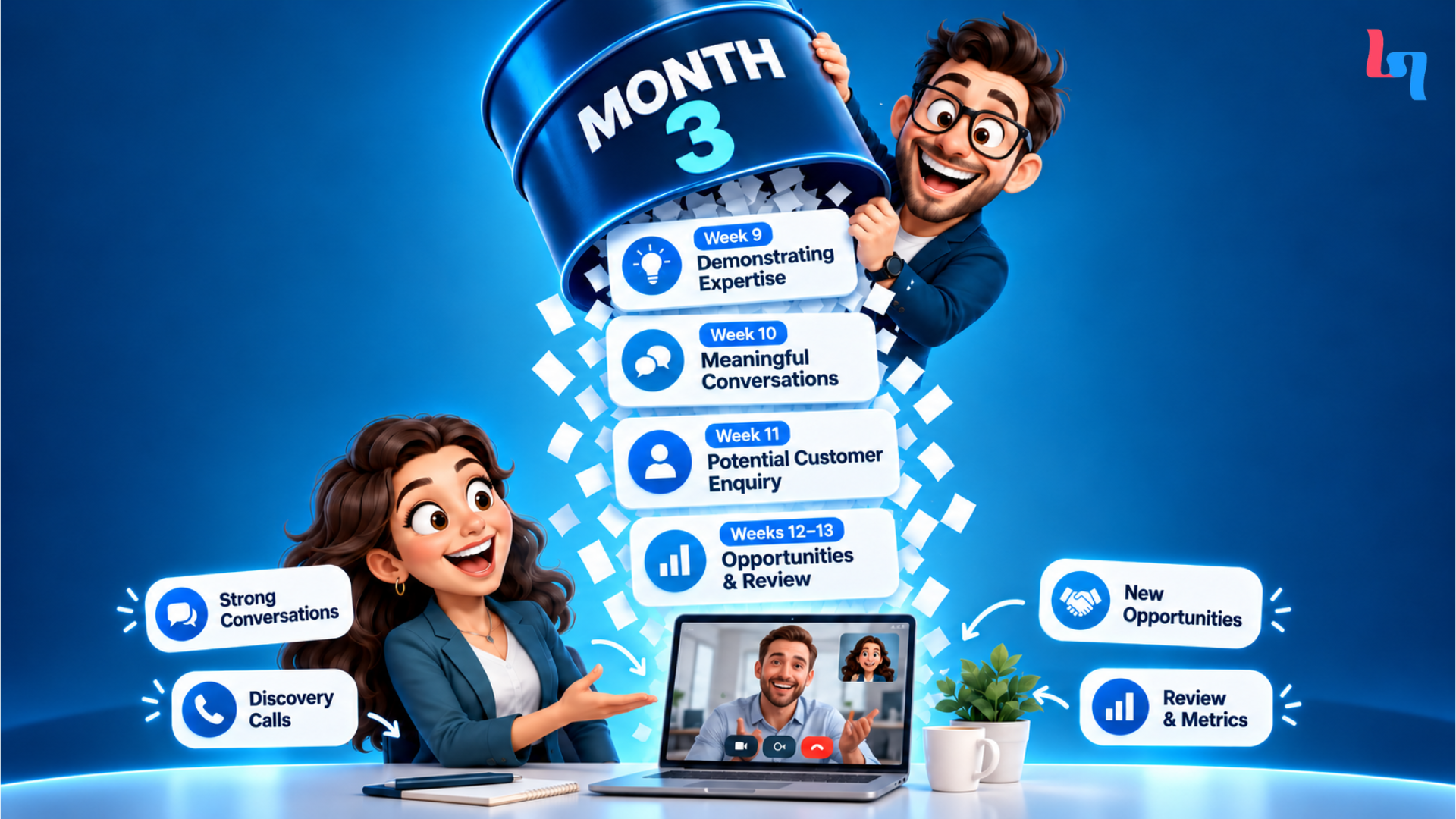
Week 9: Raj Stopped Giving Advice and Started Explaining His Decisions
Another new role involves managing through 3 separate approval systems.
Whereas others may suggest processes should be made uniform, Raj would analyse the situation.
Firstly he would seek to uncover the reasons for the current methods in different departments. In some cases this may relate to legal needs.
Other departments may face real business risks and a third could have been applying a method which has never been challenged for many years.
After analysing these factors, he would then advise on any required alterations.
Although this is an example scenario, the approach is based upon Raj’s experience.
It therefore helps to further illustrate his working style.
The agency also began to create further structured guidance, together with appropriately anonymised case studies provided that both approval and appropriate content was available.
There is demand for this sort of information.
The 2025 Edelman–LinkedIn study found that 63% of hidden decision-makers spent more than an hour each week consuming thought leadership.
Raj didn’t need every reader to study his posts for an hour.
He wanted interested professionals to come away understanding something useful.
Week 10: Someone Asked Raj a Question He Couldn’t Answer in One Comment
An operations director commented on Raj’s post about standardizing workflows.
Their company had several departments using different systems, and getting everyone to agree on a common process had become difficult.
Raj replied with a question about how the departments handled exceptions.
The person responded with more detail.
They then hit it off.
Raj did not immediately give a brochure or ask to meet.
But Raj enjoyed solving the problem so continued talking.
The agency documented the conversation along with any other relevant conversations.
Some led nowhere. Others introduced Raj to people working on similar challenges.
That was fine.
Not everyone reading a post needs to become a customer.
A professional network becomes more useful when people have genuine reasons to keep talking.
Week 11: A Potential Customer Wanted to Know What Raj’s Company Did
One of Raj’s links shared that their business was conducting a review into their processes.
Having seen some of Raj’s material, they wished to ascertain if his business undertook similar work.
Why did you carry out this review?
It became apparent that various departments were working with differing processes which were resulting in avoidable issues in relation to both reporting and authorisation.
We then decided to arrange an information-gathering meeting.
Within our example, the query was not instigated by one particularly insightful piece of content.
Indeed, the person had previously come across Raj’s work and so had already formed a basic understanding of it.
The 2025 Edelman–LinkedIn research found that 95% of hidden decision-makers said strong thought leadership made them more receptive to sales and marketing outreach.
That doesn’t mean 95% will book a meeting.
But it helps explain why a person who understands your thinking might be more willing to start a conversation.
Raj and the agency agreed to track enquiries carefully.
A relevant company, a genuine business problem, and a willingness to explore a solution would matter more than the total number of LinkedIn messages received.
Week 12: Not Every Opportunity Came With a Sales Meeting
Raj received an invitation to contribute to an online discussion about enterprise automation.
The organizer had come across his content and thought his experience would be useful to the audience.
The invitation, like Raj’s story, is illustrative.
But it shows why thought leadership doesn’t always produce results that fit neatly into a sales report.
A speaking invitation might introduce an executive to new professionals. A useful conversation might lead to a referral months later.
The agency looked at these interactions alongside more familiar metrics.
They checked which target-company professionals had engaged repeatedly, who had connected with Raj, and whether new discussions were developing.
Research from the LinkedIn B2B Institute reported a 2.3% response rate among warm audiences compared with 1.0% among cold audiences in a specific group of North American technology-buyer advertising campaigns.
Those figures aren’t benchmarks for organic LinkedIn posts.
They do offer an example of how familiarity can influence the response to marketing activity.
By this point, Raj had several people in his network who recognized his name and knew something about the work he did.
Week 13: The Numbers Were Useful, but the Conversations Told More
The agency’s final review began with Raj’s old LinkedIn profile.
He was surprised by how little it said.
Three months ago, there were just a job title and description.
There are now blog posts about common issues within the enterprise, examples of tough decisions and interviews with experts in the right industry.
The agency compared his starting metrics with the latest results.
They reviewed impressions, profile visits, connection quality, comments, enquiries, and business discussions.
Some posts hadn’t worked particularly well.
Raj’s target audience had been well targeted by others.
Instead of making promises about how many leads they can generate in the next quarter, we focused on the topics that got people talking.
We looked at the audience building approach and identified which companies and professions to target.
Raj hadn’t become famous on LinkedIn.
That was never particularly important to him.
He has a clearer professional identity, useful content and a better understanding of how LinkedIn can help him with his business.
What Should You Get When You Hire a LinkedIn Thought Leadership Agency?
Ask them what they will be doing every month.
Beyond just knowing how many posts they will produce,
Ask how they will research your industry, gather your ideas, verify technical details, get sign off and build your network.
For example, a Banter Marketo-style engagement may include the following monthly work, depending on the agreed package.
| Service | Illustrative Monthly Scope |
|---|---|
| LinkedIn posts | 12 researched posts |
| Graphics and carousels | 12 supporting creatives |
| Targeted networking | Up to 800 connection invitations |
| Engagement | Relevant commenting and networking support |
| Reporting | Weekly tracking and monthly reviews |
These are planned activities rather than guaranteed business results.
An agency can send 800 carefully selected invitations. It can’t make 800 people accept them.
The same applies to content. Publishing twelve posts doesn’t guarantee that one will become viral or generate a particular number of leads.
A useful agency should be able to explain what it controls, what it measures, and what requires client participation.
How Should You Measure Progress During the First 90 Days?
There’s little point judging a Week 3 campaign by the number of sales meetings it generates if the executive has only just started publishing.
Different stages call for different questions.
| When | What to Check |
|---|---|
| Day 30 | Is the profile clearer? Is useful content being published consistently? |
| Day 60 | Are relevant professionals reading, connecting, and participating in discussions? |
| Day 90 | Have those interactions contributed to enquiries, meetings, or other worthwhile opportunities? |
Say your posts reach 40,000 people in a month.
This is great!
However, if nearly all of these people are not in your target industry, you can see how you may still have issues.
Alternatively, say you received 5 serious leads from companies that fit your ideal customer profile.
If you are a specialist enterprise consultant, these could be much more valuable to you.
These both are very valuable pieces of information but they are giving you different information.
You should also consider whether an opportunity was driven by activities such as referrals, events or prior relationships.
What Can Go Wrong During a LinkedIn Thought Leadership Engagement?

A founder might publish three posts every week and still leave readers with little understanding of what makes them different.
Often, the writing is the problem.
The posts discuss leadership, innovation, and business growth without mentioning a single difficult decision or relevant experience.
Sometimes the writer simply hasn’t had enough access to the client.
If every interview lasts ten minutes and the founder only offers broad opinions, the drafts are unlikely to contain much depth.
Targeting can create another problem.
Adding hundreds of connections won’t help if few have any relationship to the industries you serve.
And turning every new connection into a sales pitch can discourage the people you’re trying to build relationships with.
The answer depends on what’s going wrong.
Better interviews can improve weak content. More selective audience research can improve networking. Poor lead quality may require changes in positioning or qualification.
Simply increasing the posting schedule isn’t a reliable solution.
Is a 90-Day LinkedIn Thought Leadership Engagement Worth It?
That depends on what you’re expecting.
If you have experience that could help potential customers understand difficult business problems, LinkedIn gives you a place to share it.
An agency can help when you don’t have time to manage the research, writing, design, and publishing yourself.
But you’ll still need to contribute.
Someone has to explain what happened during the difficult project, why you disagreed with a customer’s original plan, or what you’ve learned from years of working in your industry.
Those details make your content useful.
If you’re hoping to publish a few posts and immediately receive a large number of sales enquiries, the first quarter may be disappointing.
But if you want to become more familiar to the people who could eventually need your expertise, a structured engagement can provide a useful starting point.
What Should Be Different After 90 Days?
Remember Raj scrolling through LinkedIn and recognizing a problem he’d solved years earlier?
At the beginning, he had plenty of experience but almost nothing on his profile to show it.
Three months later, his content explained the problems he understood, the decisions he’d made, and what other businesses could learn from his work.
Some posts did better than others. A few conversations showed commercial potential. Others simply helped him meet people in his industry.
At Banter Marketo, we help B2B founders and professionals share their expertise through LinkedIn thought leadership and build relationships with relevant decision-makers.
You may already have the experience your next customer needs.
But when they look you up on LinkedIn, will they find a reason to contact you?
Frequently Asked Questions
1. How long does LinkedIn thought leadership take to show results?
You may notice changes in profile activity and engagement within 30 days. Relevant business conversations often take longer, especially when customers have lengthy buying cycles.
2. How many posts should an executive publish each week?
Three useful posts per week are a reasonable starting point. Choose topics based on your experience and the problems your audience faces.
3. Can LinkedIn generate B2B leads within 90 days?
Yes, although it depends on your network, audience, and industry. Some professionals receive enquiries early, while others need more time.
4. How involved does a founder need to be?
You’ll need to share experiences, review drafts, and join important discussions. The agency can handle research, writing, design, and scheduling.
5. Is LinkedIn ghostwriting the same as thought leadership management?
No. Ghostwriting covers content creation. Thought leadership management also includes positioning, networking, publishing, and performance reviews.
6. What should I ask before hiring an agency?
Ask how it collects ideas, researches your industry, targets relevant professionals, checks content accuracy, and reports results.