
Your Next Customer May Find You Without Visiting Your LinkedIn Profile
You’ve been posting your insights on LinkedIn for months. You have a growing network and established yourself as an expert. Your posts are getting interaction.
LinkedIn AI search visibility is becoming an important consideration for professionals as potential customers increasingly use ChatGPT and Perplexity to research businesses, consultants and industry experts. However, publishing regularly on LinkedIn does not guarantee that AI platforms will recommend your services or cite your content.
But when someone asks ChatGPT to recommend a consultant in your industry, your name doesn’t appear.
Someone with a smaller LinkedIn following might be recommended instead.
Therefore this creates a challenge.
With the ability to now research companies using AI generated responses, professionals aren’t being searched for via their profile or websites.
A September 2026 Suff Digital study found LinkedIn citations in just 1.6% of 4,966 AI answers covering business, careers and software questions.
Professionals should therefore look into ways of knowing if they are easily accessible with their expertise based on how their customers are finding answers using AI tools.
Does ChatGPT Actually Use LinkedIn Content to Answer Questions?
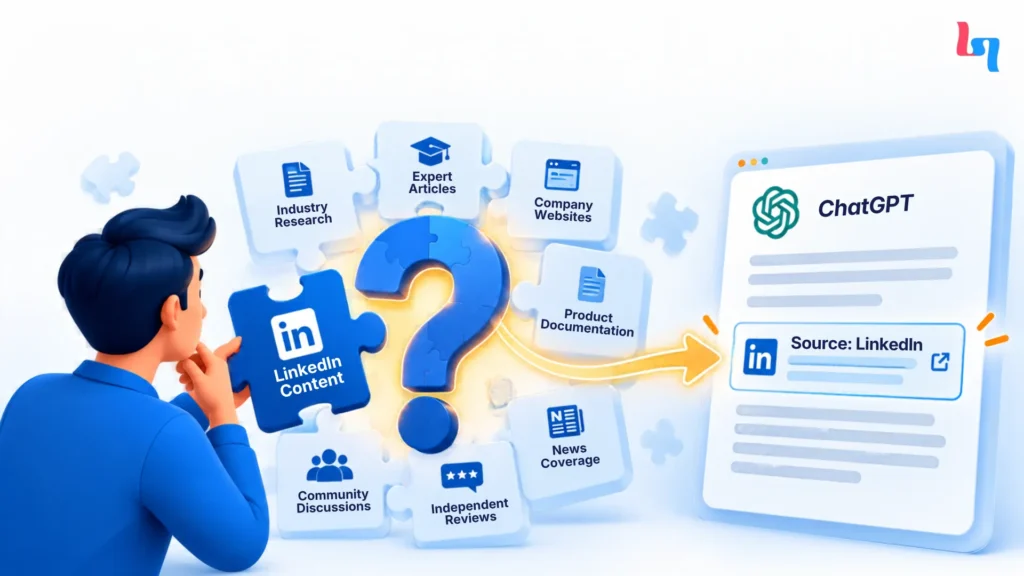
You can get LinkedIn content in your ChatGPT outputs, but regular output doesn’t mean you’ll be cited.
A 2026 Semrush study examined 325,000 prompts across ChatGPT Search, Google AI Mode and Perplexity. Researchers identified 89,000 unique LinkedIn URLs cited in AI-generated answers.
Approximately 11% of the outputs included LinkedIn.
This suggests that LinkedIn can play a part in your AI search visibility. However, it is heavily dependent on what questions you are asking.
If you are looking into leadership techniques you may get a response citing an executive’s professional article. If you are looking to compare different software you may be provided with information from technical documentation or independent reviews.
Depending on what question you ask you will get different evidence.
It’s also important to understand the difference between being mentioned and cited.
Being mentioned means ChatGPT will include your company/brand name in its response, whereas being cited means ChatGPT will link to a specific source such as your LinkedIn article or company website.
You may find that your business is mentioned as a recommendation but not cited from your LinkedIn content. Or your research may be used to provide information within the AI response but not recommended.
Instead of focussing on how many times you’re mentioned look at what questions you’re appearing in and what sources are providing the information.
How ChatGPT and Perplexity Find Information Differently
This may be a problem. While there is some good information out there, AI tools will not find it.
ChatGPT Search and Perplexity can search for information and provide answers using that information from outside sources. However, they don’t necessarily select identical pages.
How ChatGPT Search works
ChatGPT Search can access publicly available information when responding to questions.
According to OpenAI’s publisher documentation, website owners can permit OAI-SearchBot to access their pages for search purposes.
Making content accessible allows it to be considered, but it doesn’t guarantee inclusion in an answer.
How Perplexity finds information
Perplexity also retrieves online information and provides supporting references.
If you are looking into employee retention, some AIs may tell you about the study conducted in the workplace whilst others may give a thorough explanation by an HR Consultant.
This depends on what your question is and what information is available.
It is also important to know whether the information given was learned by the AI or found during the search.
A citation doesn’t establish that an AI model was trained on that page.
I wouldn’t approach AI search as a fixed ranking system where businesses can permanently secure a particular position. Instead, I would concentrate on publishing accessible, accurate information that answers specific customer questions.
Which Parts of Your LinkedIn Presence Can Appear in AI Search?
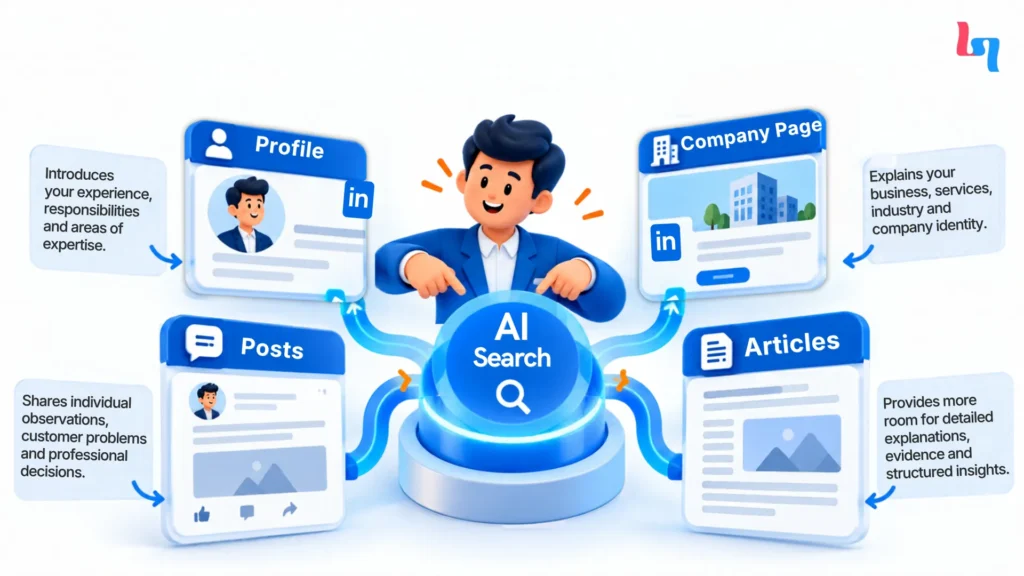
Your LinkedIn profile, Company page, Articles and Posts can all help show off your professional knowledge.
Your Profile will allow you to show your experience, your Company Page will help to show people what your business is about. Posts will help to show your personal thoughts and Articles will give you more room to go into detail.
A September 2026 Promptwatch report, analysing August citations, found that LinkedIn articles accounted for 30.41% of observed LinkedIn citations across tracked AI platforms. Regular posts contributed 27.75%, while company pages represented 18.05%.
This doesn’t mean there is a higher chance of getting cited from these formats, it just shows the percentage of citations from each format.
Personal profiles and company pages
Your Profile should show your experience, what role you play and what areas you specialise in. Your Company Page should give accurate information about what services you provide, what industry you’re in and who your business is.
Someone discovering either page should understand what you do without reading several unrelated updates.
LinkedIn posts and articles
Posts are great to talk about individual customer issues, industry news and decisions you have made professionally.
Articles are best used when you need to go into more depth with evidence, comparisons and structured information.
For example, a SaaS consultant could publish a short post explaining why customers abandon software during onboarding. A detailed article could examine onboarding practices, product adoption and customer retention measurement.
Both serve different purposes.
Businesses developing a consistent publishing approach can explore LinkedIn marketing services to organise content around relevant audience interests.
I would choose the format based on what readers need to understand rather than which format receives more engagement.
How to Optimise Your LinkedIn Presence for AI Search Visibility
More frequently can be an issue if you’re not answering questions people want to know. Start by looking at how clear your expertise is explained on your LinkedIn profile.
1. Describe your services clearly
A title such as “Helping businesses reach exceptional growth” will look great but does not tell people much about your service.
Whereas a title such as “Helping B2B SaaS companies improve their customer retention through onboarding and Customer Success consulting” tells people who your target audience is, what you do and what area of expertise you have.
According to LinkedIn’s official Page guidance, pages with complete information, including your description and website link you can get 30% more views per week.
Whilst this is about visibility on LinkedIn it shows the importance of having correct information about your business.
2. Answer questions customers actually ask
Often you will find that having conversations with your customers will give you ideas for content. A marketing consultant may often be asked how they are getting enquiries from LinkedIn but very few conversions.
Rather than another blog about increasing leads, explain how having vague qualification criteria, slow response times and bad follow up can negatively impact conversions.
This gives your reader something to take away and use.
3. Share lessons from actual projects
Having real life experiences can be more valuable when explaining your thought process.
A software engineer talking about application reliability can talk through why a system was struggling due to increased users, what technical decisions were made to improve the performance and what impact this had.
Having real life examples of what decisions were made means your readers will learn more.
4. Explain complicated subjects properly
Topics such as Cyber Security, Enterprise Tech and Financial Planning often require a lot of detail. For example, if you’re a Cyber Security consultant talking about managing staff access you may need to go into detail about the access they have to credentials, approvals and monitoring.
An article allows you to go into detail whereas shorter posts can cover individual points.
5. Keep professional information accurate
Your LinkedIn profile and website should consistently describe your current services, qualifications and experience.
Outdated descriptions make it harder for potential customers to verify your expertise.
6. Support important claims with evidence
If you’re talking about research ensure you have links to the source. If you’re talking about improving a business ensure you state what was measured and what improved.
A June 2026 OtterlyAI study analysed 1,310,455 LinkedIn AI citations across six AI search platforms, demonstrating the scale at which LinkedIn sources can appear in AI answers.
However, citation research doesn’t establish a guaranteed publishing formula.
I would prioritise original experience, clear explanations and verifiable evidence over publishing several similar posts each week.
Why LinkedIn Alone May Not Be Enough to Build AI Search Visibility
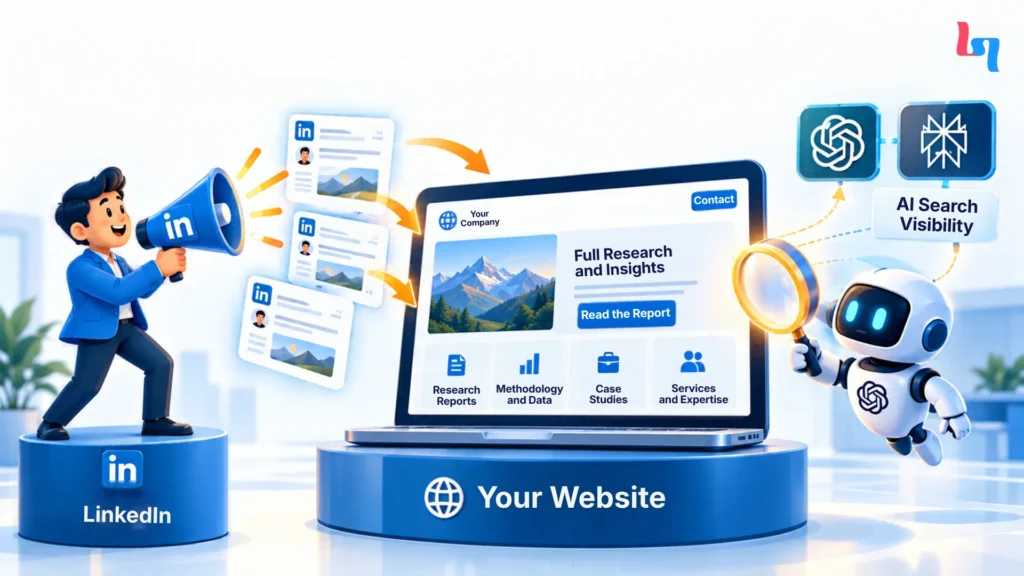
It’s important that your most valuable research is not solely available on LinkedIn.
Whilst LinkedIn is a great way for professionals to share their knowledge, your website will give you more control over your information.
For example, if you’re a consultancy providing research into enterprise transformation projects.
You can write a post on LinkedIn stating a key finding but include the full methodology, evidence and recommendations on your website.
Your audience will now have access to the original research.
Your website will link your professional knowledge with your services, past projects and contact details.
It’s also important your website is technically sound so that search engines can find your information.
Google Search Central’s AI features documentation explains that established SEO practices remain relevant to AI Overviews and AI Mode.
Important pages should be accessible to search engines, contain useful information and connect through relevant internal links.
Businesses can review their SEO strategy to improve website structure, content accessibility and navigation.
I would publish detailed research and service information on the company website, then use LinkedIn to discuss findings and share professional observations.
This allows both platforms to contribute without repeating identical articles.
How to Check Whether ChatGPT or Perplexity Mentions Your Business
Before publishing any further content on LinkedIn, you might want to check if your business is being mentioned by AI platforms.
A simple audit can reveal which questions produce recommendations and citations.
Start with realistic customer questions
Choose between 10-15 real questions that people will ask when looking up your industry.
For example, if you offer SaaS consultancy then you might have questions like how to find Customer Success consultants, reduce churn, improve onboarding, and when to outsource.
Don’t just use your brand name as people who aren’t familiar with your business won’t know it exists.
Compare both platforms
Use the same questions and search using ChatGPT and Perplexity. Note down the date, responses and citations.
Check which platform mentions, recommends or cites your business.
Examine the actual sources
Check whether ChatGPT or Perplexity cites your LinkedIn profile, articles, company website or third-party sources.
Record the cited URLs and check whether the information is accurate and relevant to the question.
This helps identify which sources contribute to your AI search visibility.
Review results over time
Create a spreadsheet recording each question, platform, brand mention, cited URL and source category.
Repeat the exercise after updating your content.
An August 2026 Am I Cited analysis found that 15 of 3,052 sampled Perplexity responses cited LinkedIn, approximately 0.5%.
That finding illustrates why businesses shouldn’t expect every relevant search to produce a LinkedIn citation.
I would examine recurring patterns across multiple tests rather than changing the entire strategy after one unsuccessful search.
What Should You Measure Beyond LinkedIn Likes and AI Mentions?
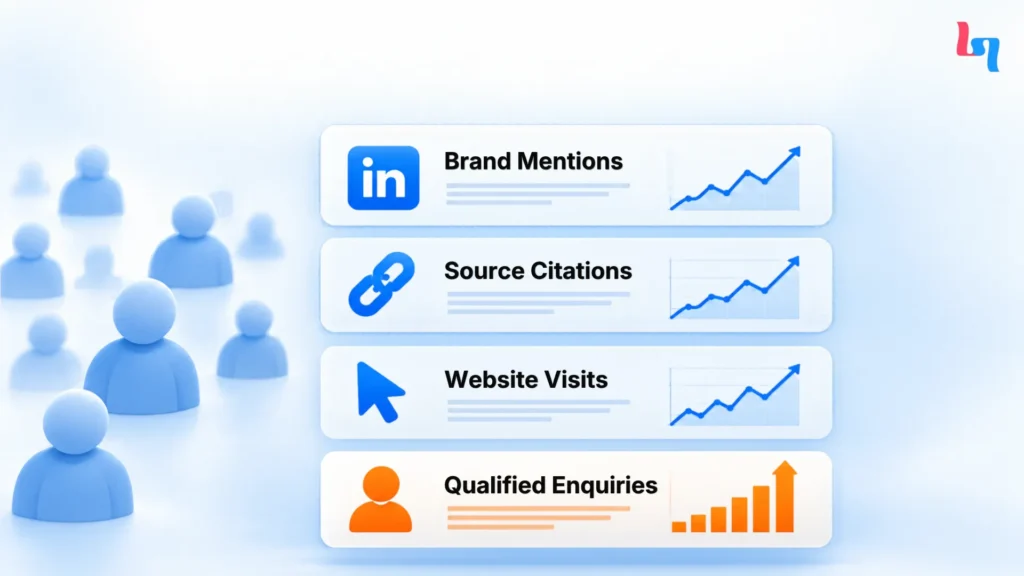
A LinkedIn post receiving thousands of impressions may attract attention without generating a relevant business enquiry.
I would evaluate AI search visibility through brand mentions, source citations and customer actions.
First, examine how often your business appears in relevant AI-generated answers. Then identify whether those responses cite your LinkedIn content, website or independent publications.
Finally, review what happens when visitors reach your website from AI search platforms.
A June 2025 Ahrefs study found that AI search contributed only 0.5% of its website traffic during a measured 30-day period but generated 12.1% of signups.
Although those figures reflect Ahrefs’ own experience, they demonstrate why traffic volume shouldn’t be the only measure of performance.
For consulting businesses, a few qualified enquiries may be more valuable than thousands of unrelated website visits.
Track consultation requests, demo bookings and other commercially relevant actions wherever reliable attribution is available.
I would also examine branded searches and direct visits, while recognising that increases cannot automatically be credited to AI search.
The objective is to understand whether visibility contributes to genuine customer interest.
A Practical 30-Day Plan to Improve Your AI Search Presence
Improving your AI search presence doesn’t require rebuilding your entire marketing strategy.
I would begin with one subject your business understands well and develop useful information around it.
Week 1 Review your existing visibility
Pick between 10-15 questions and test them in ChatGPT and Perplexity. Note down if your brand was mentioned, what sources were cited and if there were any competitor sources.
Check your LinkedIn profile and website to ensure they’re accurately explaining your services.
Week 2 Publish one detailed resource
Pick one question that your customers often ask and create a full response. For example, if you’re a tech consultancy you might want to explain when a business should improve their current software architecture rather than re-developing their application.
Within your article include the factors to consider, your professional experience and evidence to back up your points. Once finished publish this on your website.
Week 3 Develop related LinkedIn content
Create 2-3 posts around this topic.
You could create one about a common mistake, one explaining an important business decision and one answering a customer concern.
Each post should have a unique observation.
A connected digital marketing strategy can help businesses organise LinkedIn publishing alongside website content and customer acquisition.
Week 4 Compare the findings
Repeat the initial AI search questions and review changes in citations, website referrals and customer enquiries.
A May 2026 Indexly analysis examined 3,077,153 citation URLs and identified 9,767 LinkedIn citations, representing approximately 0.32% of the total.
The figures reinforce why results should be evaluated carefully.
Use the first month to establish a reliable measurement process rather than expecting immediate citations.
Common Mistakes That Can Make AI Search Optimisation Less Effective
Businesses sometimes concentrate so heavily on appearing in AI-generated answers that their content becomes less useful to readers.
One common mistake is publishing advice that could apply to almost any industry. Another is repeating keywords or producing several articles containing essentially the same information.
Businesses also confuse citations with recommendations, even though an AI platform may reference an article without endorsing its author.
Google’s guidance on AI-generated content warns that generating large amounts of content without adding value may violate its scaled content abuse policy.
Rather than publishing ten similar posts about customer retention, I would examine one overlooked reason customers leave, explain its causes and support the findings with actual experience.
Useful content should help readers make better decisions, even when an AI platform doesn’t reference it.
Frequently Asked Questions
Can ChatGPT read my LinkedIn posts?
ChatGPT Search can sometimes retrieve publicly accessible LinkedIn content. However, publication doesn’t guarantee a citation.
Does LinkedIn improve Google rankings?
LinkedIn can introduce readers to your website, but followers and engagement aren’t established direct Google ranking factors.
Can Perplexity cite LinkedIn articles?
Yes. Research has identified LinkedIn articles and posts among Perplexity’s cited sources, although inclusion depends on the question and retrieved information.
Do more LinkedIn followers improve AI rankings?
A larger following doesn’t guarantee citations because relevance, accessibility and credible information also influence what sources may be useful.
How long does AI search optimisation take?
There is no guaranteed timeframe. Regular testing across relevant questions provides a better understanding of progress than checking one response after publication.